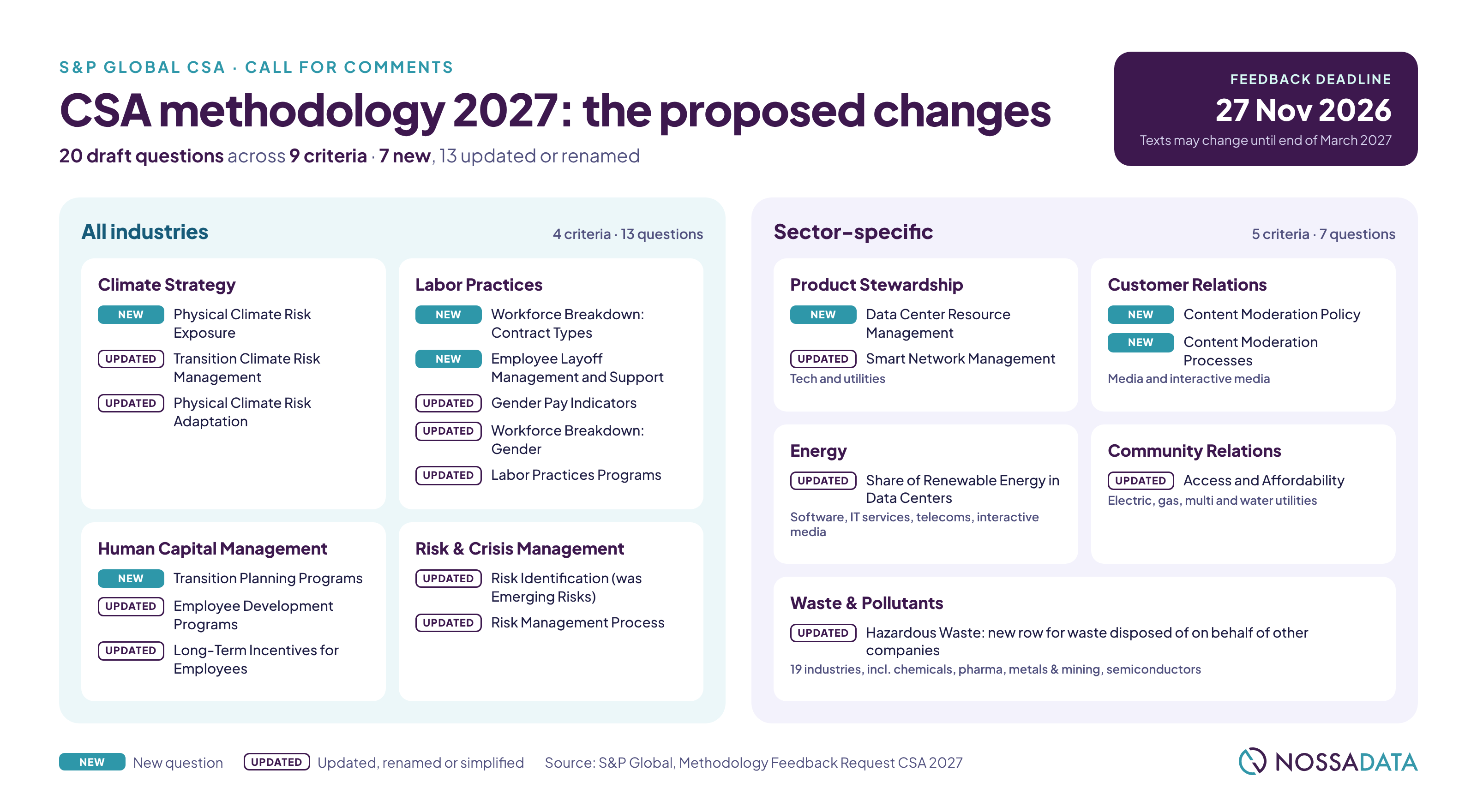
S&P Global has published its draft CSA methodology 2027 changes, and companies have until 27 November 2026 to send feedback. The proposals cover 9 criteria of the Corporate Sustainability Assessment (CSA), with new questions on physical climate risk, contract types, layoffs, workforce transition planning and content moderation.
If your company responds to the CSA, these drafts are the clearest preview you'll get of next year's questionnaire. S&P says the texts may still change at any time before the end of March 2027, so treat them as proposals. But most of them ask for data you can start collecting now.
Here's what you need to know:
- Feedback closes on 27 November 2026. Each criterion has its own PDF and online survey on the CSA methodology page.
- Climate Strategy gets a split. A new Physical Climate Risk Exposure question sits next to a renamed Transition Climate Risk Management question, both for all industries.
- Labor Practices grows. 2 new questions (Workforce Breakdown: Contract Types and Employee Layoff Management and Support), plus simplified gender pay and gender breakdown questions.
- Human Capital Management adds Transition Planning Programs. It asks whether you run a workforce gap analysis and how you respond to trends such as AI and decarbonisation.
- Risk & Crisis Management is restructured. Emerging Risks becomes Risk Identification, with the focus on the quality of your risk descriptions.
- Sector questions change too. Data centres, utilities, media platforms and hazardous waste producers each see targeted updates.
What is the CSA methodology?
The CSA methodology is the rulebook S&P Global uses to score companies in its Corporate Sustainability Assessment. It turns an average of about 1,000 data points per company into a score from 0 to 100, with metrics weighted by how material they are to each sub-industry.
The CSA covers 62 industries. Each has its own questionnaire of roughly 100 to 130 questions. General criteria such as Human Capital Management and Risk & Crisis Management make up about 40 to 50% of the assessment, and industry-specific topics make up the rest. (Our summary of the S&P Global CSA Sustainability Yearbook 2026 shows how those scores play out in practice.)
How the call for comments works
S&P reviews the questions every year. For the 2027 cycle it has published one feedback document per criterion, each with:
- A short summary of what changed and why.
- The full draft question: rationale, industries affected, definitions, data requirements and the proposed layout.
- A link to an online survey where you can comment.
The drafts show which answers will earn additional credit for public information, which is often where scores move most. That detail alone makes them worth reading.
CSA 2027 key dates
There are 2 dates to plan around. Dates for the 2027 assessment window itself aren't in the feedback documents, so check S&P's CSA timeline page closer to the time.
| Date | Milestone |
|---|---|
| 27 November 2026 | Deadline for feedback on the draft 2027 CSA methodology |
| End of March 2027 | Question texts and methodology may change at any point up to here |
The draft layouts show FY 2025 as the most recent data column, and the gender questions say data older than FY-2 won't be accepted.
Proposed 2027 CSA changes: environmental criteria
Climate Strategy (all industries)
This is the biggest environmental change, and it touches every company.
- Transition Climate Risk Management (renamed). Financial Risk of Climate Change now covers any type of transition risk: policy, carbon pricing, technology, markets or stakeholder expectations. For the most significant risk you report a description and management methods, the financial implication before action, the average time frame in years and the cost of action. CDP responders use the midpoint of their time range (0 to 3 years becomes 1.5).
- Physical Climate Risk Exposure (new). You tick which of 12 hazards you're exposed to, from tropical cyclones and 3 types of flooding to heat stress, subsidence and extreme cold. Then you give the summed financial implications before action, an average time frame and a quantification of exposed assets or activities, such as the share of assets or revenue at risk.
- Physical Climate Risk Adaptation (updated). The plan is now scored on 5 components: coverage of more than 50% of at-risk operations, asset-level measures, an implementation timeline, defined targets and programmes to track progress. You also tick adaptation measures (8 options, including upstream and downstream value chain) and report estimated CapEx and OpEx.
One detail to watch: a timeline doesn't count as a target. S&P says so explicitly.
Energy
Share of Renewable Energy in Data Centers (Interactive Media, Software, Telecoms and IT Services) adds 4 indicators. You now split data centre energy into renewable and non-renewable, from the grid and generated on-site. Extra credit goes to public disclosure of the grid renewable share and the on-site renewable share for at least the latest year. Grid renewables need backing from RECs, GOs, I-RECs, PPAs, green tariffs or similar.
Product Stewardship
- Data Center Resource Management (new). The same 4 tech industries get a public-information question on circularity (energy efficiency, waste heat reuse, equipment reuse and certified energy management) and water (efficient cooling, replenishment, water risk assessment before construction and certified water management).
- Smart Network Management (renamed and updated). Formerly Sustainable Utility Services for End Users, it now asks electric, gas and multi/water utilities about supply-side tools (advanced network control, predictive modelling) and demand-side programmes (dynamic tariffs, smart meters, customer advisory services, usage platforms). Basic SCADA and weather-based forecasts don't qualify.
Waste & Pollutants
Hazardous Waste gets 1 new row: total hazardous waste disposed of on behalf of other companies, in metric tonnes. It applies to 19 industries, including Chemicals, Pharmaceuticals, Metals & Mining and Semiconductors.
Proposed 2027 CSA changes: social and governance criteria
Labor Practices (all industries)
Labor Practices has the most new material of any criterion.
- Workforce Breakdown: Contract Types (new). You report permanent, temporary, full-time, part-time, non-guaranteed hours employees and non-employees (agency workers, contractors, interns) for the last financial year. Pick headcount or FTE and use it consistently across the table.
- Employee Layoff Management and Support (new). Moved in from the Future Questions section. It scores 9 practices across retrenchment planning (alternatives assessed, costs assessed, external consultation, non-discriminatory criteria) and severance and support (job transition help, well-being services, severance, extended health cover, support for retained staff). S&P names AI adoption as one driver of layoffs.
- Gender Pay Indicators and Workforce Breakdown: Gender (simplified). Both now ask for 1 year of data, with coverage as a share of FTEs. Equal pay ratios go in as decimals (0.9, not 90%), and the gender pay gap formula follows the UK government's statutory guidance.
- Labor Practices Programs (updated). The reskilling option moves to the new Transition Planning Programs question in Human Capital Management.
The layoff question has strict wording tests. "We aim to ensure criteria are free from discrimination" fails; "we ensure" passes. Phrases such as "to maintain competitiveness" don't count as assessing alternatives. If your company publishes gender pay data for the EU Pay Transparency Directive, much of it will carry over (see our EU Pay Transparency Directive tracker).
Human Capital Management (all industries)
- Transition Planning Programs (new). It asks whether you run a workforce gap analysis, which trends drive your workforce transition (economic, environmental, societal, geopolitical, technological), which strategies you use (reskilling, upskilling, recruiting, automation or AI, streamlining) and whether you disclose the impact on the business and on employees. Trends only count if you link them to your workforce.
- Employee Development Programs (updated). New options for coaching, employee networks, early career programmes, digital transition programmes and funding for external education.
- Long-Term Incentives for Employees (updated). Open text boxes become a dropdown of 4 LTI types (cash, ESPPs, stock options, RSUs/PSUs). The minimum payout period is 2 years, and plans for senior management don't count.
Risk & Crisis Management (all industries)
Emerging Risks becomes Risk Identification, and it absorbs the risk identification part of the Risk Management Process question. S&P now assesses governance, management and identification separately. Any risk can qualify, and the requirements are no longer bundled. But each risk description is tested on its company-specific impact, category, likelihood, magnitude, mitigating action and timeframe, with more credit for long-term risk management. Generic "may" or "could" language fails, and IFRS S2, TCFD or CDP reports aren't accepted as evidence.
Customer Relations and Community Relations
- Content Moderation Policy (new, Media). Asks for a formal, public content moderation policy.
- Content Moderation Processes (new, Media and Interactive Media). Covers human review, user reporting or trusted flaggers, and appeals. It references the EU Digital Services Act (DSA) and the Santa Clara Principles.
- Access and Affordability (renamed and updated, utilities). Formerly Affordability & Access, it now separates access measures (underserved communities, network expansion) from affordability measures (bill assistance or social tariffs, outreach to prevent disconnection, flexible payment).
All proposed questions at a glance
| Criterion | Question | Change | Industries |
|---|---|---|---|
| Climate Strategy | Transition Climate Risk Management | Renamed, updated | All |
| Climate Strategy | Physical Climate Risk Exposure | New | All |
| Climate Strategy | Physical Climate Risk Adaptation | Updated | All |
| Labor Practices | Workforce Breakdown: Contract Types | New | All |
| Labor Practices | Employee Layoff Management and Support | New (from Future Questions) | All |
| Labor Practices | Gender Pay Indicators | Simplified | All |
| Labor Practices | Workforce Breakdown: Gender | Simplified | All |
| Labor Practices | Labor Practices Programs | Updated | All |
| Human Capital Management | Transition Planning Programs | New | All |
| Human Capital Management | Employee Development Programs | Updated | All |
| Human Capital Management | Long-Term Incentives for Employees | Updated | All |
| Risk & Crisis Management | Risk Identification | Renamed, updated | All |
| Risk & Crisis Management | Risk Management Process | Updated | All |
| Energy | Share of Renewable Energy in Data Centers | Updated | IMS, SOF, TLS, TSV |
| Product Stewardship | Data Center Resource Management | New | IMS, SOF, TLS, TSV |
| Product Stewardship | Smart Network Management | Renamed, updated | ELC, GAS, MUW |
| Community Relations | Access and Affordability | Renamed, updated | ELC, GAS, MUW |
| Customer Relations | Content Moderation Policy | New | PUB |
| Customer Relations | Content Moderation Processes | New | IMS, PUB |
| Waste & Pollutants | Hazardous Waste | Updated | 19 industries |
Two patterns run through the list. First, S&P keeps moving from yes/no policy checks to quantified, decision-useful data: exposed assets, adaptation CapEx, contract-type headcounts. Second, workforce change is now its own topic, with AI named in both the layoff and transition planning questions.
What reporting teams should do now
- Read the drafts that hit you. Every company is affected by Climate Strategy, Labor Practices, Human Capital Management and Risk & Crisis Management. Check the sector PDFs if you're in tech, utilities, media or a hazardous waste industry.
- Send feedback by 27 November 2026. If a definition doesn't fit how you collect data (contract categories, for example), say so now. It's much harder to change after March 2027.
- Map your physical risk work to the 12 hazards. Find out whether your climate scenario analysis can produce a share of assets or revenue at risk, and whether adaptation CapEx and OpEx are tracked anywhere.
- Check your HR data for contract types. Non-guaranteed hours employees and non-employees are often the gaps. Agree a headcount or FTE basis with HR early.
- Review how you describe risks. Rewrite generic risk factors in your annual report so each one has a company-specific impact, likelihood, magnitude, mitigation and timeframe. (Annual report season is the natural time to do it, as we covered in why annual report season is the best time to improve your ESG ratings.)
- Document your layoff and transition practices publicly. Many of these questions give extra credit for public evidence, and the wording tests are strict.
- Line up the CSA with your other cycles. Much of the climate data overlaps with CDP, so plan collection once. Our guide to the 2027 CDP disclosure cycle has the dates.
Frequently asked questions
What is the deadline for feedback on the 2027 CSA methodology?
27 November 2026. You submit comments through the online survey linked from each criterion's feedback document.
Are the 2027 CSA changes final?
No. S&P says the question texts and methodology may change at any time before the end of March 2027, and the layout in the Online Assessment Tool may look different.
Which CSA criteria change in 2027?
9 criteria have draft proposals: Climate Strategy, Community Relations, Customer Relations, Energy, Human Capital Management, Labor Practices, Product Stewardship, Risk & Crisis Management and Waste & Pollutants.
What is the new Physical Climate Risk Exposure question?
A new question for all industries. It asks which of 12 physical hazards you're exposed to, the estimated financial impact before action, the time frame and how much of your assets or activities are at risk.
Do small companies have to answer the new workforce questions?
Companies with 100 or fewer employees can mark the Labor Practices gender, contract type and layoff questions as not applicable. For Transition Planning Programs the threshold is 25 or fewer employees.
Can I use my TCFD or CDP report as evidence for Risk Identification?
No. The draft says IFRS S2, TCFD and CDP reports aren't suitable evidence for this question, because it looks at your general approach to risk identification.
Sources
- S&P Global, CSA Methodology
- S&P Global, Methodology Feedback Request CSA 2027 (9 documents, 2026): Climate Strategy, Community Relations, Customer Relations, Energy, Human Capital Management, Labor Practices, Product Stewardship, Risk & Crisis Management, Waste & Pollutants. All linked from the CSA methodology page.
- ILO and IFC, Managing Transitions and Retrenchments Guidelines (cited in the layoff question)
- EDGE Certification (cited in the gender questions)