

The EU Pay Transparency Directive requires employers to give job candidates a pay range, explain how pay is set, answer employees' questions about pay and, for larger employers, publish gender pay gap data. Member states had until 7 June 2026 to bring it into national law. By late October 2026, only Greece, Italy, Lithuania, Malta and Slovakia had fully done so.
The delays don't push back reporting by much. Under the Directive, employers with 150 or more workers file their first gender pay gap report by 7 June 2027, based on 2026 pay data. Italy, Malta and Slovakia have kept that date, so for groups with staff there the first reporting year is already under way.
Companies reporting under the CSRD already calculate a gender pay gap for ESRS S1. The Directive asks for more detail from the same payroll data, so the two are best planned together.
This guide covers what the Directive requires, who is in scope and when, the transposition status in each of the 27 member states (with links to the national legislation), an example of a disclosure, and the steps to take now.
What is the EU Pay Transparency Directive?
The Pay Transparency Directive, formally Directive (EU) 2023/970, sets out how employers must show they pay women and men equally for equal work or work of equal value. The principle of equal pay has been in EU law since 1957, but the gender pay gap across the EU is still around 12%. The Directive's answer is to make pay information available to candidates, employees and regulators. It entered into force on 6 June 2023, with a three-year transposition period.
The main obligations for employers are:
- Pay information before hiring. Candidates must be told the starting pay or pay range, either in the job advert or before the interview. Employers can't ask candidates about their current or past pay, and job titles and adverts must be gender-neutral.
- Pay and progression criteria. Employers must make the criteria they use to set pay and career progression available to staff. Member states can exempt employers with fewer than 50 workers from the progression requirement.
- Right to information. Workers can ask for their own pay level and the average pay of women and men doing the same work or work of equal value. Employers must reply within two months, and contract clauses that stop staff disclosing their pay are no longer enforceable.
- Gender pay gap reporting. Employers with 100 or more workers report against seven indicators, set out later in this guide.
- Joint pay assessments. Where a report shows a gap of at least 5% in any category of workers that can't be justified by objective, gender-neutral factors, and the gap isn't corrected within six months, the employer must carry out a joint pay assessment with worker representatives.
- Enforcement. In equal pay claims the burden of proof sits with the employer. Workers can recover full back pay with no upper limit, and member states must set penalties that are "effective, proportionate and dissuasive".
How the Directive relates to the CSRD
Companies within the scope of the CSRD already report a gender pay gap and an annual total remuneration ratio. Under the revised ESRS adopted in July 2026, these sit in disclosure requirement S1-15 (they were S1-16 in the 2023 ESRS). The Directive goes further, asking for medians, variable pay, pay quartiles and a breakdown by category of worker, reported for each legal entity. Both draw on the same payroll data. If HR and sustainability teams calculate them separately, a company can end up publishing two different gender pay gap figures for the same year.
The table below lists the ESRS S1 datapoints that overlap with the Directive, taken from EFRAG's draft list of datapoints for the revised ESRS Delegated Act (version of 28 August 2026). The first two are the direct equivalents of the Directive's reporting; the others hold data or narrative that the Directive's obligations will feed into.
| Datapoint ID | DR and paragraph | Datapoint | Type | Link to the Directive |
|---|---|---|---|---|
| ESRS26_S1-15_01 | S1-15, para 41 a | Gender pay gap | Percent | Same measure as Art. 9(1)(a), reported at group level rather than per entity |
| ESRS26_S1-15_02 | S1-15, para 41 b | Annual total remuneration ratio | Percent | Uses the same remuneration data; not required by the Directive |
| ESRS26_S1-5_01 | S1-5, para 20 a | Total number of employees (headcount), by gender | Integer | Headcount sets the Directive's reporting bands (100, 150, 250 workers) |
| ESRS26_S1-5_02 | S1-5, para 20 b | Employees (headcount) in the ten largest countries | Integer | Shows which national transposing laws apply |
| ESRS26_S1-5_03 | S1-5, para 20 c i | Permanent employees (headcount or FTE), by gender | Integer / decimal | Workforce base for the pay gap calculation |
| ESRS26_S1-5_04 | S1-5, para 20 c ii | Temporary employees (headcount or FTE), by gender | Integer / decimal | The Directive covers all workers, including temporary staff |
| ESRS26_S1-8_01 / _02 | S1-8, para 27 | Gender distribution at top management level (number and %) | Decimal / percent | Context for the upper pay quartile, Art. 9(1)(f) |
| ESRS26_S1-7_05 | S1-7, para 25 a | Employees covered by workers' representatives in the EEA, by country | Percent | Worker representatives take part in joint pay assessments (Art. 10) |
| ESRS26_S1-2_05 | S1-2, para 14 | Grievance mechanism available to own workforce | Semi-narrative | Channel for pay information requests and equal pay complaints |
| ESRS26_S1-16_01 | S1-16, para 43 a | Substantiated incidents of discrimination | Integer | Equal pay claims brought under the Directive would be counted here |
| ESRS26_S1-16_03 | S1-16, para 43 c | Fines, penalties and compensation for discrimination and human rights incidents | Monetary | Back pay and penalties awarded under the Directive's enforcement rules |
| ESRS26_S1.GDR-P | S1-1, para 10 | Policies related to own workforce | GDR-P | Pay-setting and progression criteria policies (Art. 6) |
| ESRS26_S1.GDR-A | S1-3, para 16 | Actions and resources related to own workforce | GDR-A | Measures to close unexplained pay gaps |
| ESRS26_S1.GDR-T | S1-4, para 18 | Targets related to own workforce | GDR-T | Any target the company sets for its gender pay gap |
Under the ESRS, these datapoints only need to be reported if own workforce is a material topic for the company. Source: EFRAG Secretariat, Draft List of Datapoints Effective From 2026, Revised ESRS Delegated Act (3 July 2026), non-authoritative supporting material.
Which companies are impacted, and when?
The Directive applies to all employers in the EU, in both the public and private sectors. The rules on pay ranges for candidates, salary history questions and employees' right to information apply regardless of size, from the date national law takes effect. Gender pay gap reporting is phased in by headcount under Article 9:
| Employer size (workers) | How often | First report due | Covering |
|---|---|---|---|
| 250+ | Every year | 7 June 2027 | 2026 |
| 150–249 | Every three years | 7 June 2027 | 2026 |
| 100–149 | Every three years | 7 June 2031 | 2030 |
| Under 100 | Not required, unless national law says so | — | — |
These are minimum requirements, and national laws differ from them in both timing and scope.
Several countries have set a later first reporting date. The Dutch bill requires employers with 150 or more workers to report by 7 June 2028 on 2027 data. Denmark's bill sets 1 September 2028 and Finland's 2 May 2028, and Czechia and Lithuania also start in 2028.
Others have lowered the threshold. France, Spain and Portugal all propose reporting from 50 workers, and Denmark would include some employers with 50 to 99 staff.
Headcount is counted for each legal entity in each country. A group with 3,000 employees may have subsidiaries in every band, each reporting to a different national authority on a different date. Companies headquartered outside the EU, including UK and US groups, must comply for their EU employing entities.
What does a pay transparency disclosure look like?
The first reports under the new national laws aren't due until 2027, so there are no published examples yet. The content is set by Article 9(1), which lists seven indicators:
| Indicator | What it measures |
|---|---|
| (a) Gender pay gap | Difference in average pay between women and men, as a % of men's average |
| (b) Gap in variable pay | The same, for bonuses and other complementary or variable pay |
| (c) Median gender pay gap | Difference in median pay |
| (d) Median gap in variable pay | Difference in median bonus or variable pay |
| (e) Share receiving variable pay | % of women and % of men who receive any variable pay |
| (f) Pay quartiles | % of women and men in each quarter of the pay distribution |
| (g) Gap by category of workers | The gap within each group doing equal work or work of equal value, split by basic pay and variable pay |
Indicators (a) to (f) are reported to the national monitoring body and will generally be made public. Indicator (g) is shared with workers, their representatives and the labour inspectorate on request, and it is the indicator that determines whether a joint pay assessment is needed.
Companies reporting under the CSRD already publish some of this. XTB's 2025 gender pay gap statement uses the ESRS method and also reports quartile gaps, which the ESRS gender pay gap datapoint doesn't require. A condensed version of the disclosure:
Gender pay gap, XTB Group, 2025
Average gap (basic and variable pay): 29.86%, down from 31.56% in 2024
Median gap: 25.18%. Lower quartile: 19.96%. Upper quartile: 29.90%.
Annual total remuneration ratio (highest-paid individual to median of all other employees): 12.23, down from 15.53
Scope: all employees on employment contracts in group companies and branches at 31 December 2025. Hourly rates use contractual basic salary plus variable pay paid in 2025.
Context: the gap is driven by job structure and seniority, specialist pay markets, how variable pay is distributed, and multiple locations.
This covers indicators (a) and (c) and part of (f). To meet the Directive, XTB would also need to report the variable pay gaps, the share of women and men receiving variable pay, the proportion of women and men in each quartile and the gap by category of worker, for each legal entity rather than for the group.
Publicis Groupe's 2025 Universal Registration Document reports a group gap of 7.0% under ESRS S1-16 (the 2023 numbering). It notes that the figure "does not include structural factors such as level, function or seniority" and "should not be interpreted as a direct measure of pay equity". Indicator (g) addresses this by comparing pay within categories of workers doing equal work.
EU Pay Transparency Directive transposition tracker
As of 27 October 2026, Greece, Italy, Lithuania, Malta and Slovakia have fully transposed the Directive. Estonia, Poland and Belgium have transposed parts of it, with Belgium's rules covering the public sector only. Seven countries have a bill before parliament, eleven are at the consultation or drafting stage, and Sweden has put its legislation on hold.
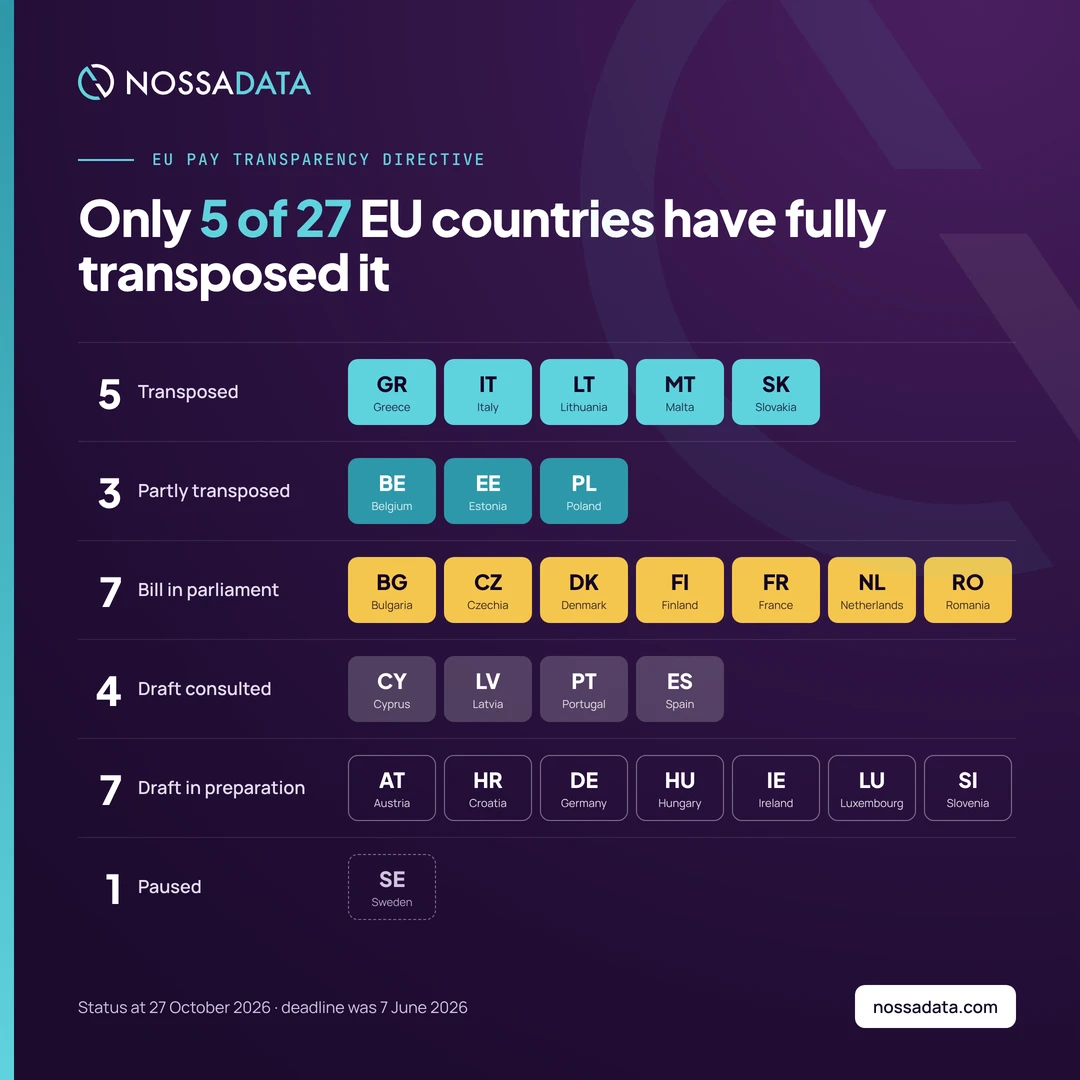
Each entry links to the law, bill or official document it is based on. Where no official source was available, we link to a law firm or news report and mark it secondary.
| Country | Status | Law or document | Adopted / issued by | In force or expected | Gender pay gap reporting |
|---|---|---|---|---|---|
| Greece | Transposed | Law 5316/2026, ΦΕΚ Α' 105 (text via Taxheaven); Labour Ministry circular 26923 | Hellenic Parliament; published 6 Jul 2026 | Core duties (Arts 8–20, 27) from 1 Nov 2026 | 100+; 250+ yearly; reports to the Ombudsman |
| Italy | Transposed | Legislative Decree 96 of 7 May 2026, Gazzetta Ufficiale no. 125 | Government (final approval 30 Apr 2026); published 1 Jun 2026 | 7 Jun 2026; implementing decrees pending | 100+; 150+ first by 7 Jun 2027; 100–149 by 7 Jun 2031 |
| Lithuania | Transposed | Law XV-969 amending the Labour Code; companion Law XV-972 (public sector) | Seimas, 21 May 2026; published 25 May 2026 | 7 Jun 2026; some articles from 1 Jan 2027 | 100+ insured persons; 150+ first by spring 2028; 100–149 in 2031 |
| Malta | Transposed | L.N. 173 of 2026, Equal Pay (Transparency and Reporting) Regulations | Minister under the Employment and Industrial Relations Act; Gazette 5 Jun 2026 | June 2026 | 100+; 150+ first by 7 Jun 2027; 100–149 by 7 Jun 2031; under 100 voluntary |
| Slovakia | Transposed | Act No. 76/2026 Coll. on equal pay for women and men | National Council, 15 Apr 2026; promulgated 8 May 2026 | 7 Jun 2026; pay structures by 31 Jul 2026 | 100+; 150+ first by 7 Jun 2027; 100–149 by 7 Jun 2031 |
| Estonia | Partly transposed | Employment Contracts Act amendments (Riigi Teataja); Ministry of Economic Affairs explainer | Riigikogu, 17 Jun 2026 | 13 Jul 2026 (recruitment, pay history ban, equal pay) | Not yet legislated; ministry plans 100+ |
| Poland | Partly transposed | Labour Code amendment, Dz.U. 2025 poz. 807 (recruitment); draft bill UC127 | Sejm (2025 law); Ministry of Family, Labour and Social Policy (draft) | 24 Dec 2025 (recruitment); rest 6 months after publication, Council of Ministers planned Q4 2026 | 100+ every 3 years; 250+ yearly (draft) |
| Belgium | Partly transposed (public sector) | Flemish Parliament decree, doc. 823 (2025-26) no. 6; federal status: VBO-FEB (secondary) | Flemish Parliament, 10 Jun 2026; no federal bill | Flemish public bodies from 7 Jun 2026; private sector not set | Private sector not yet set |
| Bulgaria | Bill in parliament | Bill 52-602-01-42 amending the Protection against Discrimination Act; consultation | Government bill, registered 11 Sep 2026; Human Rights Committee | Not set; first reading pending | 100+, phased (consultation draft) |
| Czechia | Bill in parliament | Chamber print 300, Labour Code amendment; government approval; MPSV release | Government, 31 Aug 2026; first reading 20 Oct 2026 | 1 Jan 2027 proposed | 100+; 150+ from 2028; 100–149 from 2031 |
| Denmark | Bill in parliament | Bill L 68 (2026-27); consultation draft | Minister for Employment; introduced 8 Oct 2026, first reading 22 Oct | 1 Mar 2027 proposed | 100+ (some 50–99 employers); 150+ first by 1 Sep 2028 |
| Finland | Bill in parliament | Government proposal HE 129/2026; Tax Administration notice | Ministry of Social Affairs and Health; government, Jul 2026 | 1 Jan 2027 proposed | 100+; 150+ first by 2 May 2028; 100–149 by 2 May 2031 |
| France | Bill in parliament | Bill no. 944 (2025-26), Senate file; Council of Ministers report | Ministers of Labour and Public Action; filed in Senate 10 Sep 2026, fast-track | New index from 2028 | 50+; simplified rules for 50–99 |
| Netherlands | Bill in parliament | Bill 36949, explanatory memorandum; committee decision | Royal message 20 May 2026; committee legislative meeting, date not set | 1 Jan 2027 target, now uncertain | 100+; 150+ first by 7 Jun 2028; 100–149 by 7 Jun 2031 |
| Romania | Bill in parliament | Senate file L445/2026: Senate sitting record; Economic and Social Council opinion | Private members' bill, registered 17 Jun 2026; negative Legislative Council opinion | Tacit Senate adoption date 17 Oct 2026; Chamber of Deputies decides | 100+; 150+ first by 7 Jun 2027 |
| Cyprus | Draft consulted | Draft bill on the Labour Ministry e-consultation; status: Cyprus Mail (secondary) | Ministry of Labour; consultation 5 Nov to 4 Dec 2025 | Not set; awaiting Cabinet | 150+ first by 7 Jun 2027 (draft) |
| Latvia | Draft consulted | Draft Pay Transparency Law 26-TA-700 | Ministry of Welfare; consultation from 26 Mar 2026 | Not set; still in inter-ministry review | 100+; 250+ first by 7 Jun 2027 |
| Portugal | Draft consulted | Draft bill in BTE Separata no. 26; summary: CMS (secondary) | Government (labour ministry); published 5 Aug 2026 for 20 days' comment | First day of the month after publication | 50+; 150+ first by 7 Jun 2027; 50–149 from 2031 |
| Spain | Draft consulted | Draft Royal Decree amending RD 902/2020; impact assessment | Ministry of Labour; hearing 4–24 Aug 2026 | Not set; awaiting Council of Ministers | 50+; 150+ first by 7 Jun 2027; 50–149 by 7 Jun 2031 |
| Austria | Draft in preparation | Parliamentary answer 6135/AB | Minister of Labour, 30 Sep 2026; draft in coalition talks | Not set; consultation to follow | 100+; 150+ first by 7 Jun 2027 (planned) |
| Croatia | Draft in preparation | Labour Ministry 2026 work plan; Zip.hr (secondary) | Ministry of Labour; Labour Act amendments | Feb 2027 reported | Not yet published |
| Germany | Draft in preparation | Bundestag paper 21/7026 (government answer) | Federal Family Ministry; no cabinet decision yet | Not set | Not yet published |
| Hungary | Draft in preparation | Autumn 2026 legislative programme; Telex (secondary) | Ministry of Social and Family Affairs; bill not yet submitted | Adoption planned autumn 2026 | Not yet published |
| Ireland | Draft in preparation | Government Legislation Programme, Summer 2026; partial General Scheme, Equality (Misc. Provisions) Bill 2024 | Dept of Children, Disability and Equality; heads in preparation | Not set | 50+ under existing gender pay gap law |
| Luxembourg | Draft in preparation | Castegnaro (secondary) | Ministry of Labour; bill not yet filed | Not set | Not yet published |
| Slovenia | Draft in preparation | Forbes Slovenija (secondary) | Ministry of Economy, Labour and Sport; to social partners Nov 2026 | Q1 2027 expected | Not yet published |
| Sweden | Paused | Government press release, 26 Mar 2026; earlier Council on Legislation referral | Minister for Gender Equality; no bill planned | Not set; state employers bound from 7 Jun 2026 | Not set |
National legislation is changing quickly, so check the official gazette before relying on any date in this table. We weren't able to open the official pages for Estonia, Portugal and Hungary directly, and we found no infringement proceedings by the European Commission relating to this Directive so far.
How should companies prepare?
Preparation can start before national law is final. The first reports use 2026 pay data, and correcting an unexplained pay gap usually takes longer than measuring it. We suggest working through the following steps.
- Map your entities. List each EU employing entity with its headcount and country. This shows which entities report in 2027 or 2028, which report from 2031, and which national rules apply to each.
- Consolidate your pay data. Collect base pay, variable pay, allowances, benefits in kind, working hours and gender on a consistent basis across payroll systems. The Directive defines pay broadly, so all of these elements need to be included.
- Define categories of workers. Group roles that involve equal work or work of equal value, using objective criteria such as skills, effort, responsibility and working conditions. This is usually the most time-consuming step, and the indicators depend on it.
- Calculate the indicators internally. Run all seven indicators for each entity and category, and identify any gap of 5% or more that can't be explained by objective, gender-neutral factors.
- Address unexplained gaps. Employers have six months after reporting to correct a gap before a joint pay assessment is required. Dealing with gaps before the first report reduces that risk.
- Update recruitment practices. Add pay ranges to job adverts, remove questions about pay history from applications and interviews, and review job titles for gendered language.
- Document pay and progression criteria. Record how pay levels and progression are decided, and make the criteria available to employees.
- Set up a process for information requests. Make sure requests can be answered within two months, and brief managers on what information they can share.
- Align with CSRD reporting. Use the same governed dataset for the Directive's reports and your ESRS S1-15 disclosures, so the figures are consistent and can be assured.
- Assign responsibility. HR, reward, legal and sustainability teams are all involved. Agree who is accountable for the reports and for tracking national legislation in each country.
Frequently asked questions
When does the EU Pay Transparency Directive come into effect?
The transposition deadline was 7 June 2026, but employers' obligations start when each country's law takes effect. Under the Directive, employers with 150 or more workers report first by 7 June 2027. Several countries, including the Netherlands, Denmark and Finland, have proposed 2028 instead.
Does it apply to small companies?
Yes. The rules on pay ranges for candidates, salary history and the right to information apply to all employers. Gender pay gap reporting applies from 100 workers under the Directive, and France, Spain and Portugal propose lowering this to 50.
What if my country hasn't transposed it yet?
Private employers are generally bound only once national law is in force. Public sector employers can be bound by the Directive directly, which is why Swedish state employers have been covered since 7 June 2026. The pay data that will be reported is still being generated in the meantime.
What triggers a joint pay assessment?
A gap of 5% or more in any category of workers that the employer can't justify by objective, gender-neutral factors and hasn't corrected within six months of reporting.
How does the Directive relate to the CSRD?
Both require gender pay gap data. ESRS S1-15 asks for a group-level gap and total remuneration ratio, while the Directive asks for seven indicators for each legal entity, including a breakdown by category of worker. Using one payroll dataset for both keeps the figures consistent.
Getting ready with Nossa Data
The Directive turns equal pay from a policy commitment into figures that employees can question and regulators can check. For companies reporting under the CSRD, those figures also need to match the sustainability statement.
Nossa Data combines an ESG data platform with sustainability specialists who help companies prepare consistent, evidenced disclosures across frameworks, including workforce and pay data.
Contact our team to find out how Nossa Data can help you prepare for pay transparency reporting.
This article is general information, not legal advice. Country status reflects public sources as of 27 October 2026.
Sources
National sources are linked in the tracker table. Other sources:


