I was recently speaking with someone who works in sustainability reporting, and we got into a discussion about which is harder to disclose against under the ISSB: IFRS S1 or IFRS S2. I hadn't really thought about it before. Almost every conversation I have on ISSB reporting ends up focused on IFRS S2 (the Climate Standard), so I decided to look into it a bit more.
S2 gets the attention for good reason. It is where the numbers are: Scope 3 emissions, scenario analysis, and the financial effects of climate risk, which few companies have ever had to quantify. But the longer I spent with the standards, the more IFRS S1 looked like the bigger job. It asks a company to decide which sustainability matters beyond climate could affect its prospects, and to show it has considered the SASB Standards in reaching that view.
Where a company reports also changes the answer. Australia has made AASB S1 voluntary and removed industry metrics from AASB S2. The UK has kept both standards but softened the SASB requirement, and the FCA will apply UK SRS on a comply-or-explain basis from 2027.
What IFRS S1 and IFRS S2 require
The ISSB issued both standards in June 2023, effective for annual periods beginning on or after 1 January 2024. They are meant to be read together. IFRS S1 sets the general requirements for sustainability-related financial disclosure, and IFRS S2 applies them to climate.
IFRS S1 covers any sustainability-related risk or opportunity that could reasonably be expected to affect an entity's cash flows, access to finance or cost of capital. It sets out the conceptual foundations, including fair presentation, materiality, the reporting entity and connected information. Disclosure is organised around governance, strategy, risk management, and metrics and targets. The standard also deals with practical matters such as where disclosures sit, timing, comparatives and errors.
IFRS S2 uses the same four areas for climate and adds specific requirements. A company must assess its climate resilience using scenario analysis, describe its transition plan and targets, and report Scope 1, 2 and 3 greenhouse gas emissions under the GHG Protocol. It must also disclose cross-industry and industry-based metrics, together with the current and anticipated financial effects of climate-related risks and opportunities.
Where SASB comes in
The SASB Standards cover 77 industries, each with its own disclosure topics and metrics. IFRS S1 uses them to give the general requirements an industry lens. Paragraph 55(a) says an entity shall refer to and consider the applicability of SASB disclosure topics when identifying sustainability-related risks and opportunities. Paragraph 58(a) says the same of SASB metrics where no IFRS Standard applies, and paragraph 59 requires the entity to state which industries and sources it used.
On the climate side, the equivalent is the Industry-based Guidance on Implementing IFRS S2, which was derived from SASB. Under IFRS S2 paragraph 32, an entity shall disclose industry-based metrics and shall refer to and consider that guidance. The guidance itself is not mandatory, but considering it is.
Comparing this to TCFD, TCFD had sector supplements, but nothing obliged a company to consider industry metrics. For companies moving from TCFD reporting, industry-based metrics are often the first gap to appear.
December 2025 amendments
The ISSB amended the greenhouse gas requirements in IFRS S2 in December 2025. Entities can now limit Scope 3 Category 15 emissions to financed emissions, and relief applies where a jurisdiction requires a different measurement method. New paragraphs 29A to 29C add disclosure where Category 15 emissions are included.
So which is harder?
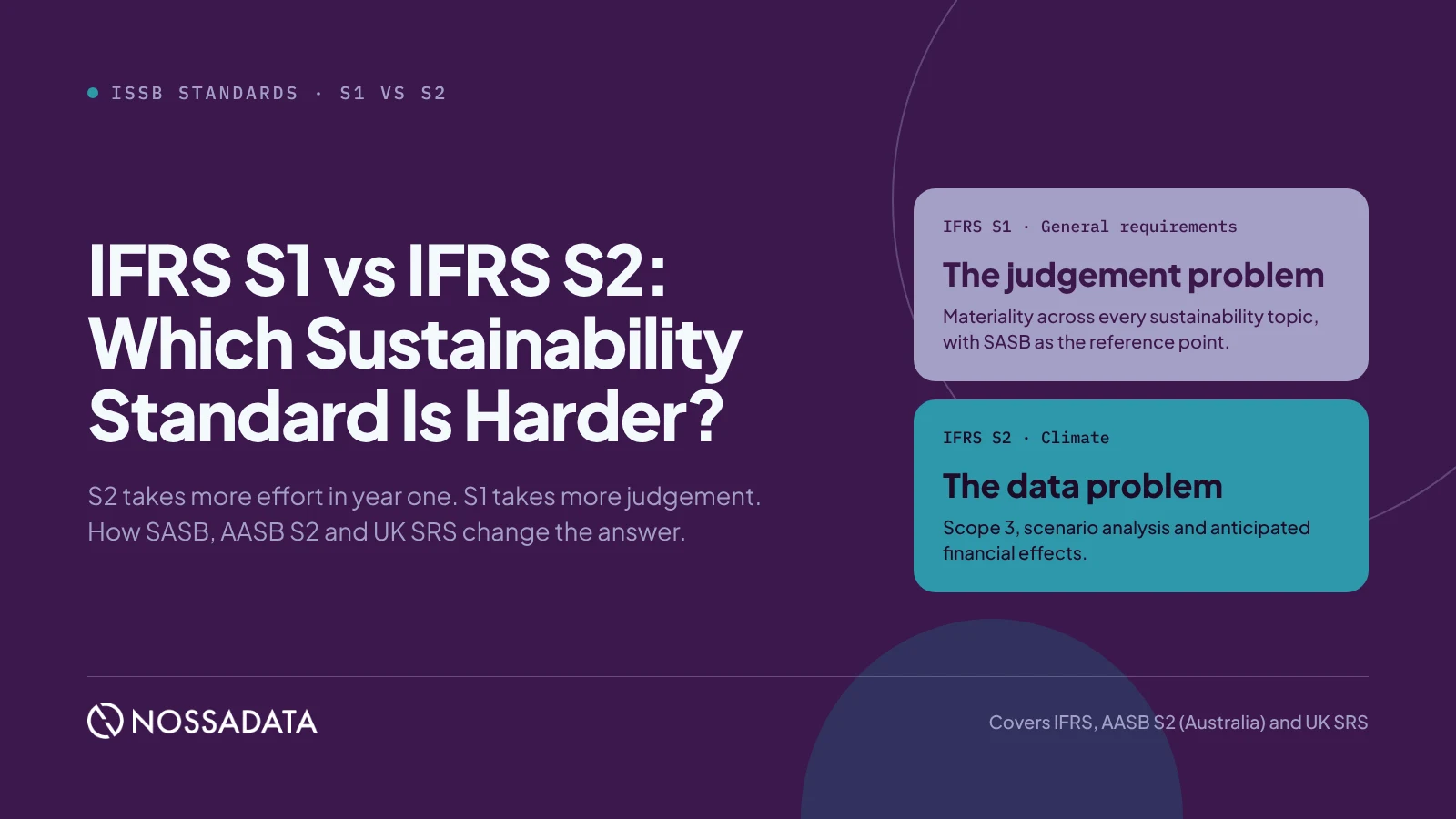
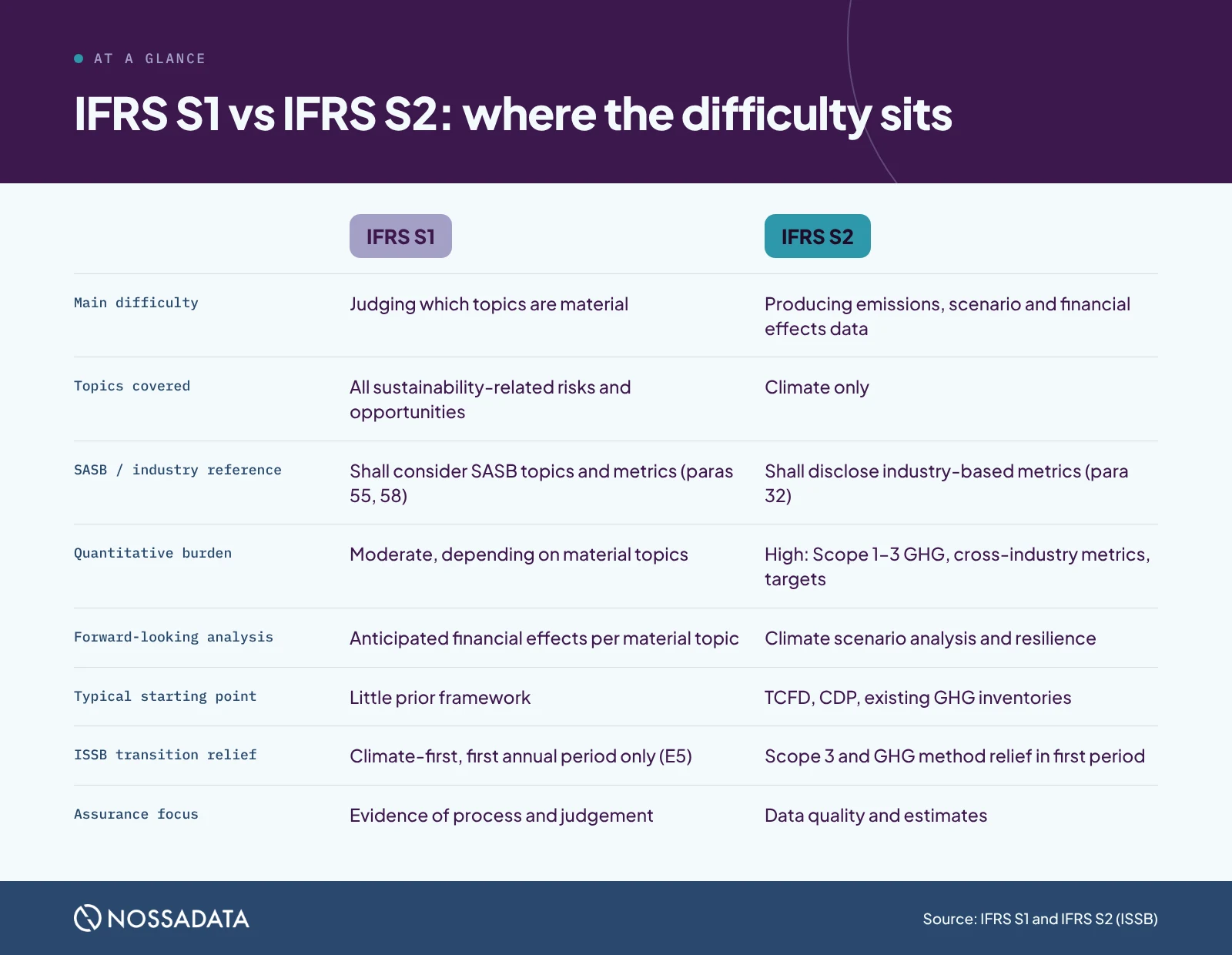
It depends on whether you are measuring effort or risk. IFRS S2 takes more effort to produce in the first year. IFRS S1 involves more judgement, and so more room to get it wrong.
The case for IFRS S2
Most of the difficulty in S2 is data. Scope 3 covers 15 GHG Protocol categories, and much of that information sits with suppliers and customers rather than the company. Scenario analysis needs modelling capability that many finance teams do not have in house.
Paragraphs 15 to 21 then ask for the current and anticipated financial effects of climate risk on financial position, performance and cash flows. TCFD reports usually treated this qualitatively, so it is often where the largest gap lies. Transition plans and targets also need more detail than most companies currently give.
The case for IFRS S1
S1 has no list of topics. A company has to decide for itself which sustainability matters are material and be able to defend that decision. Under the ISSB baseline it must show it considered the SASB topics for its industry and disclose the industry classification it used.
Disclosures also have to connect to the financial statements and to each other. For topics such as water, workforce, biodiversity and supply chain, the data controls built for carbon reporting often do not exist yet.
Which one is harder?
If your company already had a well-developed TCFD report you will usually find IFRS S2 gaps are narrow but data-heavy. Meanwhile, IFRS S1 gaps tend to be broader and slower to close. I would prioritise the S2 data but start the S1 materiality work at the same time, because under the ISSB standards the climate-first relief only lasts one reporting period.
Why quantifying financial effects is so difficult
If I had to pick the single hardest requirement in either standard, it would be financial effects. The requirements are identical in IFRS S1 (paragraphs 34 to 40) and IFRS S2 (paragraphs 15 to 21), so the problem follows a company from climate into every other material topic.
The standards ask for two things. Current financial effects are the effects on financial position, performance and cash flows in the reporting period, such as flood insurance premiums already paid. Anticipated financial effects look ahead over the short, medium and long term. IFRS S2 paragraph 16 asks how the company expects its financial position to change given its investment and disposal plans, "including plans the entity is not contractually committed to", and how it expects performance and cash flows to change.
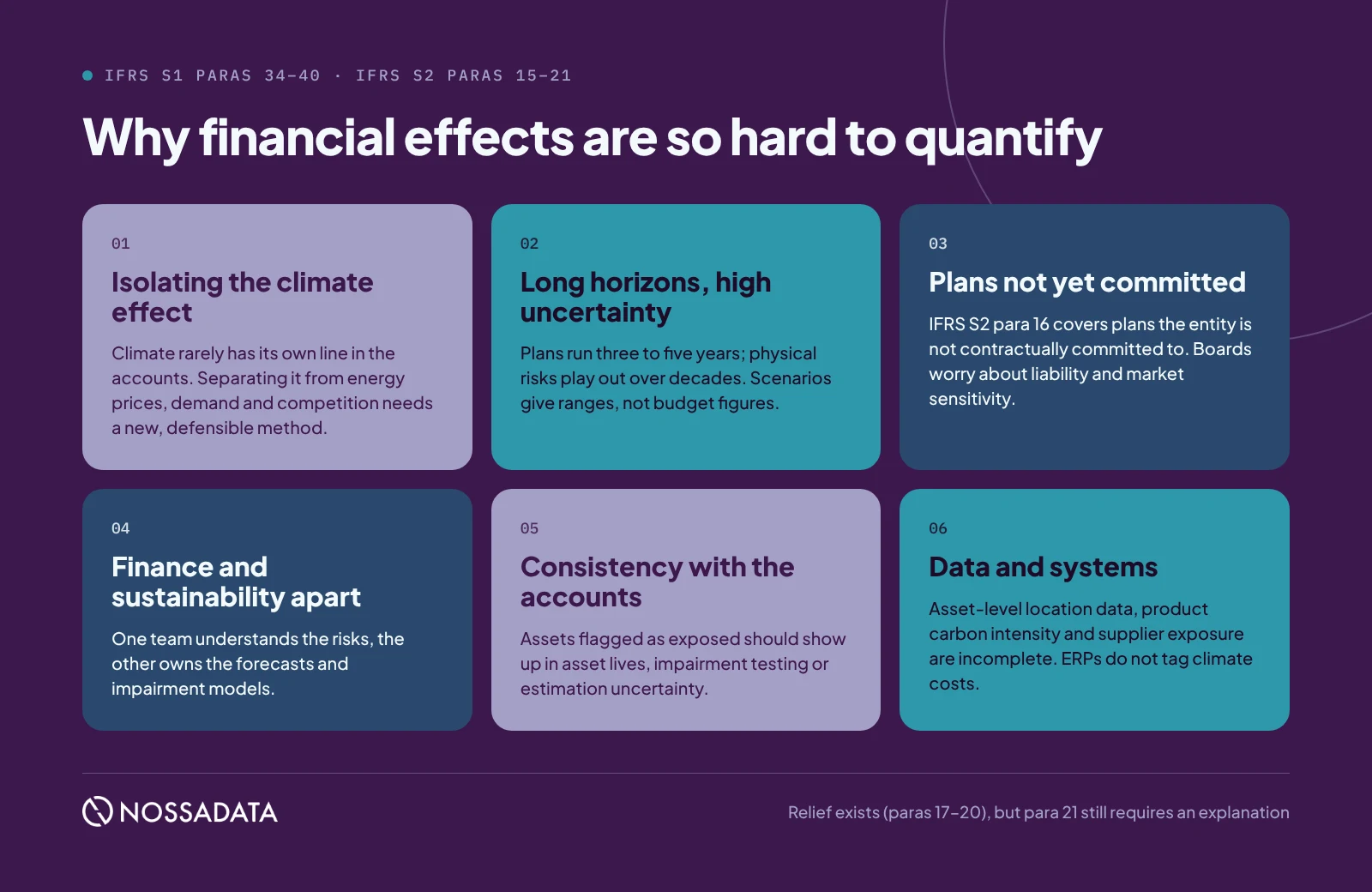
In practice, companies run into the same problems again and again.
Isolating the climate effect
Climate rarely shows up as its own line in the accounts. A fall in margin might come from carbon costs, energy prices, demand shifts and competition all at once. Separating out the part caused by a climate risk usually means building an allocation method that did not exist before, and defending it.
Long time horizons and uncertainty
Financial planning tends to run three to five years. Many climate risks, particularly physical risks, play out over decades. The further out a company looks, the more the numbers depend on assumptions about carbon prices, policy, technology and the climate itself. Scenario analysis helps, but it produces ranges and narratives, not figures that sit easily next to a budget.
Committing to uncommitted plans
Disclosing the effect of plans the company has not yet committed to is difficult. Boards worry about forward-looking statements, liability and market sensitivity, and legal teams are often reluctant to put figures on capital expenditure that has not been approved.
Sustainability and finance working apart
The information needed sits across two teams that do not usually work together. Sustainability teams understand the risks but not the impairment models. Finance teams own the forecasts but have rarely built climate assumptions into them. Without a joint process, the numbers in the sustainability report and the financial statements can drift apart.
Consistency with the financial statements
Investors and auditors will compare the two. If the sustainability report says a group of assets is exposed to transition risk, the financial statements should reflect that in asset lives, impairment testing or the disclosure of estimation uncertainty. If they do not, the company needs to explain why.
Data and systems
Asset-level location data for physical risk, product-level carbon intensity, and supplier exposure are often incomplete. Most ERP and planning systems were not built to tag costs or revenues as climate-related.
What the standards allow
The ISSB recognised these problems and built in some relief, which it calls proportionality mechanisms.
Under IFRS S2 paragraph 18, a company uses all reasonable and supportable information available at the reporting date without undue cost or effort, and an approach commensurate with its skills, capabilities and resources. Paragraph 17 allows a range instead of a single amount.
Paragraph 19 says quantitative information is not needed if the effects are not separately identifiable, or if measurement uncertainty is so high that the figures would not be useful. For anticipated effects only, paragraph 20 adds that a company need not quantify if it lacks the skills, capabilities or resources to do so.
A company that relies on these exemptions (paragraph 21) must explain why, describe the effects qualitatively, identify the line items in the financial statements likely to be affected, and give quantitative information on the combined effects of climate and other factors unless that would not be useful. The ISSB's educational material on anticipated financial effects (August 2025) also makes clear that skills and capabilities are expected to improve over time, so a company cannot rely on the same explanation indefinitely.
TCFD asked for the "actual and potential impacts" on businesses, strategy and financial planning, and most companies answered in words. Under the ISSB standards, words alone need a justification, and the line items still have to be named.
Practical ways to make progress
- Start with current effects. These are already in the accounts: insurance costs, adaptation capex, carbon costs, green revenue. Tagging them is the easiest first step.
- Use the climate metrics IFRS S2 already requires. The amount and percentage of assets vulnerable to physical and transition risk, and capital deployed towards opportunities, can feed directly into anticipated effects.
- Link to existing financial statement judgements. Impairment testing, useful lives and provisions are natural places to connect climate assumptions.
- Give ranges where single figures are not credible, and say clearly which scenario each range relates to.
- Set up a joint working group between finance and sustainability, with the CFO's team owning the numbers.
- Where you cannot quantify, follow paragraph 21 in full and document the reasoning for the assurance provider.
Australia and the UK: how local adoption changes things
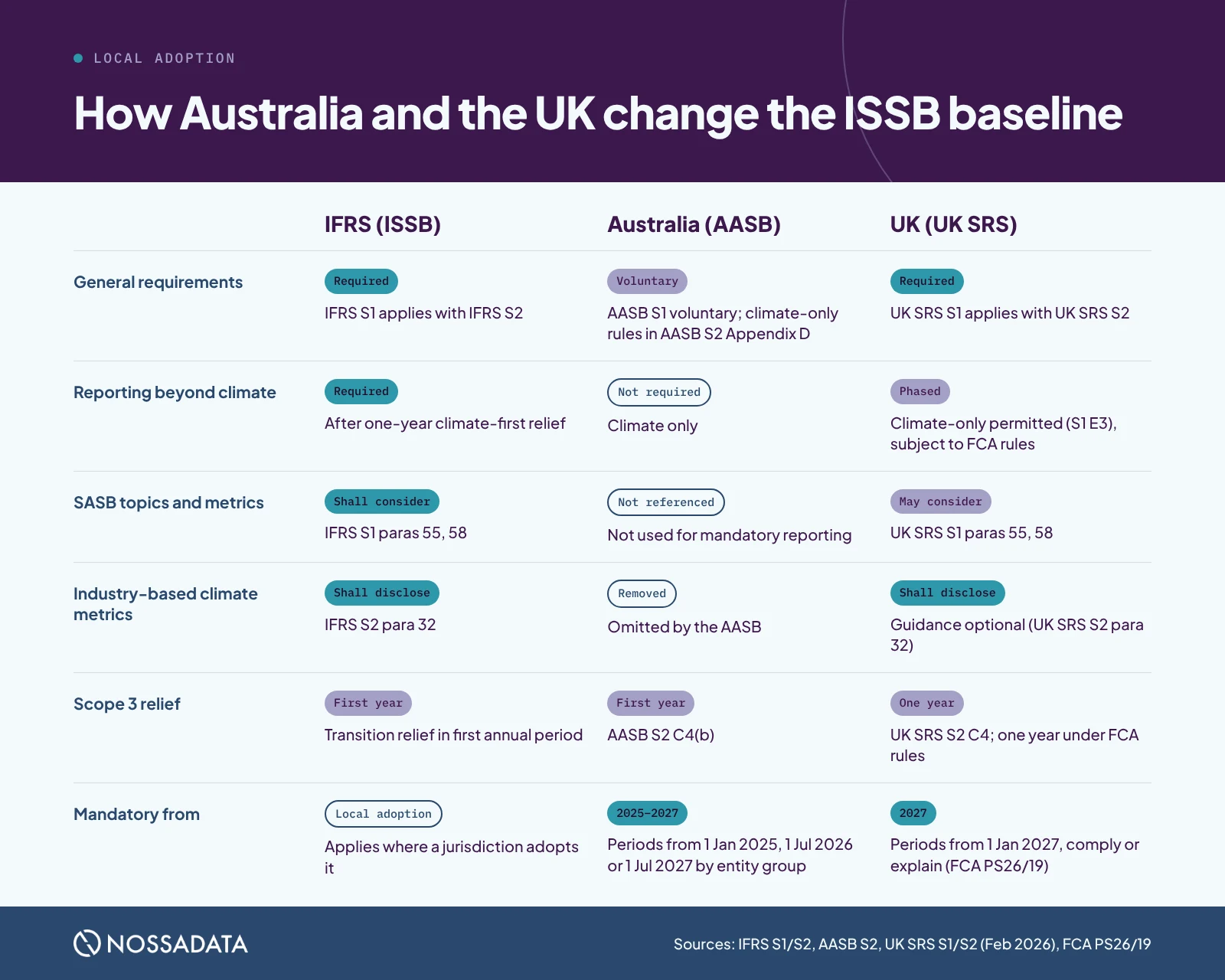
Both jurisdictions start from the ISSB standards but have made different choices on S1 and SASB.
Australia (AASB S2)
Only AASB S2 is mandatory. The AASB moved the parts of IFRS S1 needed for climate reporting into Appendix D of AASB S2, so the standard works on its own. AASB S1 is available but voluntary. The AASB also removed the requirement to disclose industry-based metrics and to consider the related disclosure topics.
In practice, Australian reporters face the S2 problem and very little of the S1 one. Scope 3, scenario analysis and financial effects take up most of the effort. The first reports from Group 1 entities, including BHP, Commonwealth Bank, Telstra and Origin Energy, are a useful benchmark for the level of detail expected.
United Kingdom (UK SRS)
The Department for Business and Trade published UK SRS S1 and S2 in February 2026. In Policy Statement PS26/19, issued on 30 September 2026, the FCA confirmed that in-scope listed companies will report against UK SRS on a comply-or-explain basis for accounting periods beginning on or after 1 January 2027. The rules include transitional relief for wider UK SRS S1 disclosures and one year of relief for Scope 3.
Three UK changes matter here. UK SRS S1 replaces "shall" with "may" for SASB topics and metrics, so considering SASB becomes optional. UK SRS S2 paragraph 32 still requires industry-based metrics, although referring to the guidance is optional. And UK SRS S1 paragraph E3 allows climate-only reporting without the one-period limit in the ISSB version, leaving its availability to the FCA and the Companies Act.
For UK companies, then, S2 is the immediate task. S1 can be phased in, with any gaps explained.
How to approach the work
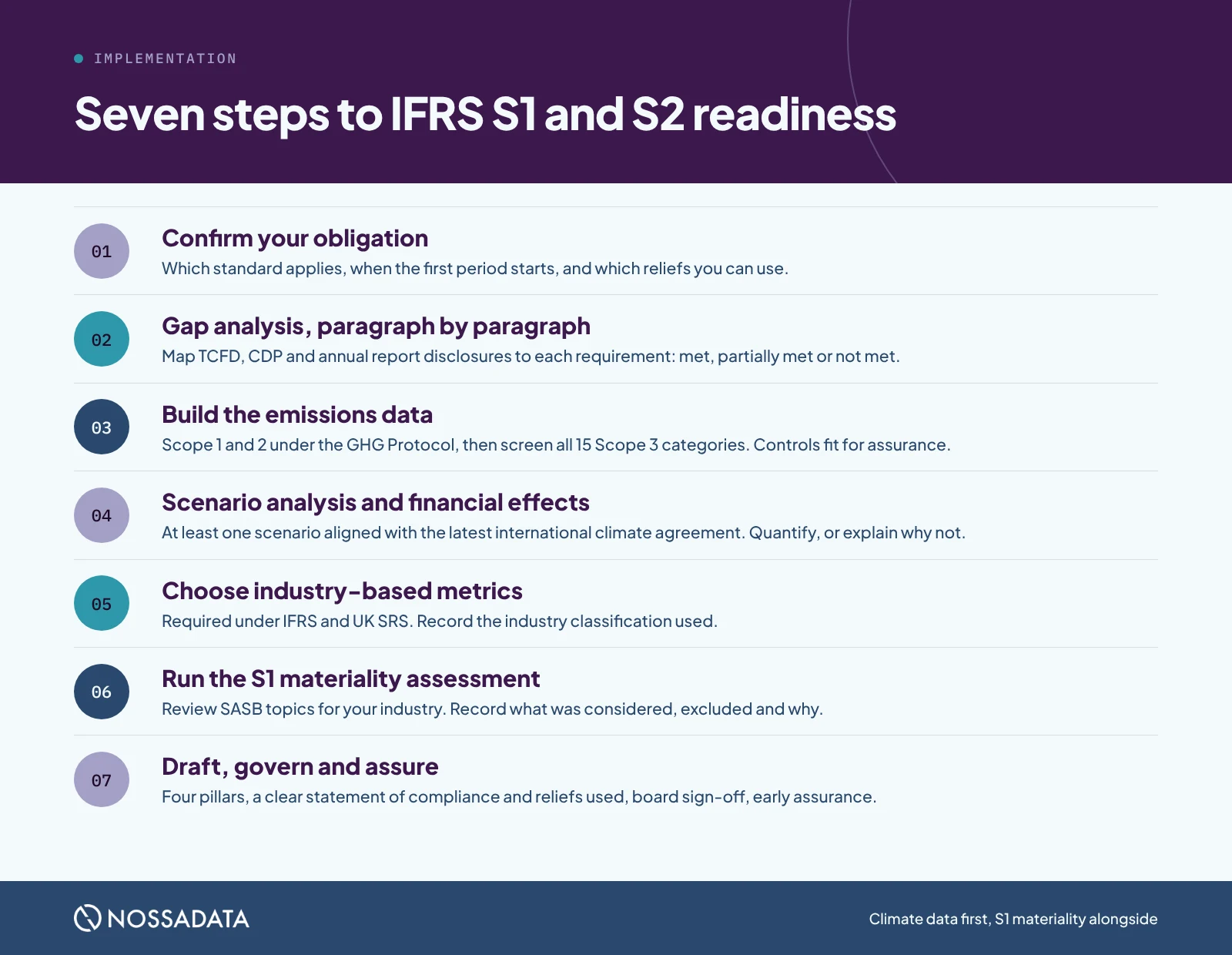
- Confirm which standard applies (IFRS, AASB S2, UK SRS or another local version), when the first reporting period starts, and which reliefs you can use. Check whether reporting beyond climate is required, voluntary or comply-or-explain.
- Carry out a gap analysis paragraph by paragraph. Map existing TCFD, CDP and annual report disclosures to each requirement and grade each one as met, partially met or not met. TCFD alignment is a starting point, not evidence of compliance.
- Build the emissions data. Start with Scope 1 and 2 under the GHG Protocol, then screen all 15 Scope 3 categories. Put controls in place that will stand up to limited assurance and, later, reasonable assurance.
- Develop the scenario analysis and financial effects. Use at least one scenario aligned with the latest international agreement on climate change. Quantify the effects on financial position, performance and cash flows, or explain why that is not yet possible.
- Choose industry-based metrics where they are required (IFRS and UK SRS) and record the industry classification used.
- Run the S1 materiality assessment. Review the SASB topics for your industry, which is mandatory under IFRS and optional under UK SRS. Record which topics were considered, which were excluded and why, and link each material topic to the financial statements.
- Draft the report under the four pillars, with a statement of compliance that lists any reliefs used. Align the timetable with financial reporting, take it through the board, and involve the assurance provider early.
A few mistakes are worth avoiding. Treating a TCFD report as IFRS S2 compliant without checking financial effects and industry metrics is the most common. Others include leaving S1 materiality until the climate-first relief has run out, reporting a Scope 3 figure without saying which categories it covers or how it was measured, and omitting the statement of compliance or the reliefs relied on.
Common questions
Is IFRS S1 or IFRS S2 harder to disclose against?
IFRS S2 usually takes more work in the first year because of Scope 3, scenario analysis and financial effects. IFRS S1 becomes harder over time because it needs a documented materiality judgement across all sustainability topics.
Is SASB mandatory under IFRS S1?
Companies do not have to disclose the SASB metrics. They do have to refer to and consider their applicability under IFRS S1 paragraphs 55 and 58. UK SRS S1 makes this optional, and AASB S2 does not refer to SASB.
Do I need IFRS S1 if I only report on climate?
Under the ISSB standards, yes. IFRS S1 applies alongside IFRS S2, and the climate-first relief lasts one reporting period. In Australia, AASB S1 is voluntary. In the UK, UK SRS S1 permits climate-only reporting, subject to FCA rules.
Is a TCFD report enough for IFRS S2?
No. IFRS S2 builds on TCFD but adds industry-based metrics, more detailed financial effects, Scope 3 and more specific transition plan disclosure.
When does UK SRS reporting start?
For in-scope listed companies, it applies to accounting periods beginning on or after 1 January 2027, on a comply-or-explain basis under FCA PS26/19.
Sources
- IFRS S2 Climate-related Disclosures (IFRS Foundation, 2026 edition) and Amendments to IFRS S2 (December 2025)
- UK SRS S1 and UK SRS S2 (Department for Business and Trade, February 2026)
- FCA PS26/19: Aligning listed issuers' sustainability disclosures with international standards (30 September 2026)
- AASB S2 Climate-related Disclosures (AASB, September 2024)
- AASB project summary: climate-related financial disclosures