
If you want to improve your ESG ratings, the most important work happens long before a rater sends you a draft score. It happens while you prepare your annual report / public disclosure for the upcoming fiscal year.
Many sustainability and investor relations teams treat ESG ratings as something that happens to them. A scorecard arrives, the team spots gaps, and then the scramble starts to correct the record. By then, the window to change the outcome has usually closed.
The companies that climb ESG rankings year after year take a different approach. They plan their disclosures around what raters and investors look for, and they publish that information in time to count. This article explains why annual report preparation for FY2026 is your best opportunity to lift your ESG scores, and how to make sure your data is visible, verifiable and easy to find.
Investors and ESG raters assess you one fiscal year at a time
Investors, ESG rating agencies and benchmark providers compare your performance against a reporting period, usually your fiscal year. Your FY2026 disclosures will become the baseline they use to judge your policies, targets and performance for the next rating cycle.
The question disclosure teams should ask themselves? When FY2026 data goes live, will it include what investors and raters want to see?
That means more than reporting what you have always reported. It means:
- Knowing which indicators your key raters and benchmarks score you on
- Checking which of those indicators your last report covered, and which it missed
- Building the missing data points into this year's report plan
If you wait until after publication to look at these questions, any gaps stay in the public record for a whole year.
If it isn't public, it doesn't count
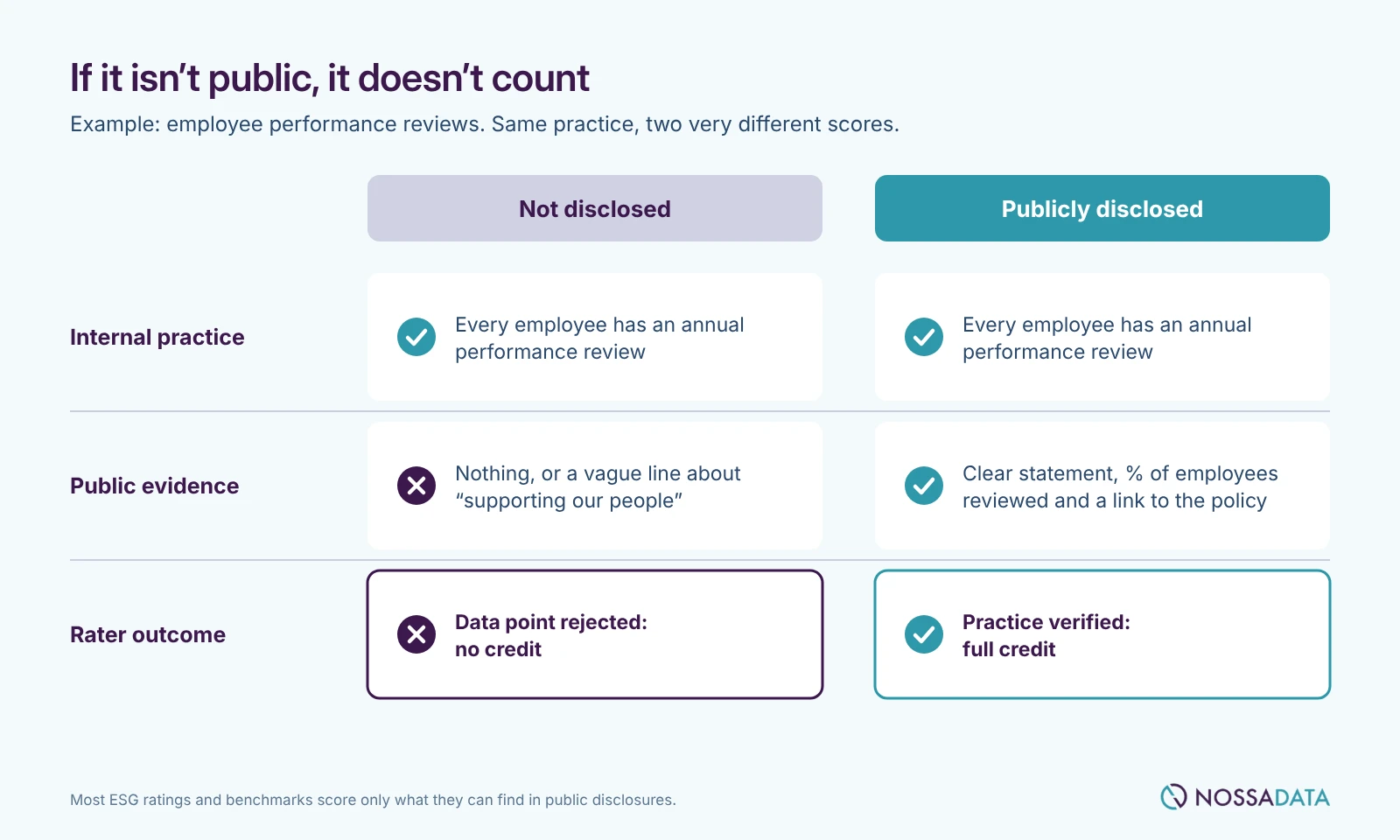
Most ESG ratings and benchmarks score you on publicly available information. If a rater can't find evidence of a practice in your public disclosures, it usually assumes you don't have that practice, however well established it is inside your business.
Take a common example: employee performance reviews.
- What happens internally: every employee has an annual performance and career development review.
- What the public record shows: nothing, or a vague line about "supporting our people".
- The result: the rater rejects the data point. Your score reflects a practice you don't appear to have.
The same applies to almost every ESG topic, from whistleblowing channels and supplier codes of conduct to board oversight of climate risk. A good practice with no public evidence gets the same score as no practice.
A clear sentence, a data point (such as the percentage of employees who received a review), and a link to the relevant policy can turn a "not disclosed" into full credit.
By the time you're being rated, it may be too late
Most ESG rating agencies and benchmarks set cut-off dates: the latest point at which they will accept newly published information for a rating cycle. Anything you publish after that date usually waits until the next cycle, which can be a year away.
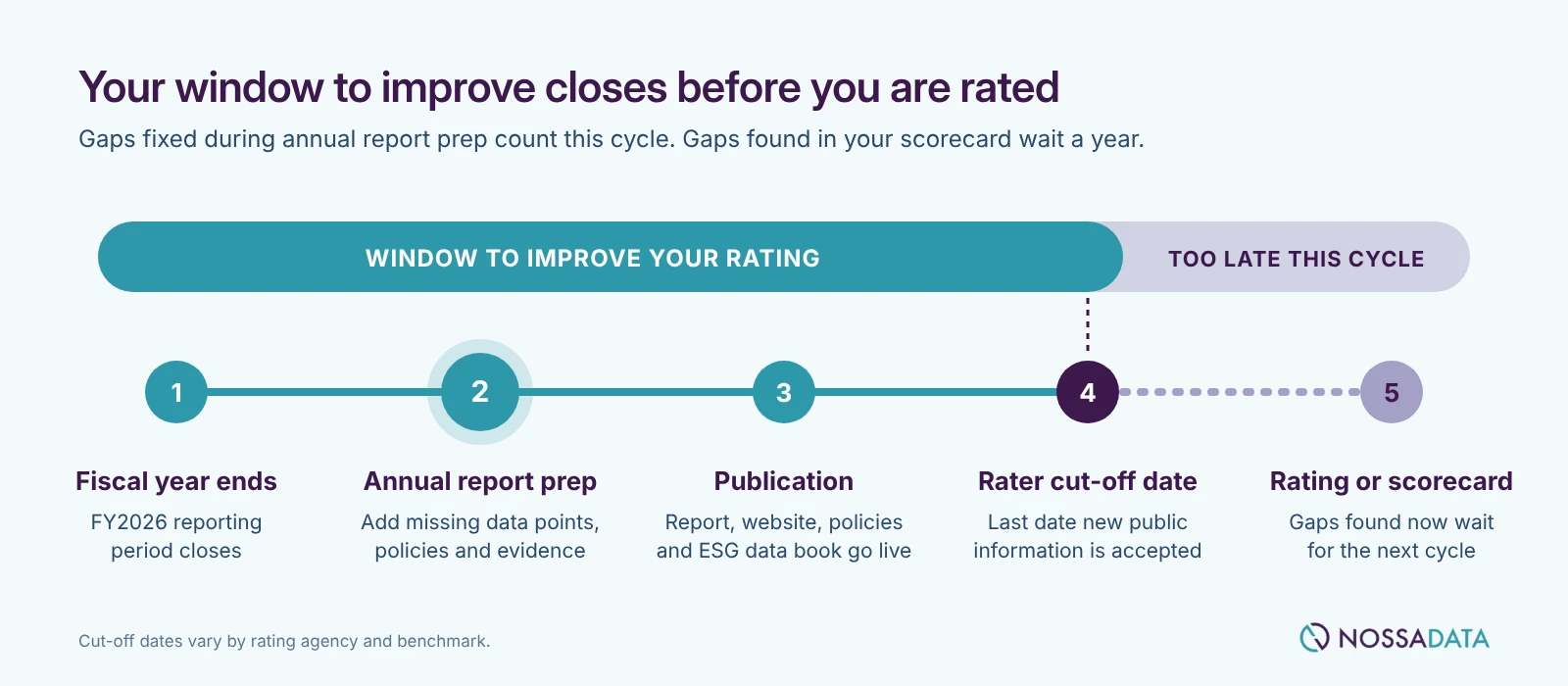
This creates a timing trap. Many companies first see their gaps when a draft rating or scorecard arrives. By then:
- The cut-off date has often passed
- The annual report is already designed, signed off and published
- Correcting the record means waiting for the next cycle
Cut-off dates and review windows differ between providers, so build a simple calendar of the raters and benchmarks that matter most to your investors. Then work backwards: the content that needs to be public by those dates should be in your annual report plan.
Your annual report is only one ESG disclosure asset
The annual report is the anchor of your disclosure, but it isn't the only place raters look. Report season is also the right time to review the other assets around it:
| Asset | What to improve |
|---|---|
| Annual report | Add missing ESG data points, targets and year-on-year figures for the fiscal year |
| Corporate website | Give ESG content clear, stable pages that link to the latest reports and policies |
| Policies | Publish up-to-date versions with approval dates, scope and who is accountable |
| ESG data book | Bring key metrics together in one table-based document or spreadsheet, with definitions and multi-year data |
An ESG data book is especially useful. It lets you publish detailed metrics that would clutter the annual report, and it gives raters one dependable place to find your numbers.
Your ESG data must be readable by AI and data scrapers
ESG data collection is increasingly automated. Rating agencies, data providers and investors use AI tools and data scrapers to pull information from corporate disclosures at scale. If a machine can't find or understand your data, a person may never see it.
Common problems that make ESG data hard to find include:
- Key metrics locked in images, infographics or scanned PDFs
- Inconsistent units, labels or reporting periods across documents
- Data scattered across many documents with no clear signposting
- Policies hidden behind broken links or buried deep in the website
Hard-to-find data creates extra work. When a scraper misreads or misses a figure, your team has to spot the error and request a correction. If nobody spots it, the wrong data gets published and feeds into your rating and investors' models.
Clear, structured and well-labelled disclosure reduces those errors at the source.
How to use FY2026 annual report prep to improve your ESG ratings
- List your priority raters and benchmarks. Focus on the ones your investors use most.
- Map their cut-off dates. Build a disclosure calendar and work backwards from it.
- Run a gap analysis. Compare last year's public disclosures with each rater's indicators.
- Turn internal practices into public evidence. Add short statements, data points and policy links for anything you already do but haven't disclosed.
- Update the wider disclosure set. Refresh your website, policies and ESG data book alongside the annual report.
- Test for AI readability. Check that machines can find, read and correctly interpret your key data before you publish.
Get an AI Readability Audit before your next reporting cycle
Nossa Data runs AI Readability Audits on your corporate disclosure before your next fiscal year of reporting. We review your annual report, website, policies and supporting documents the way ESG raters and their AI tools do. Then we show you:
- Which data points raters and investors can and can't find
- Where practices you already have lack public evidence
- Which formatting and structure issues could cause scraping errors
- Practical fixes to build into your FY2026 report before cut-off dates
The best time to improve your ESG ratings is before you publish. Book your AI Readability Audit with Nossa Data and make your FY2026 disclosure count.
Frequently asked questions
When is the best time to improve ESG ratings?
During annual report preparation. That is when you can still add missing disclosures before rating agencies' cut-off dates for the next cycle.
Do ESG rating agencies use private company information?
Most ESG ratings and benchmarks rely mainly on publicly available information. A practice with no public evidence is usually scored as if it doesn't exist.
What is an ESG data book?
An ESG data book is a supplementary disclosure that brings key ESG metrics together in one place, usually as tables with multi-year data and definitions. It makes your data easier for raters, investors and AI tools to find.
What is an AI Readability Audit?
An AI Readability Audit checks how easily AI tools and data scrapers can find, extract and correctly read the ESG data in your corporate disclosures. Nossa Data runs these audits ahead of your reporting cycle so you can fix issues before you publish.