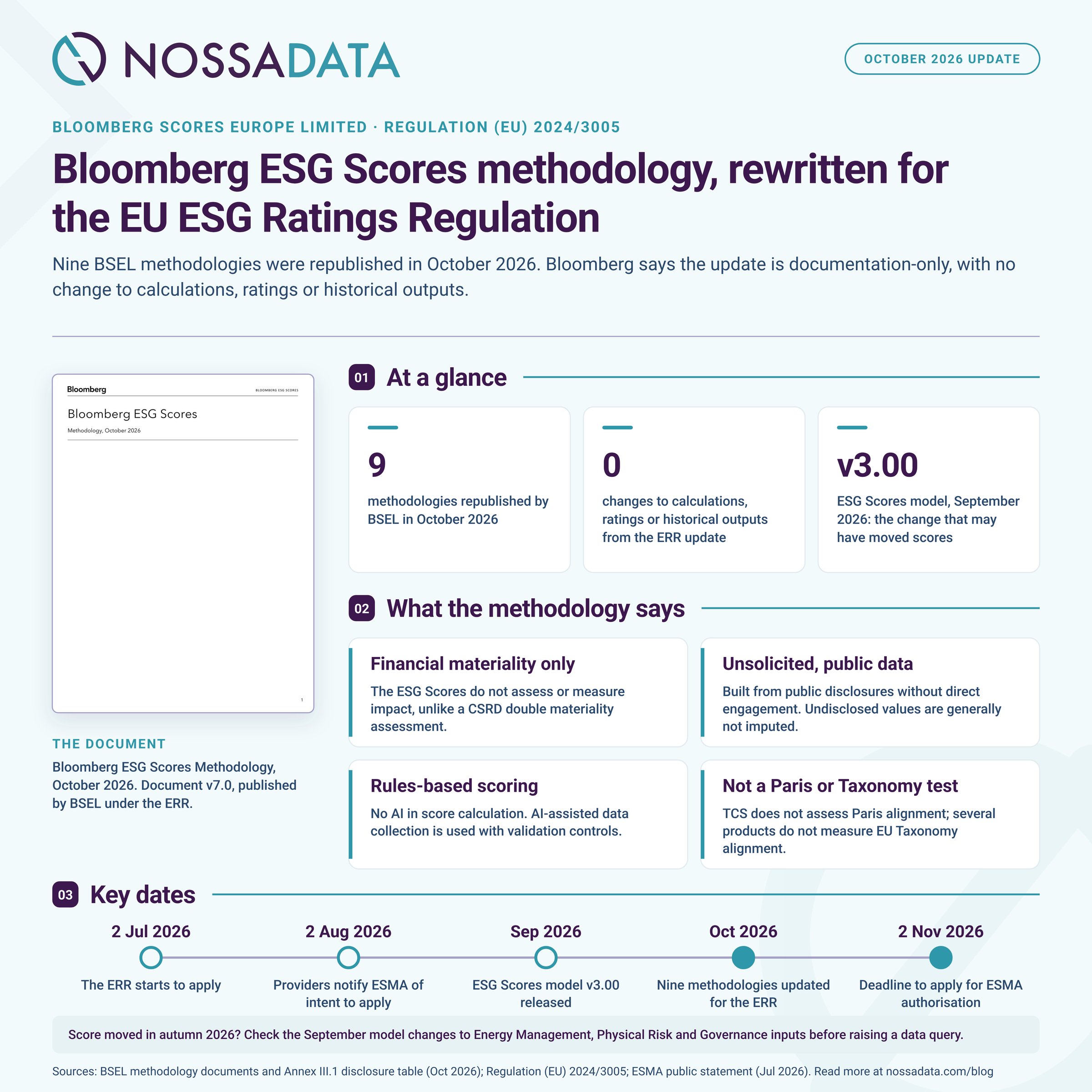
Bloomberg republished the Bloomberg ESG Scores methodology, and the methodologies of eight related ratings products, in October 2026 to meet the EU ESG Ratings Regulation (ERR). The issuer is Bloomberg Scores Europe Limited (BSEL), an Irish company that is the ESG rating provider responsible for these ratings under the ERR.
Bloomberg describes every October 2026 update as 'documentation-only', with no change to calculations, ratings or historical outputs. The real model changes happened earlier in 2026, and those are the ones that may have moved your scores.
Here is what you need to know:
- 9 methodologies, 1 provider. ESG Scores, Transition Credibility Scores, Temperature Rise, Climate Alignment Scores, TRACT, Transition Revenue Exposures, the Nature Exposure Screening Tool, Fund ESG Scores and Government Climate Scores are all issued by BSEL.
- No score changes from the ERR update itself. Each October 2026 version history marks the change as documentation-only.
- Earlier model changes matter more. ESG Scores model version 3.00 (September 2026) changed Energy Management, Physical Risk and Governance inputs.
- Unsolicited and public-data only. The ratings are built from publicly available information without direct engagement, so your published disclosures drive your scores.
- Financial materiality, not double materiality. The ESG Scores do not assess impact, which matters if you compare them with your CSRD double materiality assessment.
What is BSEL and the EU ESG Ratings Regulation?
The EU ESG Ratings Regulation, Regulation (EU) 2024/3005, requires ESG rating providers operating in the EU to be authorised and supervised by the European Securities and Markets Authority (ESMA). It applies from 2 July 2026 and sets transparency rules for methodologies, data sources and conflicts of interest.
Who issues Bloomberg's ESG ratings
Bloomberg issues these ratings through Bloomberg Scores Europe Limited (BSEL), registered in Ireland under number 815134. BSEL's Annex III disclosure table for the ESG Scores names BSEL as the provider responsible for issuing and distributing the ratings under the ERR.
What the ERR asks providers to publish
Annex III, point 1 of the ERR lists the public disclosures a provider must make. They include the rating's objective, whether it assesses risk, impact or both, the E, S and G weighting, data sources, use of artificial intelligence (AI) and known limitations. Bloomberg's October 2026 documents are organised around these headings, which makes them easier to compare across products.
ERR timeline and Bloomberg methodology dates
The ERR deadlines and Bloomberg's own methodology releases overlap through 2026. The key dates:
After 2 November 2026, ESMA says third parties should consult its register to confirm which providers' ratings can still be published or distributed. See ESMA's public statement and the ESG rating providers page.
What changed in the October 2026 Bloomberg methodologies
The October 2026 documents add disclosure, not new scoring rules. Each version history now separates changes to the methodology from changes to the document. The changes worth knowing:
- Documentation-only updates. Every product's October 2026 entry states no change to calculations, ratings or historical outputs.
- Clearer materiality statements. The ESG Scores are framed explicitly as financial materiality only. The Nature Exposure Screening Tool says impact scores align with impact materiality and dependency scores with financial materiality.
- Explicit Paris and EU Taxonomy positions. Transition Credibility Scores state they do not assess Paris alignment. Climate Alignment Scores state they do not measure EU Taxonomy alignment, and TRACT states it does not correlate with it.
- AI disclosures. Bloomberg states that score calculations are rules-based and do not use AI. AI-assisted techniques may be used in data collection, with validation controls. GHG emissions estimates use a statistical model with a machine learning component.
- Restatement rules spelled out. Monthly ESG Scores are immutable once published, while Fiscal Year-Aligned Scores are recalculated and can change. Government Climate Scores are never restated.
The model changes that may have moved your scores
The ESG Scores model version 3.00, released in September 2026, made substantive changes:
- Enhanced methodologies for Energy Management and Climate Exposure – Physical Risk.
- Data Security & Customer Privacy extended to Automobiles and Institutional Brokerage, and Water Management extended to Automobiles.
- Indicators refined across peer groups where GHG Emissions Management, Water Management and Data Security & Customer Privacy apply.
- A review of Governance inputs across Board Composition, Executive Compensation, Shareholder Rights and Audit.
If your score moved in autumn 2026, check these changes before assuming your data was misread.
Which Bloomberg ESG ratings are covered?
BSEL issues nine company, fund and sovereign ratings, and each uses a different scale and materiality lens. Comparing a score with another provider's, or with your own assessment, only works if you know which one you are looking at.
TCS weights its five pillars at 10% Ambition, 35% Implementation, 10% Engagement, 35% Metrics/Performance and 10% Governance. Bloomberg gives the heavier weights to the pillars that show ambition turning into capital allocation and measurable outcomes.
One detail stands out for Temperature Rise. Bloomberg's methodology still reflects version 1.0 of the CDP-WWF methodology, although CDP and WWF have published a new version of the temperature scoring methodology. Bloomberg says it reviews external updates before implementing them.
How the Bloomberg ESG Scores methodology works
The Bloomberg ESG Scores rate your performance on financially material ESG issues against peers in your industry. They are quantitative and rules-based, with no analyst override of individual scores.
Financial materiality, not impact
Bloomberg defines financial materiality as issues that can affect revenue, operating costs, cost of capital, asset value or liabilities. The Annex III disclosure states plainly that the ESG Scores do not assess or measure impact. Your CSRD double materiality assessment and your Bloomberg score therefore answer different questions.
Peer groups and structure
Companies are compared within the Bloomberg ESG Classification System (BECS), a proprietary system built from the Bloomberg Industry Classification System (BICS). Scores build up from fields to sub-issues, issues, themes (Governance only), pillars and an overall score.
Environmental and social issues are weighted by their probability, the potential severity of the financial effect and its likely timing. Governance weighting is informed by industry and academic research.
Scales and Score Bands
The ESG Scores use several related measures:
- 0-10 scores at every level, measuring best-in-class performance within the BECS peer group.
- Percentiles from 0 to 100 for issue, theme, pillar and overall scores.
- Standardized Scores from 0 to 10, where the peer group median scores 5.
- ESG Score Bands from A to G, based on Standardized Scores. Band A (8.4375 to 10) is significantly better than the peer average; Band D (4.3125 to below 5.6875) is the peer average.
Disclosure is part of performance
The ESG Scores treat the disclosure of quantitative data as a dimension of performance, and the model generally avoids imputing values you do not disclose. A separate ESG Disclosure Score measures the extent of disclosure using the same industry framework.
Timing
Scores are calculated monthly with the latest data. Bloomberg typically stops computing scores about 24 months after the end of the last fiscal year for which a company disclosed data.
What reporting teams should do now
The ERR does not place new duties on your company as a rated item, but it gives you better material to manage your Bloomberg ratings. Practical steps:
- Check which Bloomberg ratings cover you. Your company may have ESG Scores, TCS, Temperature Rise, Climate Alignment, TRACT, Transition Revenue Exposure and NEST outputs at the same time.
- Explain recent score moves. Compare any change since September 2026 with the ESG Scores model 3.00 changes before raising a data query.
- Read your Industry Guide. Bloomberg makes Industry Guides available to rated items, listing the issues, frameworks and indicators for your peer group.
- Make quantitative data easy to find. Undisclosed values are generally not imputed, so a missing number can lower your score. Publish data in machine-readable tables in your annual report or ESG data book.
- Submit SBTi and CDP targets cleanly. Temperature Rise only uses targets with a base year, target year, coverage and reduction ambition. Incomplete targets default to 3.2°C.
- Use the Inquiry Form for errors. BSEL reviews rated-item input for data or methodology-application errors, but rated items cannot negotiate the methodology or outcomes.
- Keep the materiality lenses apart. Do not present a Bloomberg ESG Score as evidence of impact performance or of EU Taxonomy or Paris alignment.
For timing your disclosure work, see why annual report season is the best time to improve your ESG ratings.
Frequently asked questions
Did the October 2026 update change my Bloomberg ESG Score?
No. Bloomberg describes the October 2026 changes as documentation-only, with no effect on calculations, ratings or historical outputs. Model changes released in September 2026 may have.
Do Bloomberg ESG Scores use double materiality?
No. The ESG Scores reflect financial materiality only and do not assess impact. NEST is the Bloomberg product that separates impact and dependency exposure.
What do the Bloomberg ESG Score Bands mean?
Bands A to G group companies by Standardized Score within their peer group. A is significantly better than the peer average, D is the peer average and G is significantly below it.
Does Bloomberg send companies a questionnaire?
No. The ratings are unsolicited and built from public information. TCS may use data companies submit to CDP, through Bloomberg's licensing agreement with CDP.
Do Bloomberg ratings measure Paris Agreement or EU Taxonomy alignment?
Generally not. TCS and Government Climate Scores state they do not determine Paris alignment, and several products state they do not measure EU Taxonomy alignment.
How do I correct data in my Bloomberg score?
Use BSEL's Inquiry Form. Validated issues go through correction, restatement or methodology change, and formal complaints follow the BSEL Complaints Policy.
For how Bloomberg compares with other providers, see our overview of the major ESG rating agencies.
Sources
- BSEL ESG Ratings Products page, which hosts the October 2026 methodologies: Bloomberg ESG Scores, Transition Credibility Scores, Temperature Rise, Climate Alignment Scores, Transition Risk Assessment Company Tool, Transition Revenue Exposures, Nature Exposure Screening Tool, Holdings-Based Fund ESG Scores and Government Climate Scores
- BSEL, Bloomberg ESG Scores Annex III.1 Disclosure Table, October 2026 (on the BSEL products page)
- Regulation (EU) 2024/3005 on the transparency and integrity of ESG rating activities
- ESMA, ESG Rating Providers
- ESMA, Public Statement on publication or distribution of ESG ratings by third parties from 2 July 2026