At a recent Nossa Data breakfast, we asked sustainability leaders a simple question: who has been asked to cut the sustainability section of your annual report? Nearly every hand in the room went up.
The request usually comes from the CFO, the board or the CEO. The reasons are familiar: cost, page count, legal risk, and the sense that the rules have relaxed. In the EU, the Omnibus package has narrowed the CSRD's scope, and the revised ESRS cut mandatory datapoints by more than 60%. In the US, the number of large companies publishing a sustainability report in the first half of the year roughly halved between 2024 and 2025.
Being asked to cut is now common. What matters is how you respond: you need to stay compliant, keep the stakeholders who matter to your business on side, and still give leadership a shorter report.
Here is a four-step way to work out what to keep, what to cut and what to move elsewhere.
Step 1: Separate regulatory disclosure from voluntary disclosure
Before anything is cut, split everything in the sustainability section into two piles: what the law requires, and what you publish by choice. Most sustainability sections have grown by mixing the two, and that is why they are hard to shorten.
Regulatory disclosure is driven by rules such as the EU CSRD, ISSB-based standards (IFRS S1 and S2, and the UK Sustainability Reporting Standards built on them), UK climate-related financial disclosure rules, and the EU Taxonomy.
Voluntary disclosure is everything you publish to meet the expectations of investors, customers and rating agencies. This covers MSCI, ISS, Sustainalytics, CDP, EcoVadis, the S&P Global CSA, GRI content indexes, SASB metrics, and industry or initiative-specific reporting.
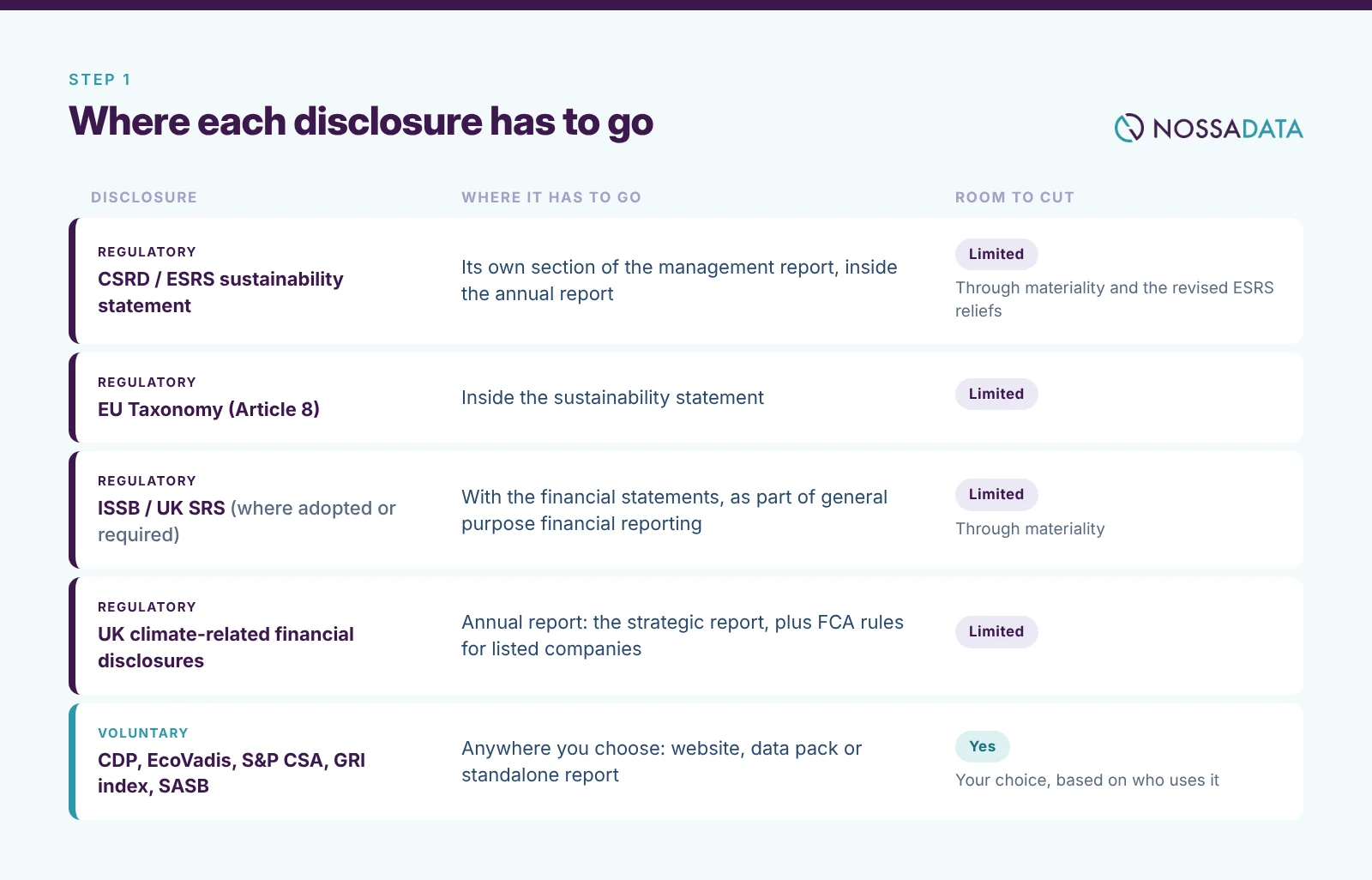
The split matters because regulation also dictates where the data has to sit:
View as text
| Disclosure | Where it has to go | Room to cut |
|---|---|---|
| CSRD / ESRS sustainability statement (regulatory) | Its own section of the management report, inside the annual report | Limited: through materiality and the revised ESRS reliefs |
| EU Taxonomy, Article 8 (regulatory) | Inside the sustainability statement | Limited |
| ISSB / UK SRS, where adopted or required (regulatory) | With the financial statements, as part of general purpose financial reporting | Limited: through materiality |
| UK climate-related financial disclosures (regulatory) | Annual report: the strategic report, plus FCA rules for listed companies | Limited |
| CDP, EcoVadis, S&P CSA, GRI index, SASB (voluntary) | Anywhere you choose: website, data pack or standalone report | Yes: your choice, based on who uses it |
Regulatory content has to stay in the annual report. Much of the voluntary content can come out of it and move to your website, an ESG data pack or a standalone sustainability report, so nothing is lost.
Step 2: Regulation is not optional, so start with compliance
If a disclosure is legally required, leadership does not get to choose whether to publish it. What you can do is explain clearly what is required, and reduce regulatory content only in the ways the rules allow.
The rules have become lighter, which does give you some room to shorten the report:
- Scope: after the Omnibus, the CSRD applies to companies with more than 1,000 employees and more than €450m turnover. Check first whether you are still in scope.
- Fewer datapoints: the revised ESRS, adopted in July 2026, cut mandatory datapoints by more than 60% and total datapoints by more than 70%. They apply from financial years starting 1 January 2027, and companies can adopt them early for 2026.
- No voluntary datapoints: the revised ESRS drop voluntary datapoints altogether, so any you were still reporting can come out of the sustainability statement.
- Materiality: a tighter double materiality assessment, based on how your business actually operates, reduces the number of topics you have to report on. Many companies add topics every year and never take any off, so review the list properly.
- Targeted reliefs: the revised ESRS allow certain information to be left out, such as information that would seriously prejudice your commercial position, subject to conditions.
What you should not do is drop required content and hope no one notices. Missing disclosures can be raised by auditors and assurance providers, regulators and investors. Agree the regulatory baseline with finance, legal and your assurance provider before discussing anything else.
Step 3: For voluntary disclosure, decide which stakeholders you care about
Every voluntary disclosure should have a reader. If you can't say who a page is for, it's a good candidate to cut. If you can, ask how much that reader matters to the business.
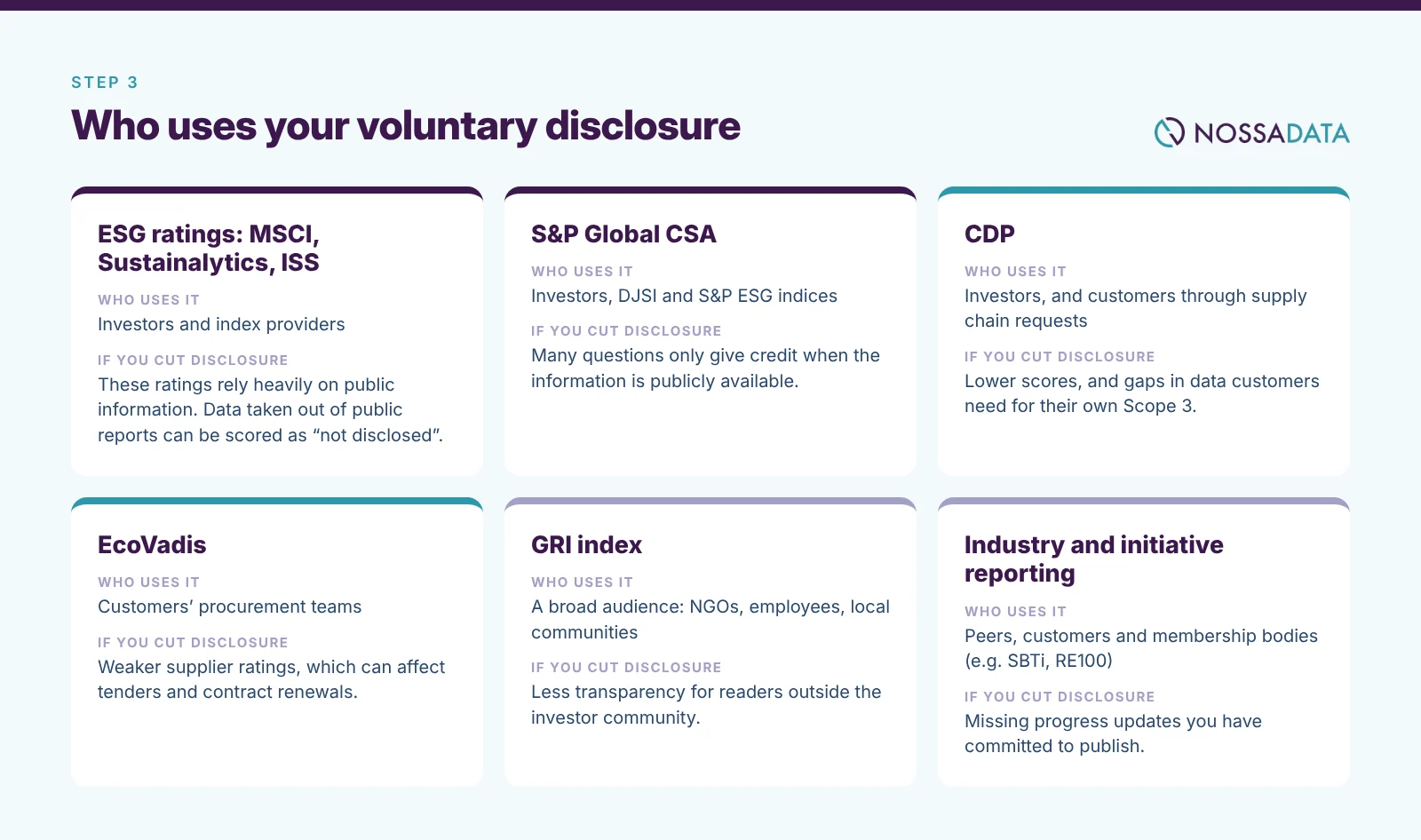
These are the main audiences, what they use your data for, and what happens if it disappears:
View as text
| Stakeholder | Who uses it | If you cut disclosure |
|---|---|---|
| ESG ratings: MSCI, Sustainalytics, ISS | Investors and index providers | These ratings rely heavily on public information. Data taken out of public reports can be scored as "not disclosed". |
| S&P Global CSA | Investors, DJSI and S&P ESG indices | Many questions only give credit when the information is publicly available. |
| CDP | Investors, and customers through supply chain requests | Lower scores, and gaps in data customers need for their own Scope 3. |
| EcoVadis | Customers' procurement teams | Weaker supplier ratings, which can affect tenders and contract renewals. |
| GRI index | A broad audience: NGOs, employees, local communities | Less transparency for readers outside the investor community. |
| Industry and initiative reporting | Peers, customers and membership bodies (e.g. SBTi, RE100) | Missing progress updates you have committed to publish. |
Investors still use company reports directly. In ERM's 2026 Rate the Raters survey, 40% of investors named corporate sustainability reports among their most useful information sources, ahead of third-party ESG data at 33%.
Not every audience matters equally to every company. A B2B supplier may depend on EcoVadis and CDP supply chain scores to win contracts and care little about index inclusion. A large-cap listed company may care most about MSCI, Sustainalytics and the S&P CSA. Rank your audiences by commercial impact, then protect the disclosures they rely on.
Step 4: Match your disclosure to your company's ambition
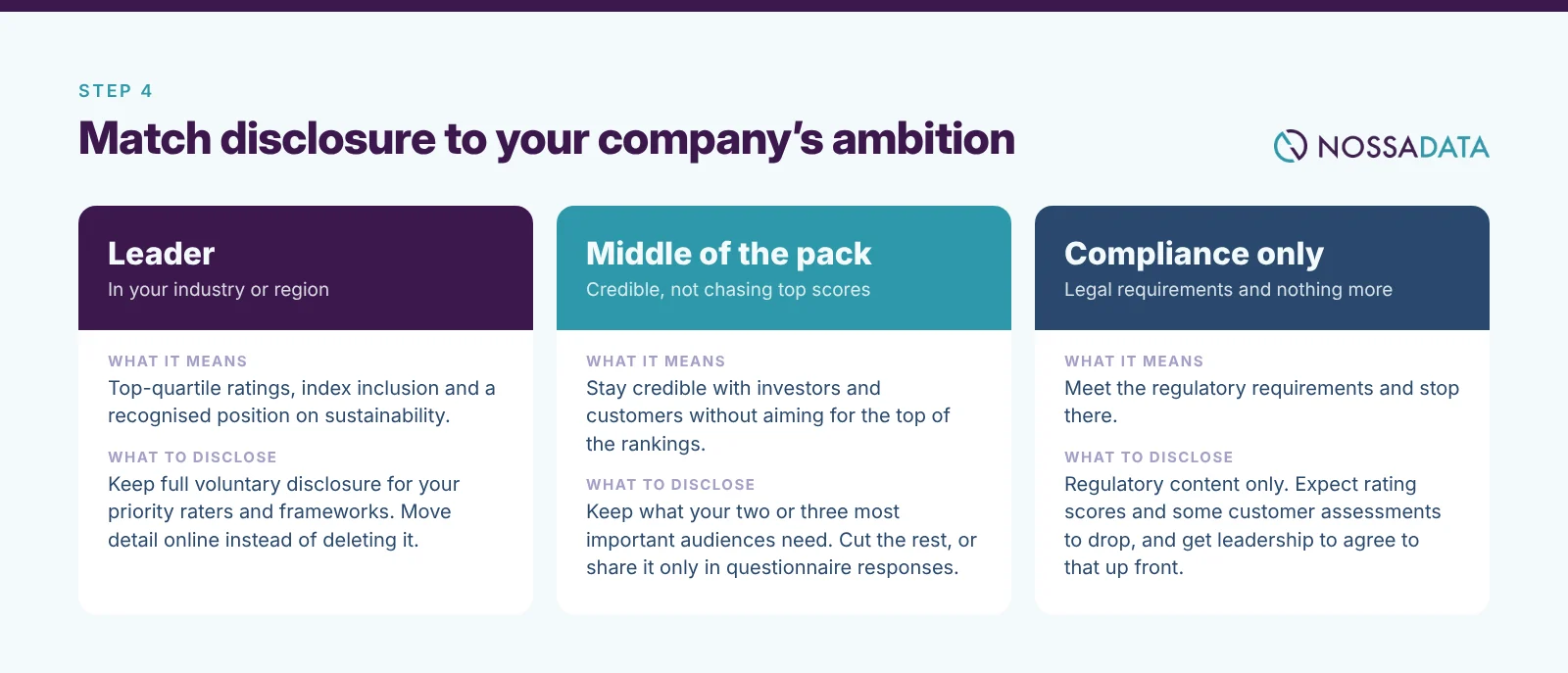
How much voluntary disclosure you need depends on where the company wants to sit compared with its peers. Ask leadership to pick one of three positions and use that to decide the scope.
View as text
| Ambition | What it means | What to disclose |
|---|---|---|
| Leader in your industry or region | Top-quartile ratings, index inclusion and a recognised position on sustainability. | Keep full voluntary disclosure for your priority raters and frameworks. Move detail online instead of deleting it. |
| Middle of the pack | Stay credible with investors and customers without aiming for the top of the rankings. | Keep what your two or three most important audiences need. Cut the rest, or share it only in questionnaire responses. |
| Compliance only | Meet the regulatory requirements and stop there. | Regulatory content only. Expect rating scores and some customer assessments to drop, and get leadership to agree to that up front. |
Asking leadership to choose gives you a clear answer to work from, instead of a general request to make the report shorter. If the board wants to lead its sector, cutting the data that ratings and customers use will work against that. If it is happy with compliance only, make sure the likely effect on ratings is understood and signed off now, so it doesn't come as a surprise next year.
Putting it together: keep, cut or move
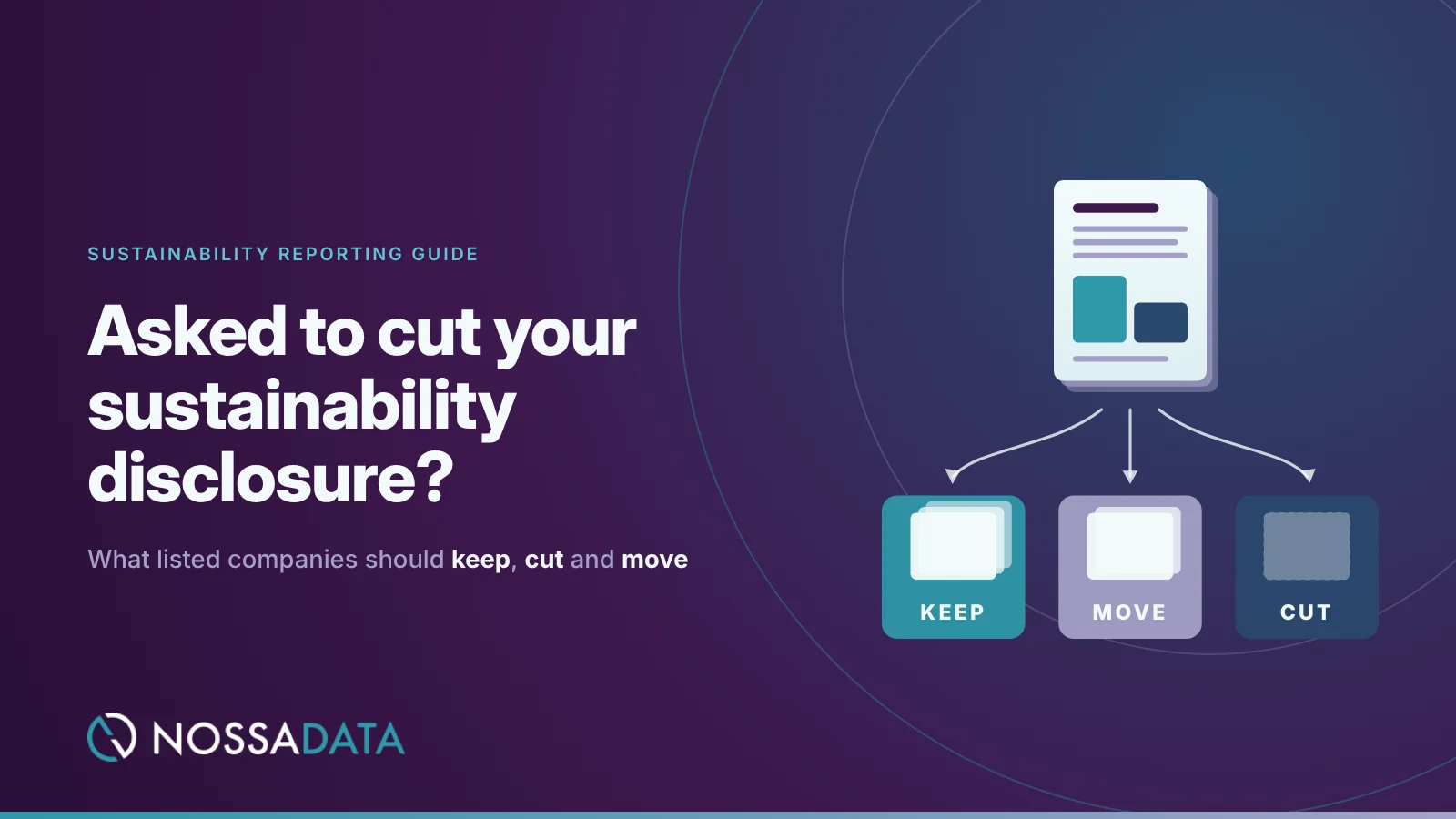
After working through the four steps, sort each piece of content into one of three groups:
- Keep in the annual report: everything required by regulation, plus the headline metrics and narrative your priority stakeholders expect to find there.
- Move: voluntary detail that a priority audience still relies on. Put it in a website hub, an ESG data pack or a standalone report. Content that changes little each year, such as policies and methodology notes, belongs here too.
- Cut: content with no regulatory basis and no priority audience, repeated text, case studies with no link to strategy, and datapoints no rater or customer uses.
Taking it back to the C-Suite / Decision Maker
- Show the regulatory baseline you have agreed with legal and your assurance provider.
- Show the pages you can remove or move, and the page count that results.
- List the stakeholders you are protecting and what each one is worth to the business, such as contracts that depend on EcoVadis, or index inclusion that depends on the S&P CSA.
- Ask leadership to confirm the ambition level, and record the expected effect on ratings for anything else that is cut.
You end up with a shorter report, and leadership knows exactly what was cut and what it might cost.
Frequently asked questions
Can we remove sustainability data from our annual report?
You can remove or move voluntary content. Regulatory content under the CSRD, ISSB-based standards or UK climate rules has to stay, although materiality and the revised ESRS can reduce how much of it there is.
Do we still need to report under the CSRD after the Omnibus?
Only if you meet the new thresholds: more than 1,000 employees and more than €450m net turnover. Companies below them can use the voluntary SME standard (VSME) to answer requests for data from larger customers.
Will cutting sustainability disclosure lower our ESG ratings?
It can. MSCI, Sustainalytics, ISS and many S&P CSA questions rely on public information, so data removed from public reports may be scored as not disclosed.
What is the safest way to shorten the sustainability section?
Move rather than delete. Keep regulatory content in the annual report, move voluntary detail into a website hub or data pack, and cut only content with no regulatory basis and no priority audience.
Who should decide what gets cut?
Leadership should decide the ambition level. The sustainability team should then turn that decision into a keep, cut and move plan, agreed with finance, legal and the assurance provider.
Sources
- European Commission adopts revised ESRS and voluntary VSME standard, Debevoise & Plimpton
- ESG downsizing brings cheers – and fears, ACCA AB Magazine
- Publication of sustainability reports dropped by half in 2025, Trellis
- ERM Rate the Raters 2026 investor survey, via OneStop ESG
- What Europe's sustainability reporting reset means, BCG
- As sustainability reporting rules are diluted, the real test for CFOs begins, IMD