Nature risk is now treated as financial risk. In October 2026 the Taskforce on Nature-related Financial Disclosures (TNFD) published the final version of its recommendations and LEAP assessment guidance v2.0. We also expect the ISSB to publish its own nature proposals, built on the TNFD framework, later in 2026.
This guide explains what the TNFD is, where it came from and how it differs from the TCFD. It also explains what changed in 2026, which companies already disclose, how the TNFD compares with the ISSB's nature work, and what an issuer needs to do to report.
Key takeaways
- The TNFD sets out 14 recommended disclosures across four pillars: governance, strategy, risk and impact management, and metrics and targets.
- It keeps all 11 TCFD disclosures and adds three for nature, so climate and nature can be reported together.
- The October 2026 update adds environmental crime guidance and final metrics for invasive alien species and the state of nature. The TNFD says this completes its metrics architecture.
- By September 2026, more than 1,000 organisations in 56 countries or areas had published some TNFD-aligned disclosure.
- The ISSB plans to put its nature requirements in an IFRS Practice Statement, with an exposure draft targeted for October 2026. It draws on the work done under the TNFD, in the same way the TCFD was ultimately replaced by the IFRS S2 climate standard.
What is the TNFD?
The Taskforce on Nature-related Financial Disclosures (TNFD) is a global, market-led, science-based and government-supported initiative. It was launched in 2021 to give companies and financial institutions a risk management and disclosure framework for nature-related issues. Its output is a set of recommendations, metrics and guidance. Any organisation can use them, and they are designed to be reported alongside financial statements.
The framework is voluntary. Organisations that say they align with it are expected to apply its six general requirements and report against the 14 recommended disclosures. They should also explain where they have not yet done so.
Why nature, and why now
The TNFD's case is that cash flows depend on ecosystem services such as fresh water, pollination, soil health and flood protection. The 2026 Recommendations note that seven of nine planetary boundaries have been breached. They also cite water stress hitting supply chains from agribusiness to semiconductors, and permit refusals and lawsuits against companies that mismanaged their impacts.
Policy is developing in the same direction. Target 15 of the Kunming-Montreal Global Biodiversity Framework (GBF), agreed by nearly 200 countries in December 2022, asks governments to require large and transnational companies and financial institutions to disclose their nature-related risks, dependencies and impacts.
Key TNFD concepts
| Concept | What it means |
|---|---|
| Dependencies | The ecosystem services a business relies on, such as water supply or pollination |
| Impacts | Changes the business causes to the state of nature, good or bad |
| Risks | Physical (acute and chronic), transition (policy, market, technology, reputation, liability) and systemic risks to the organisation |
| Opportunities | Business performance and sustainability performance opportunities, such as new markets or resource efficiency |
| Four realms | Land, ocean, freshwater and atmosphere |
| Five drivers of nature change | Land/freshwater/ocean-use change, climate change, pollution, resource use and invasive alien species |
| Priority locations | Sites that are ecologically sensitive or material to the business; disclosed under Strategy D |
| LEAP | The TNFD's optional assessment approach: Locate, Evaluate, Assess, Prepare |
Who the TNFD is for
The framework is written for organisations of all sizes and sectors: corporates, banks, insurers, asset managers and owners. Regulators, stock exchanges, assurance firms and data providers also use it. The 2026 report notes that SMEs often sit closest to nature impacts and dependencies, and it points to tools built for them.
History of the TNFD (2020 to 2026)
The TNFD took six years to go from an informal working group to a finished framework, and the ISSB is now turning that framework into standard-setting. Its design copied the TCFD's playbook: a market-led taskforce, open consultation, then handover to a standard-setter.
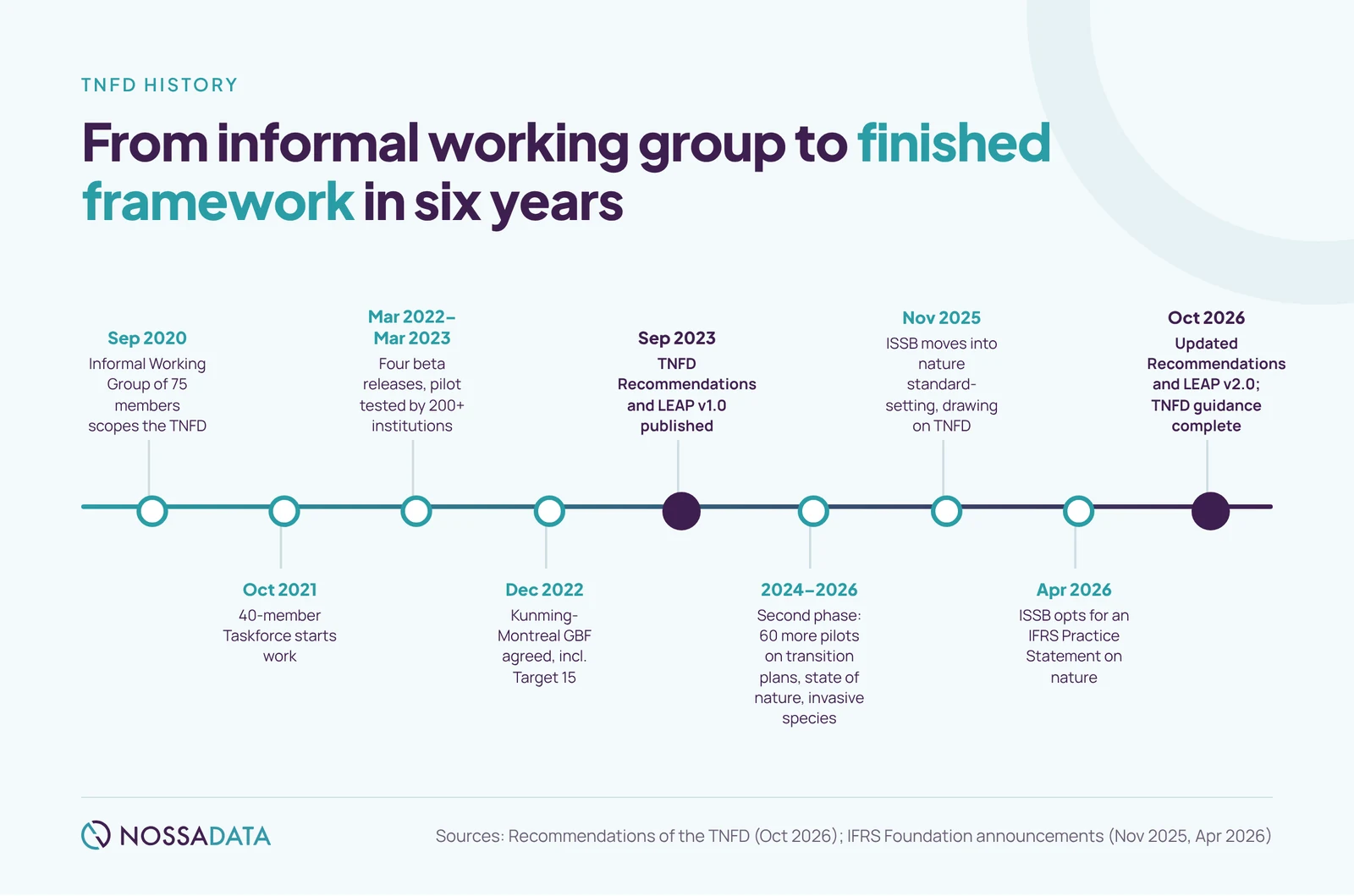
The 75-member Informal Working Group that scoped the TNFD included 49 financial institutions and corporates, 8 governments and regulators, and 18 think tanks. The founding partners were UNDP, UNEP FI, Global Canopy and WWF, and the G20 added the TNFD to its Sustainable Finance Roadmap in 2021. The Taskforce itself is co-chaired by David Craig and Razan al Mubarak (previously Elizabeth Mrema).
The TNFD is funded by the governments of Australia, France, Germany, Japan, the Netherlands, Norway, Switzerland and the UK, along with the GEF, UNDP, UNEP FI and philanthropic funders. It is supported by more than 1,900 TNFD Forum member organisations.
With its guidance complete, the TNFD now focuses on four things:
- Supporting the ISSB, GRI and ISO in building TNFD content into their standards
- Raising market awareness
- Training and capacity building
- Working with partners on nature data
TNFD vs TCFD: what's the difference?
The TNFD is built on the TCFD. It keeps the four pillars and all 11 TCFD recommended disclosures, so a company with TCFD or IFRS S2 reporting already has the structure in place. It then adds three nature-specific disclosures, which brings the total to 14.
The main difference is scope. Climate is one global system with one metric, CO2e. Nature is local, so the TNFD asks where an organisation interacts with nature and covers all five drivers of nature loss, not only climate.
| TCFD | TNFD | |
|---|---|---|
| Launched | 2015 (by the FSB); recommendations 2017 | 2021; recommendations Sep 2023, updated Oct 2026 |
| Topic | Climate-related risks and opportunities | Nature-related dependencies, impacts, risks and opportunities |
| Pillars | Governance, strategy, risk management, metrics and targets | Same four; "risk management" becomes "risk and impact management" |
| Recommended disclosures | 11 | 14 (all 11 TCFD plus 3 new) |
| Materiality | Financial (investor focus) | Financial baseline (ISSB) plus optional impact materiality (GRI) |
| Location | Not central | Central: priority locations must be identified (Strategy D) |
| Drivers covered | Climate change | Land/freshwater/ocean-use change, climate change, pollution, resource use, invasive alien species |
| Core unit of measure | GHG emissions (Scopes 1, 2, 3) | No single unit; a set of core global metrics on drivers, state of nature, risks and opportunities |
| Assessment guidance | Scenario analysis guidance | LEAP approach v2.0 plus scenario, sector, biome and transition plan guidance |
| Status today | Disbanded Oct 2023; absorbed into IFRS S2 | Guidance complete Oct 2026; feeding the ISSB nature Practice Statement |
The three disclosures the TNFD adds
The three new disclosures, highlighted below, cover Indigenous Peoples, local communities and affected stakeholders (Governance C) and priority locations (Strategy D). The third, Risk and Impact Management A(ii), splits the TCFD's single process disclosure into direct operations, A(i), and the upstream and downstream value chain, A(ii).
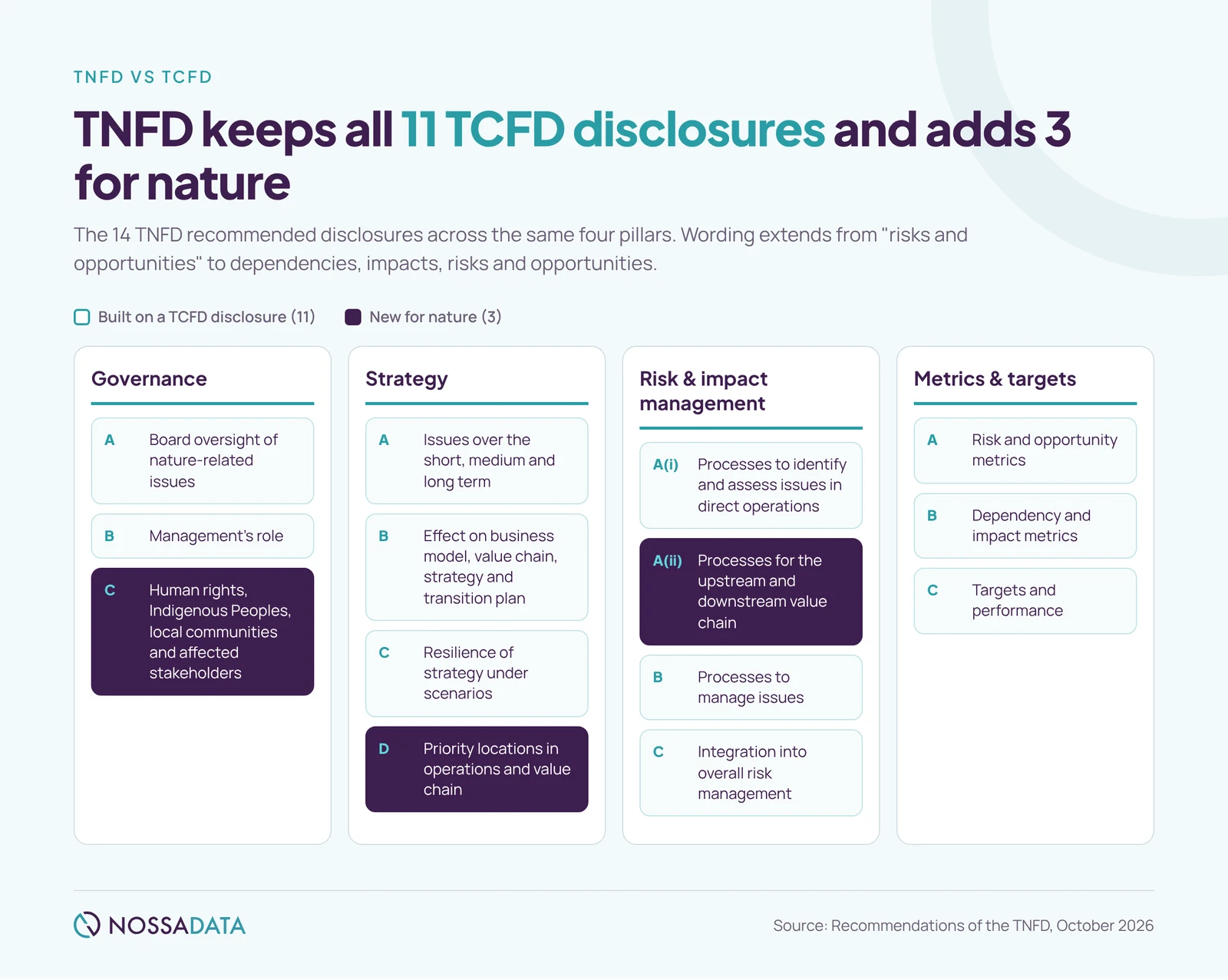
The TNFD also extends the wording of each TCFD disclosure from "risks and opportunities" to "dependencies, impacts, risks and opportunities". It adds a separate metrics disclosure (Metrics and Targets B) for dependencies and impacts.
In practice: report climate and nature together. The TNFD's general requirement 4 asks organisations to integrate the two and flag trade-offs and synergies between climate and nature targets.
What changed in 2026: the October 2026 TNFD update
In October 2026 the TNFD published updated Recommendations and LEAP guidance v2.0. The 14 recommended disclosures and four pillars are unchanged. So are the six general requirements. What changed is the guidance and the metrics behind them.
Changes to the Recommendations
- Environmental crime guidance is added to 12 recommended disclosures: Governance A and B; Strategy A, B and D; Risk and Impact Management A(i), A(ii), B and C; Metrics and Targets A, B and C.
- Invasive alien species (IAS) metrics are final. Core metric C4.0 covers the proportion of activities with high IAS impact potential run under measures to prevent introduction and spread. Additional metric A4.0 is also final. Both were developed with IUCN and Fauna & Flora.
- State of nature metrics are final. C5.0 covers ecosystem extent, C5.1 ecosystem condition and C5.2 species extinction risk, alongside additional metric A5.0. They were developed with the Nature Positive Initiative and UNEP-WCMC. They replace the placeholders left in 2023.
- The metrics architecture is complete. The TNFD says these additions finish the set of core global metrics.
- Glossary updates reflect newer standards and initiatives.
What's new in LEAP v2.0
LEAP v2.0 adds guidance on:
- State of nature measurement across land, freshwater and ocean
- Invasive alien species measurement
- Nature-related risk assessment
- Identifying and assessing opportunities
- Environmental crime throughout an assessment
- Integrating nature into transition plans
- Landscape and seascape approaches
- Financial institution portfolio assessments
- Interoperability with SBTN science-based targets for nature
It also adds TNFD nature data principles, aligned with the ISSA 5000 assurance standard, and updated use cases. The guidance notes that LEAP is now referenced by the ISSB, GRI 101: Biodiversity 2024, ISO 17298:2025 and the ESRS.
The TNFD core global disclosure metrics (2026)
| No. | Metric | Driver or category |
|---|---|---|
| C1.0 | Total spatial footprint (km2) | Land/freshwater/ocean-use change |
| C1.1 | Extent of land/freshwater/ocean-use change (km2) | Land/freshwater/ocean-use change |
| C2.0 | Pollutants released to soil, by type (tonnes) | Pollution |
| C2.1 | Wastewater discharged (m3) | Pollution |
| C2.2 | Hazardous and non-hazardous waste generated and disposed (tonnes) | Pollution |
| C2.3 | Plastic footprint | Pollution |
| C2.4 | Non-GHG air pollutants, by type (tonnes) | Pollution |
| C3.0 | Water withdrawal and consumption (m3), from areas of water scarcity, by source | Resource use |
| C3.1 | Quantity of high-impact natural commodities sourced | Resource use |
| C4.0 | Proportion of high IAS-risk activities under preventive measures (new, final 2026) | Invasive alien species |
| C5.0 to C5.2 | Ecosystem extent, ecosystem condition, species extinction risk (new, final 2026) | State of nature |
| C7.0 to C7.1 | Value of assets, liabilities, revenue and expenses vulnerable to transition and physical risks | Risk |
| C7.2 | Fines, penalties and litigation from negative nature impacts | Risk |
| C7.3 to C7.4 | Capex and financing for nature opportunities; revenue from nature-positive products | Opportunity |
The TNFD has also published sector guidance with sector-specific metrics. It covers 18 sectors, including financial institutions, food and agriculture, oil and gas, metals and mining, and chemicals.
Why it matters: with its guidance complete, the TNFD has stopped developing new technical guidance. The October 2026 text is the reference version the ISSB is drawing on.
Who discloses under the TNFD? Adopters in 2026
TNFD reporting is now mainstream among large listed companies and financial institutions. By September 2026, more than 1,000 organisations in 56 countries or areas had published some TNFD-aligned disclosure, according to the TNFD's 2026 Status Report cited in the Recommendations.
Separately, the TNFD Adopters list tracks organisations that have publicly committed to report by a set financial year. When the ISSB decision was announced in November 2025, 733 adopters had signed up. Together they represented USD 9.4 trillion in listed market capitalisation and, among 179 financial institutions, USD 22.4 trillion in assets under management.
Our analysis of the latest adopters list (838 entries) is summarised below.
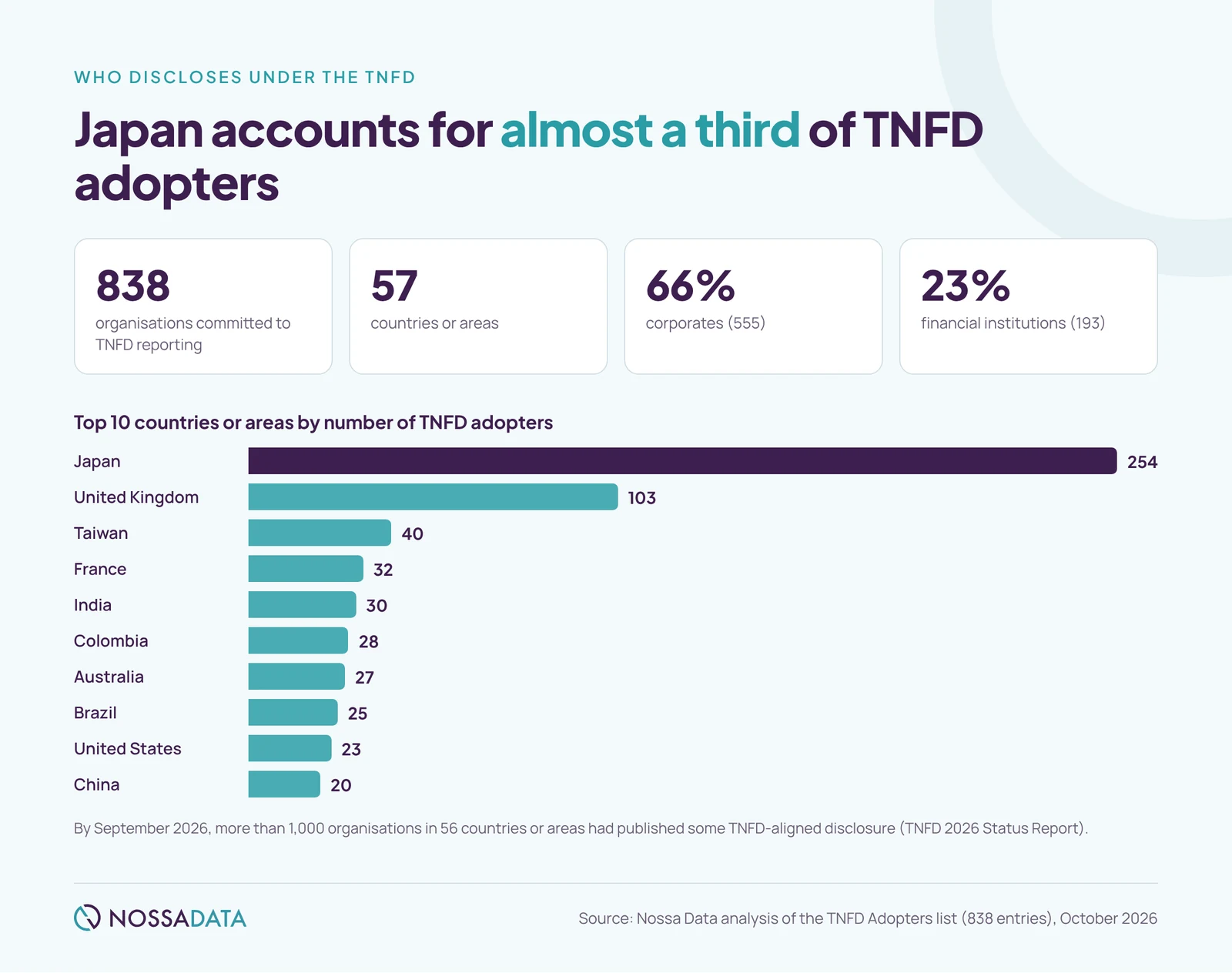
Of these adopters, 499 are publicly listed. 388 committed to report for FY2024 or earlier, 339 for FY2025, 97 for FY2026 and 14 for FY2027. The most represented sectors are asset management and custody (80), commercial banks (63), professional and commercial services (46), real estate (43) and electric utilities (33).
Examples of TNFD adopters
| Sector | Examples |
|---|---|
| Banks | Bank of America, Mizuho, MUFG, Sumitomo Mitsui Financial Group, Standard Chartered, UBS, Rabobank, Commerzbank |
| Investors and insurers | Norges Bank Investment Management, AXA, Legal & General, Schroders, Tokio Marine, Dai-ichi Life, Storebrand |
| Mining and materials | Anglo American, Vale, Holcim, Tata Steel, Zijin Mining |
| Consumer and retail | Kering, Carrefour, Tesco, Sainsbury's, Burberry, Kirin, Ajinomoto, Natura |
| Energy and utilities | EDF, Enel, Iberdrola, Ørsted, Tata Power |
| Pharma and tech | AstraZeneca, GSK, Sony, Kao, London Stock Exchange Group |
Why Japan leads: strong backing from the Japanese government and exchanges, plus early TCFD adoption, made the TNFD a natural next step for Japanese issuers. The same TCFD-to-TNFD route explains the UK's position.
TNFD vs the ISSB / IFRS nature standard
There is no stand-alone "IFRS S3" for nature yet. In April 2026 the ISSB agreed to propose its nature requirements as an IFRS Practice Statement that supplements IFRS S1 and S2. It aims to publish an exposure draft in October 2026, with a 120-day comment period. As of 15 October 2026 the project page still lists the exposure draft as the next milestone.
The ISSB's position is that material nature information is already required. In the words of ISSB Chair Emmanuel Faber: "Providing material nature-related disclosures is not optional; IFRS S1 already requires that." Applying the Practice Statement is voluntary for IFRS compliance. But a company that claims to apply it must meet all of its requirements, and jurisdictions can make it mandatory.
| TNFD (Oct 2026) | ISSB nature Practice Statement (proposed) | |
|---|---|---|
| Status | Final, voluntary market framework | Exposure draft targeted Oct 2026; final text expected 2027 |
| Legal form | Recommendations and guidance | IFRS Practice Statement supplementing IFRS S1 and S2 |
| Materiality | Financial baseline plus optional impact materiality | Financial materiality only (investor focus) |
| Scope | Dependencies, impacts, risks and opportunities | Nature-related risks and opportunities (dependencies and impacts as their source) |
| Structure | 14 disclosures, 4 pillars, 6 general requirements | Builds on the IFRS S1 and S2 four-pillar structure |
| Location | Priority locations disclosure (Strategy D) | Location-specific disclosure and guidance included |
| Cross-industry metrics | Core global metrics (C1.0 to C7.4) | None proposed for now; TNFD metrics usable as guidance |
| Industry metrics | TNFD sector guidance | Nature updates to SASB industry standards |
| Targets | Targets and performance (Metrics and Targets C) | No mandatory nature targets; guidance only |
| Assessment approach | LEAP (optional) | Companies can use LEAP, adapted for IFRS S1 consistency |
| Indigenous Peoples and communities | Governance C plus general requirement 6 | Guidance on related risks and opportunities |
Source for the proposed contents: KPMG summary of ISSB decisions. Last updated 15 October 2026. This comparison reflects the ISSB's board decisions before the exposure draft. Details may change when the exposure draft is published, and again when the final Practice Statement is issued.
What this means for issuers
- TNFD work carries over. The ISSB is drawing directly on TNFD recommendations, metrics and LEAP. In November 2025 the ISSB encouraged companies to keep using the TNFD framework to meet IFRS S1.
- Double materiality reporters still need the TNFD (or ESRS E4). The ISSB proposal covers financial materiality only. The TNFD's impact lens, aligned with GRI 101, remains the route for impact disclosure.
- Watch your jurisdiction. Many of the nearly 40 jurisdictions using ISSB Standards may decide whether to adopt the Practice Statement. The EU (through ESRS E4) and India already have nature-related reporting requirements that the TNFD describes as aligned with its recommendations.
How to disclose under the TNFD: an issuer's guide
A first TNFD report does not need to be complete. It does need to state its scope clearly. The TNFD expects organisations to start where they are, often building on TCFD or IFRS S2 reporting, and to extend coverage over time.
Step 1: Commit and set the scope
- Decide the first financial year you will report on. Optionally, register as a TNFD adopter.
- Choose your materiality approach: the ISSB financial baseline, plus impact materiality if you report under CSRD or GRI.
- Name a board-level owner and a cross-functional team covering sustainability, risk, finance, procurement and operations.
Step 2: Run a LEAP assessment
LEAP has a scoping stage and four phases: Locate your interface with nature, Evaluate dependencies and impacts, Assess risks and opportunities, and Prepare to respond and report. Each phase has four components and a clear output.
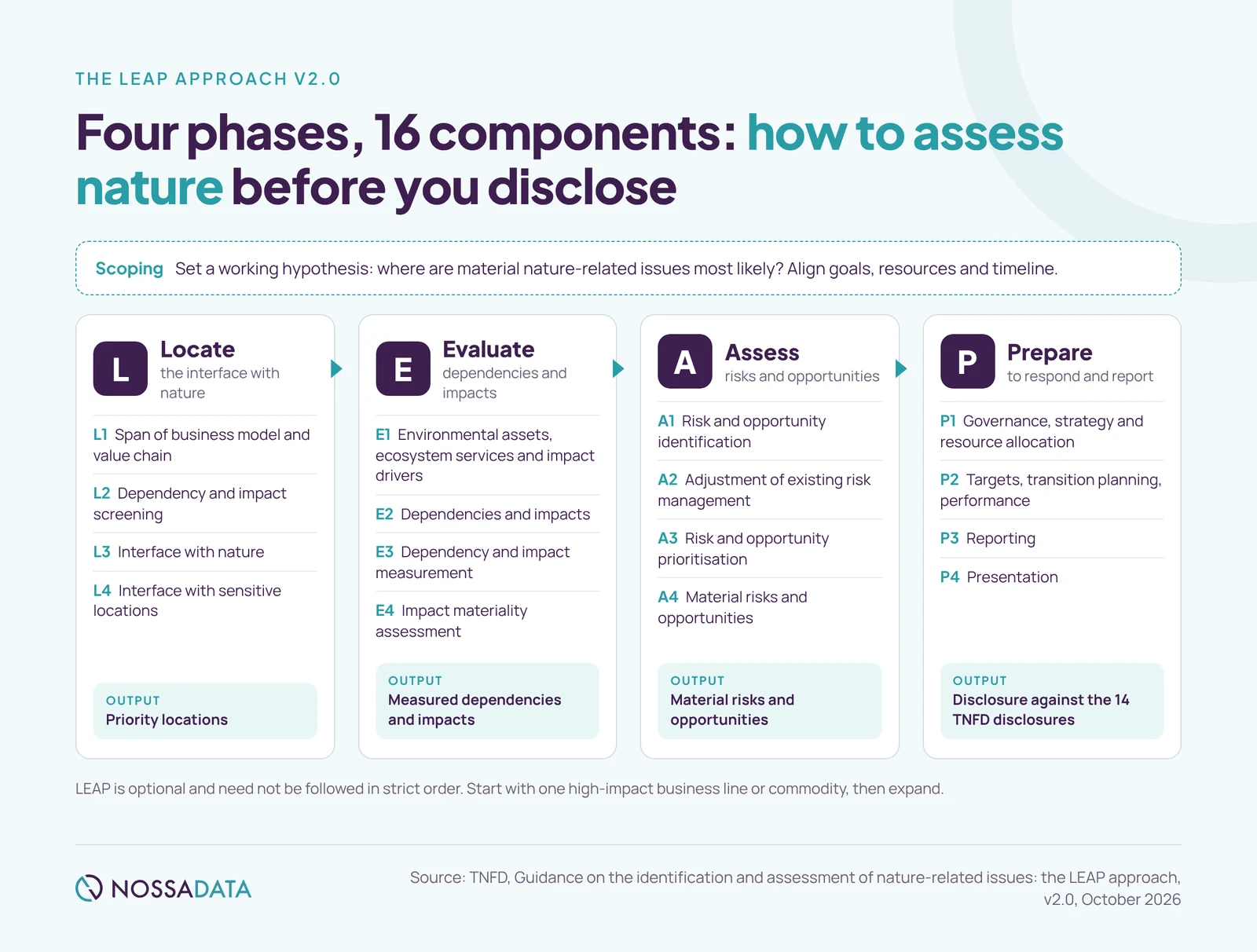
LEAP is optional and does not have to be run in order. Pilot users usually start with one high-impact business line or commodity, then expand. Screening tools named in the guidance include ENCORE, the Integrated Biodiversity Assessment Tool (IBAT) and SBTN's High Impact Commodity List.
Step 3: Meet the six general requirements
- Materiality: state the approach used
- Scope: say which operations and value chain stages were assessed and which were excluded, and why
- Location: consider where nature-related issues arise; do not aggregate sites with different ecological characteristics
- Integration: connect nature and climate disclosures, including trade-offs
- Time horizons: define short, medium and long term
- Engagement: describe how you engage Indigenous Peoples, Local Communities and affected stakeholders
Step 4: Report against the 14 recommended disclosures
Structure your report around the four pillars and 14 disclosures shown in the TNFD vs TCFD graphic above. State which disclosures you report against. Explain any you have not yet addressed and when you plan to.
Step 5: Report the core metrics on a "comply or explain" basis
Report the core global metrics and any core sector metrics that apply. If a metric is not reported, explain why: for example, it is not material, or the data is not yet available. Add additional metrics where they are material.
Step 6: Prepare for assurance and the ISSB
- Apply the TNFD data principles and keep an audit trail; assurance will increasingly follow ISSA 5000.
- Map your TNFD disclosures to IFRS S1 now, so a move to the ISSB Practice Statement is incremental.
- Reuse the work for CDP (forests, water, biodiversity), ESRS E4 and GRI 101.
Common pitfalls
- Treating nature as "climate plus": location is the key difference, and it is often missing.
- Disclosing no scope statement, so readers cannot interpret the numbers.
- Leaving out the upstream value chain, where most nature impacts sit for many sectors.
- No link to financial effects: the TNFD is a financial disclosure framework.
Need help with your first TNFD report? Book a demo to see how Nossa Data brings your nature, climate and ESG data together in one place.
TNFD FAQ
What does TNFD stand for?
The Taskforce on Nature-related Financial Disclosures, a global initiative launched in 2021 that publishes a nature-related risk management and disclosure framework.
Is TNFD reporting mandatory?
No. The TNFD is a voluntary framework. However, the EU and India have nature-related reporting requirements aligned with it, and the ISSB is consulting on nature requirements built on it.
How many TNFD recommended disclosures are there?
Fourteen, across governance, strategy, risk and impact management, and metrics and targets. Eleven come from the TCFD and three are new.
What changed in the October 2026 TNFD update?
New guidance on environmental crime; final metrics for invasive alien species (C4.0) and the state of nature (C5.0 to C5.2); and LEAP guidance v2.0. The 14 disclosures did not change.
How many companies report under the TNFD?
More than 1,000 organisations in 56 countries or areas had published TNFD-aligned disclosures by September 2026.
Will the ISSB replace the TNFD?
The ISSB is drawing on the TNFD for an IFRS Practice Statement on nature, with an exposure draft targeted for October 2026. The TNFD has completed its guidance and will support the ISSB, GRI and ISO.
Do I have to use the LEAP approach?
No. LEAP is optional. An organisation can use an equivalent due diligence process and use LEAP as a checklist.
Sources
- Recommendations of the TNFD, October 2026
- Guidance on the identification and assessment of nature-related issues: the LEAP approach v2.0, October 2026
- TNFD Adopters list (Nossa Data analysis of 838 entries, October 2026)
- TNFD welcomes ISSB decision on nature-related standard setting, November 2025
- IFRS: ISSB welcomes TNFD's support, November 2025
- IFRS: ISSB agrees on the proposed way forward for nature-related disclosures, April 2026
- IFRS project page: Nature-related Disclosures
- KPMG: Reporting on nature
- ESG Today: ISSB decides to develop non-mandatory nature-related reporting requirements