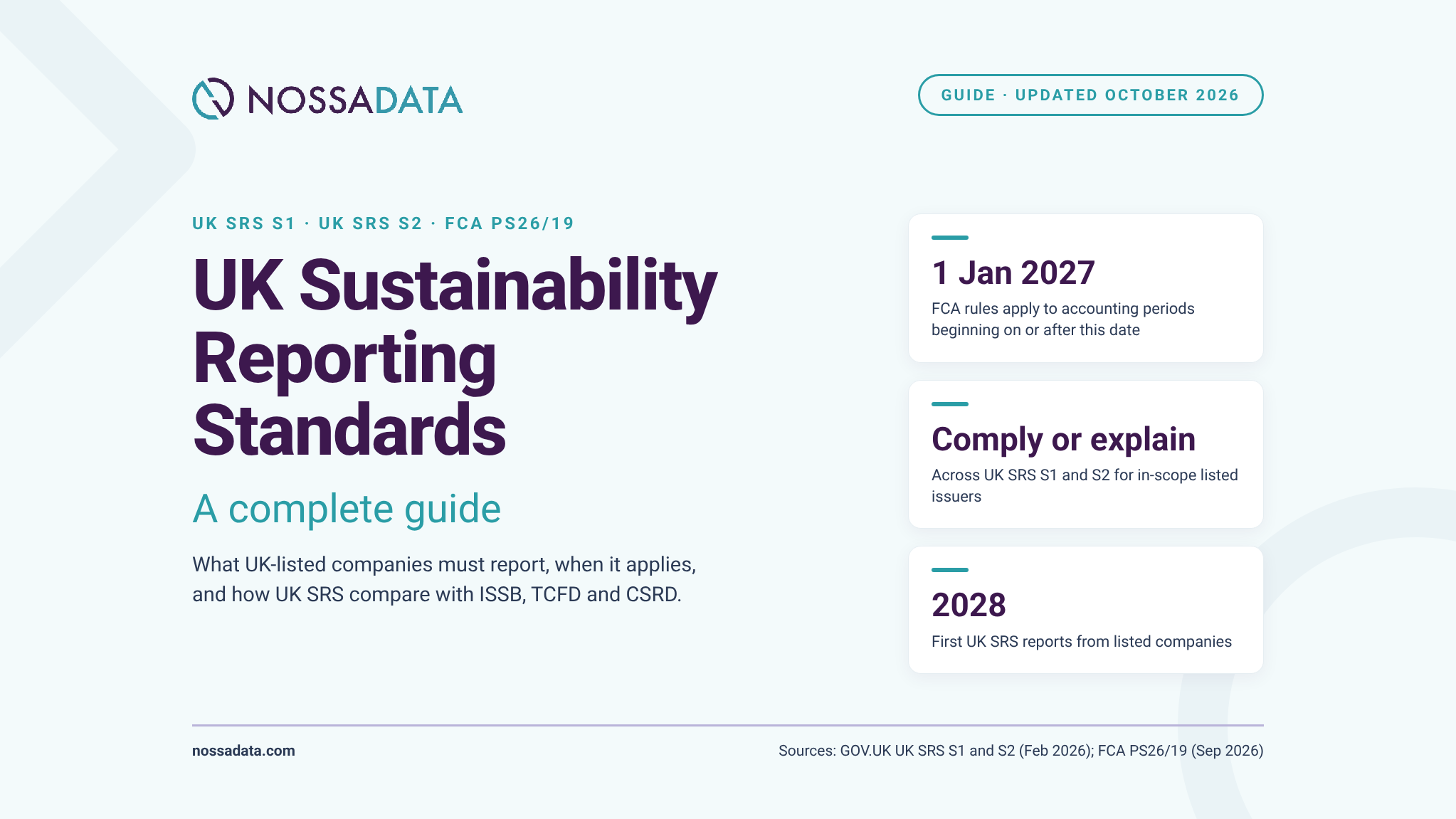

In June 2023 the International Sustainability Standards Board (ISSB) issued its first two standards: IFRS S1 and IFRS S2. Three years on, they have moved from consultation papers to annual reports.
Australia's first mandatory climate statements under AASB S2 came out in August 2026, covering the year to 30 June. Türkiye has required reporting under its TSRS standards since 2024. The UK government published UK SRS S1 and S2 on 25 February 2026.
We read nine of those early reports, from BHP, Commonwealth Bank, BlueScope, Origin Energy, Telstra, Wesfarmers, Transurban, Zip Co and İşbank, alongside the standards themselves. This article sets out what the standards ask for, where companies coming from TCFD tend to fall short, and how the first reporters have handled the hardest requirements.
What is IFRS S1?
IFRS S1 General Requirements for Disclosure of Sustainability-related Financial Information is the framework that every other ISSB standard sits within. It asks a company to report the sustainability-related risks and opportunities that could reasonably be expected to affect its cash flows, access to finance or cost of capital, over the short, medium or long term.
The test is financial materiality. Information is material if leaving it out, misstating it or obscuring it could reasonably be expected to influence the decisions of investors and lenders. Impact on society or the environment matters only insofar as it feeds back into the company's prospects.
What IFRS S1 requires
- Disclosures structured around governance, strategy, risk management, and metrics and targets, the same four pillars TCFD used.
- The same reporting entity and period as the financial statements, published at the same time.
- Connected information, so that sustainability disclosures and the financial statements tell one consistent story and use the same assumptions where possible.
- Reference to the SASB Standards when identifying risks, opportunities and metrics beyond climate.
- Disclosure of significant judgements and sources of measurement uncertainty.
- An explicit and unreserved statement of compliance. A company that meets only part of the standard cannot claim compliance, qualified or otherwise.
Example: explaining materiality judgements
Zip Co is a useful case because it is a fintech, not a heavy emitter, and still has to explain why its climate risks are or are not material. Its FY26 report states: "CRROs are considered material where they are qualitatively and quantitatively assessed as having the potential to significantly impact the Group’s operations, financial performance, and strategic objectives." (Zip Co Annual Report 2026, PDF page 43)
It is also open about where judgement was needed: "management judgement was exercised in a number of areas, including the identification and assessment of CRROs and the determination of material information for disclosure." (PDF page 42)
That second sentence is short, but it does what IFRS S1 asks. It tells investors and assurers where the estimates sit before they go looking.
What is IFRS S2?
IFRS S2 Climate-related Disclosures applies the IFRS S1 framework to climate. It covers physical risks, both acute events and chronic shifts, as well as transition risks from policy, technology and markets, and the opportunities that come with them.
For most companies, the hard parts are not the governance or risk sections. They are the numbers: financial effects, scenario analysis and Scope 3.
What IFRS S2 requires
- A climate resilience assessment using scenario analysis, proportionate to the company's size and exposure.
- The current and anticipated effects of climate risks on financial position, performance and cash flows. These must be quantified unless the effect cannot be separately identified or the measurement uncertainty is too high to be useful.
- Information on any transition plan, including its key assumptions and dependencies.
- Absolute gross Scope 1, Scope 2 (location-based) and Scope 3 emissions in tonnes of CO2e, measured under the GHG Protocol Corporate Standard (2004).
- Cross-industry metrics: assets and activities exposed to physical and transition risk, climate opportunities, capital deployed, internal carbon prices and climate-linked pay.
- Industry-based metrics, drawing on the ISSB's Industry-based Guidance on Implementing IFRS S2.
- For each climate target: its basis, whether it has been validated by a third party, progress to date and any planned use of carbon credits.
The December 2025 amendments
In December 2025 the ISSB issued Amendments to Greenhouse Gas Emissions Disclosures. They apply to annual periods beginning on or after 1 January 2027, and companies can adopt them early. Three changes stand out:
- Banks, insurers and asset managers can limit Scope 3 Category 15 emissions to financed emissions, and can leave out derivatives (paragraphs 29A to 29C).
- Where a regulator or exchange requires a different GHG measurement method, in whole or in part, a company can use it (paragraph 29(a)(ii)).
- A company that reports Category 15 must show the total and the financed emissions subtotal separately (paragraph 29C).
Australia has already folded the same changes into its compiled AASB S2 (December 2025), on the same 1 January 2027 timetable.
The four pillars, with examples from real reports
Every quote below comes from a published FY2025 or FY2026 report prepared under AASB S2 or TSRS. Page numbers refer to the PDF, not the printed page.
1. Governance
IFRS S2 paragraph 6 asks who oversees climate risk, how that responsibility is written into terms of reference and mandates, how the board makes sure it has the right skills, and how climate feeds into strategy, major transactions and pay.
BHP covers the scope of oversight in one sentence: "The BHP Board is responsible for the governance and oversight of climate change issues, including strategic approach, risk management, investment decisions, public disclosures and executive remuneration." It also explains how directors keep their knowledge current, noting that "in FY2026 the Board received an externally supported session on climate governance". (BHP 2026 Annual Report, PDF page 87)
BlueScope ties oversight to a formal document: "BlueScope’s Board oversees the Company's strategy, risks and opportunities, including those related to climate change. Its responsibilities, as set out in the Board Charter, include..." (BlueScope Annual Report FY2026, PDF page 177)
The reference to the Board Charter matters. TCFD only asked companies to describe board oversight. IFRS S2 also wants to know where that responsibility is formally recorded.
2. Strategy
Strategy is where IFRS S2 asks the most. Companies need to cover risks and opportunities by time horizon, their effect on the business model and value chain, any transition plan, current and anticipated financial effects, and resilience under different climate scenarios.
BlueScope gives a good example of how to handle financial effects when the long-term picture is uncertain: "Anticipated financial effect: Short term - not material. Medium term - up to $60M per annum decrease in EBIT (increased expense). Long term - material but not quantifiable as there is a high degree of measurement uncertainty involved in estimating these effects..." (PDF page 184). The standard permits a qualitative answer in those circumstances, provided the company explains why, which is what BlueScope does.
Wesfarmers spells out what its lower-warming scenario actually assumes. Under that pathway, "the physical climate outcome reflects a range of 1.3 to 2.4°C, with a best estimate of approximately 1.8°C by 2100." (Wesfarmers 2026 Annual Report, PDF page 64)
Telstra tests its network against three physical scenarios: "We test the resilience of our network assets to the physical impacts of climate change under three physical risk scenarios (<2°C, 2–3°C, and >4°C by 2100...)". It then gives investors a direct conclusion: "We do not expect significant impacts to our overall plan due to climate-related spend in the medium term." (Telstra Annual Report 2026, PDF page 101)
Origin Energy is candid about the limits of its 1.5°C scenario: "Although the adopted 1.5°C scenario is useful for resilience testing, there is currently a wide divergence between the consensus on market conditions and the potential future market outcomes implied by this scenario." (Origin Energy FY26 Annual Report, PDF page 172). IFRS S2 requires companies to disclose significant areas of uncertainty in their resilience assessment. TCFD did not.
3. Risk management
Under IFRS S2 paragraph 25, companies describe how they identify, assess, prioritise and monitor climate risks and opportunities. They also need to state the inputs they use, whether scenario analysis informs the process, and whether anything has changed since last year.
Transurban explains both the method and its coverage. Its shadow carbon pricing "enables an assessment of potential indirect exposure to carbon-related transition risks. This includes the quantification of potential impacts across the Group’s Scope 1, Scope 2 (location-based), and selected Scope 3 emissions..." (Transurban Corporate Report 2026, PDF page 53)
Many TCFD-era reports describe a risk process in general terms. Few name the inputs or say anything about how opportunities are assessed, and both are now required.
4. Metrics and targets
This pillar covers cross-industry metrics, industry-based metrics, and every climate target, with its baseline, timeframe, progress and any reliance on carbon credits.
BHP is precise about what its targets cover: "We have a medium-term target to reduce operational GHG emissions by at least 30 per cent by FY2030 from a FY2020 baseline, and a long-term goal to achieve net zero operational GHG emissions by CY2050... Our medium-term target aims for a gross reduction in GHG emissions, while the long-term goal aims for a net reduction." (PDF page 54). Separating gross from net is a specific IFRS S2 requirement (paragraph 36).
Commonwealth Bank explains a timing gap in its financed emissions data: "Certain metrics, including financed emissions and sector‑level goals and targets, are reported on a lagged basis, typically 12 months, due to customer reporting cadences." (CBA 2026 Annual Report, PDF page 47). IFRS S2 allows value chain data from a different period, as long as the company says so.
Origin points readers to where it reports climate-linked pay: "In line with new reporting requirements for the proportion of executive remuneration that is linked to climate-related considerations, section 4.2.6 identifies the proportion of remuneration recognised for FY26 from both STI and LTI plans." (PDF page 66)
Transition reliefs and how each jurisdiction applies them
IFRS S1 and S2 took effect for annual periods beginning on or after 1 January 2024. That date only bites once a jurisdiction adopts the standards, and each one can adjust the baseline when it does.
The IFRS S2 first-year reliefs
Appendix C of IFRS S2 and Appendix E of IFRS S1 give first-time reporters four reliefs:
- No comparative information for periods before the date of initial application (S2, C3).
- A company that used a different GHG measurement method in the prior year can keep using it instead of the GHG Protocol (S2, C4(a)).
- No Scope 3 disclosure, including financed emissions, in the first year (S2, C4(b)).
- "Climate first": a company may report only on climate in its first year (S1, Appendix E).
How AASB S2, UK SRS and TSRS compare
The main differences sit in four places: whether the general requirements are mandatory, how long the climate-first and Scope 3 reliefs last, and whether industry-based metrics apply. Sources: AASB S2, UK SRS S1 and S2, and the IFRS Foundation jurisdictional profile for Türkiye.
| Topic | IFRS S1 / S2 | AASB S2 (Australia) | UK SRS S1 / S2 | TSRS (Türkiye) |
|---|---|---|---|---|
| General requirements | IFRS S1 mandatory alongside S2 | AASB S1 voluntary; Appendix D of AASB S2 carries the needed S1 content | UK SRS S1 applies with S2 | TSRS 1 adopts IFRS S1 without modification |
| Climate-first relief | First annual period only | Climate-only by design | Permitted without a time limit (UK SRS S1 E3) | Follows ISSB baseline |
| Industry-based metrics | Required to consider | Not required (AASB S2 comparison note, para (d)) | Retained | Follows ISSB baseline |
| Scope 3 relief | First annual period | First annual period | Not required to disclose (UK SRS S2 C4), subject to UK law and FCA rules | Extended to the first two annual periods |
| Reporting entity | Same as financial statements | Consolidated or parent, as permitted by Corporations Act s292A(2) | Same as financial statements | Same as financial statements |
| Effective date | 1 January 2024 (if adopted) | Phased: years beginning 1 Jan 2025, 1 Jul 2026, 1 Jul 2027 | Set by UK law and regulators | Periods beginning on or after 1 January 2024 for entities in scope |
UK SRS S2 states its Scope 3 relief without the "first annual reporting period" wording found in IFRS S2. How long it applies in practice will depend on UK law and FCA rules.
How the first reporters disclosed their reliefs
Transurban states plainly what it used and what it chose to publish anyway: "This is the Group’s first year of reporting under AASB S2, and in line with the transition relief available, comparative information is not disclosed. The Group has also applied the transition relief available to not disclose Scope 3 greenhouse gas (GHG) emissions. However, it has elected to voluntarily disclose certain Scope 3 and customer emissions information..." (PDF page 35)
Commonwealth Bank takes a similar approach: "AASB S2 transition reliefs have been applied for comparative disclosures for periods before 1 July 2025 and Scope 3 greenhouse gas emissions, including related comparatives." (PDF page 47)
BHP is more selective: "BHP has elected to exercise the transition relief available with respect to the provision of comparative information. In some instances, BHP has voluntarily disclosed comparative information." (PDF page 90)
In Türkiye, İşbank frames its report around the four pillars and the national standard: "This report includes disclosures on İşbank’s climate-related governance, strategy, risk management, metrics, and targets, conducted in compliance with the TSRS requirements published by the Public Oversight Authority (KGK)." (İşbank Integrated Annual Report 2025, PDF page 5)
All four make the reliefs easy to find and keep voluntary data clearly separate from the compliant disclosure. That is worth copying, because an investor or assurer should never have to guess which numbers are covered by the statement of compliance.
IFRS S2 vs TCFD: what changes
If you already report against TCFD, you have the structure. IFRS S2 keeps the four pillars and all 11 recommended disclosures. But the IFRS Foundation's own comparison of IFRS S2 with the TCFD recommendations (updated February 2026) shows how much detail has been added on top.
| Pillar | TCFD | What IFRS S2 adds |
|---|---|---|
| Governance | Board oversight and management's role | Where responsibilities are written down: terms of reference, mandates, role descriptions |
| Strategy | Risks and opportunities by time horizon; resilience including a 2°C or lower scenario | Industry-based disclosure topics; where risks concentrate in the value chain; transition plan detail; quantified current and anticipated financial effects; capacity to adapt; how and when scenario analysis was done. No scenario is prescribed. |
| Risk management | How risks are identified, assessed and managed | Input parameters; use of scenario analysis; changes since last year; the same processes for opportunities |
| Metrics and targets | Scope 1 and 2 regardless of materiality; Scope 3 "as appropriate" | Materiality applies; location-based Scope 2; Scope 3 with method and assumptions; financed emissions; industry-based metrics; target validation; carbon credit use; link to the latest international climate agreement |
In the reports we reviewed, three gaps came up again and again for former TCFD reporters: putting numbers on anticipated financial effects, measuring Scope 3, and industry-based metrics.
How to prepare for IFRS S1 and IFRS S2
Aim to run at least one full dry run before your first mandatory year. The steps below are in roughly the order the dependencies fall.
- Confirm what applies to you. Work out which version you report under (AASB S2, UK SRS, TSRS or IFRS directly), your first reporting period, and which reliefs you intend to use.
- Do a paragraph-level gap analysis. Map your existing TCFD, CDP or sustainability report against each IFRS S1 and S2 requirement. Mark each one as met, partly met, not met, phased in or not material.
- Assess materiality. Identify the climate risks and opportunities that could reasonably affect cash flows, access to finance or cost of capital, and write down the judgements you made.
- Formalise governance. Update board and committee charters, role descriptions and remuneration terms so that climate oversight is recorded, not just described.
- Run scenario analysis. Include at least one scenario consistent with the latest international climate agreement, and document your inputs, time horizons and uncertainties.
- Quantify financial effects with your finance team. Estimate the effects on the balance sheet, income statement and cash flows. Where you can't, explain why.
- Build the GHG inventory. Measure Scope 1, location-based Scope 2 and Scope 3 under the GHG Protocol. Start on Scope 3 now, even if you plan to use the first-year relief.
- Line up targets and the transition plan. Disclose baselines, gross and net targets, any third-party validation, progress and carbon credit use.
- Connect to the financial statements. Use the same assumptions in impairment testing, useful lives and provisions.
- Get ready for assurance. Put controls, evidence trails and a review process in place. In Australia, assurance is being phased in under ASSA 5010.
One practical suggestion: write the statement of compliance first. It forces a decision on every relief and exemption before anyone starts drafting the narrative.
Frequently asked questions
What is the difference between IFRS S1 and IFRS S2?
IFRS S1 sets out the general rules for reporting any sustainability-related financial information. IFRS S2 adds the specific requirements for climate. The ISSB designed them to be used together.
Is IFRS S2 mandatory?
Only where a jurisdiction has adopted it. In Australia, AASB S2 applies to in-scope entities in three groups, starting with financial years beginning on or after 1 January 2025 and ending with those beginning on or after 1 July 2027.
Do I have to report Scope 3 emissions?
Yes, if they are material, from your second year under IFRS S2. Paragraph C4(b) exempts Scope 3 in the first year only. Türkiye extended that relief to the first two years.
Is a TCFD report compliant with IFRS S2?
No. It covers the same four pillars, but IFRS S2 adds requirements on financial effects, scenario analysis, Scope 3, industry-based metrics and targets that TCFD does not.
Which climate scenarios does IFRS S2 require?
It does not prescribe any. Companies choose scenarios that suit their circumstances, then explain which ones they used and whether one of them is aligned with the latest international agreement on climate change.
What changed in the December 2025 amendments?
Companies can limit Scope 3 Category 15 to financed emissions and use a GHG method required by their regulator. The changes apply from 1 January 2027.
Conclusion
The first AASB S2 reports show what investors and assurers can now expect: financial effects with numbers attached, scenario choices that are explained rather than asserted, reliefs stated up front, and targets that separate gross reductions from offsets.
For most companies the quickest way to see how far they have to go is a requirement-by-requirement comparison of their current TCFD disclosure against IFRS S1 and S2.
Nossa Data runs gap analyses against IFRS S1, IFRS S2, AASB S2 and UK SRS, mapping every data point to what you already publish. Contact our team to book an assessment.
Sources
Standards and guidance
- IFRS S1 General Requirements for Disclosure of Sustainability-related Financial Information
- IFRS S2 Climate-related Disclosures
- Amendments to Greenhouse Gas Emissions Disclosures (December 2025)
- Comparison: IFRS S2 with the TCFD recommendations (February 2026)
- AASB S2 Climate-related Disclosures (September 2024) and compiled version (December 2025)
- UK SRS S1 and UK SRS S2 (February 2026)
- IFRS Foundation jurisdictional profile: Türkiye
Company reports