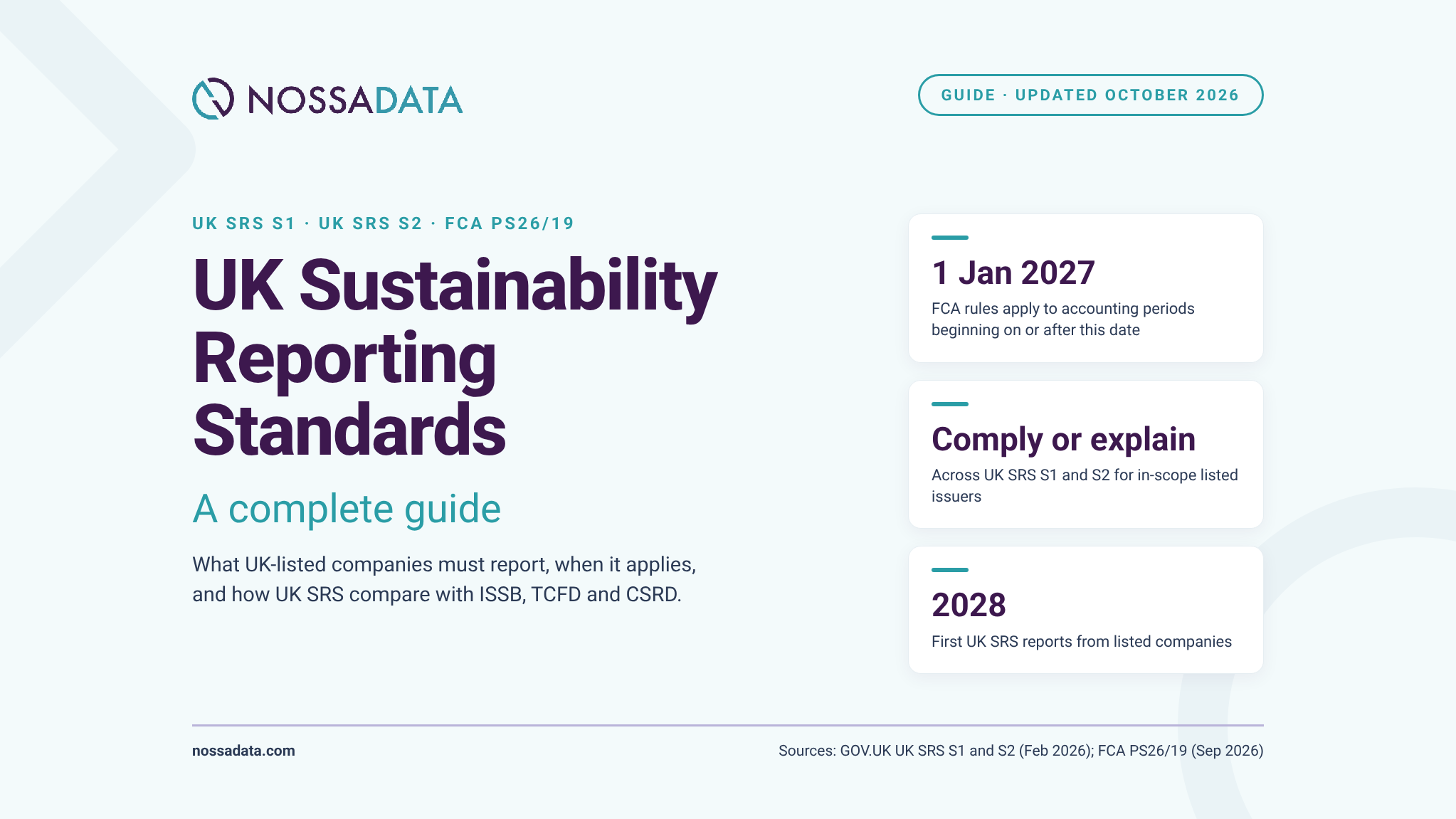
The UK Sustainability Reporting Standards (UK SRS) have been developed from the global ISSB for UK listed companies. They inform companies on how to report sustainability-related risks and opportunities that could affect their finances, with the goal of increasing accessibility to sustainability information for investors and increasing comparability between companies.
The standard is split into two facets. UK SRS S1 sets the general requirements, while UK SRS S2 covers climate disclosures. On 30th September 2026 the Financial Conduct Authority (FCA) published its final rules in their Policy Statement PS26/19. They concluded that listed issuers are to report against the UK SRS on a “comply or explain” basis for accounting periods beginning on or after 1st January 2027.
In light of recent updates, we have created this guide to explain what UK SRS require, who is affected and when, how the standards compare with TCFD, ISSB and CSRD, and what sustainability teams should do now.
Status as of 2 October 2026: UK sustainability reporting is changing quickly. This guide separates what is in force, what is final but not yet in force, and what is still only proposed.
What are the UK Sustainability Reporting Standards?
The UK SRS are disclosure standards setting out which sustainability topics a company should report on in regards to their effect on the following:
- Expected impact on revenues
- Access to finance or costs of capital
- Financial impacts over the short, medium, and long term
These considerations all encompass financial materiality. The UK SRS asks how sustainability affects the specific business operations of each individual company. They do not ask companies to report every impact they have on people and the planet; that broader approach is the one taken by the EU's CSRD.
The standards are built on IFRS S1 and IFRS S2, which the International Sustainability Standards Board (ISSB) published on 26 June 2023. The UK government assessed them for UK use, with advice from the independent UK Sustainability Disclosure Technical Advisory Committee (TAC), and endorsed them with a small number of amendments.
UK SRS are issued by the Secretary of State, not by the ISSB. The Financial Reporting Council (FRC) puts it simply: the content is "largely the same" as the ISSB standards, with some changes the government considered necessary for UK use (FRC FAQs, updated 26 February 2026).
Why has the UK introduced UK SRS?
The government wants investors to get comparable information they can use in strategic decision making. The ISSB itself was announced at COP26 in Glasgow in 2021, and the UK has supported its integration from the start.
The UK already had climate rules based on the Task Force on Climate-related Financial Disclosures (TCFD). However, the TCFD was disbanded in 2023, and its recommendations now are embedded in the ISSB standards. A UK version of the ISSB baseline keeps UK reporting aligned with other markets that are adopting the same standards.
UK SRS S1 and UK SRS S2
UK SRS S1 sets the ground rules for all UK SRS reporting. Disclosures cover the same entity as the financial statements and are published at the same time. It also covers judgements, comparatives and the statement of compliance. Beyond climate, it requires disclosure of all material sustainability-related risks and opportunities, such as water stress, supply chain labour practices or biodiversity.
UK SRS S2 covers climate: physical risks such as flooding, transition risks such as carbon pricing, and climate-related opportunities. It sets specific metrics, including Scope 1, 2 and 3 emissions, and requires a climate resilience assessment using scenario analysis.
Both standards use the four pillars familiar from TCFD: governance, strategy, risk management, and metrics and targets.
Who needs to comply with UK SRS?
In short, all UK listed companies are in scope to reporting in alignment with the UK SRS on a comply or explain basis as of January 2027. Non-UK entities can use the UK SRS voluntarily, but at current there is no law requiring them to do so.
The decision of who is in scope is made by two bodies. The FCA decides for UK-listed companies, while the UK government decides for other UK companies. The two stakeholders are coordinated by a Policy and Implementation Committee (FRC FAQs).

The UK SRS currently does not apply to private companies. The government's Modernising Corporate Reporting consultation (7 September to 30 November 2026) says it will consider how UK SRS should be reflected in the Companies Act. It proposes no thresholds or dates, so any private-company UK SRS thresholds you see elsewhere are speculation.
Do UK SRS apply to listed companies?
Yes. The FCA Board made the rules on 24 September 2026, and they come into force on 1 January 2027 (PS26/19, Appendix 1). They apply to the five listing categories already covered by the FCA's TCFD rules:
- Equity shares (commercial companies) – UKLR 6
- Equity shares (international commercial companies secondary listing) – UKLR 14
- Depositary receipts – UKLR 15
- Non-equity shares and non-voting equity shares – UKLR 16
- Equity shares (transition) – UKLR 22
Listed investment funds, shell companies and debt issuers are out of scope. There is no size threshold. The FCA rejected one, noting that climate exposure depends on business model and sector, not size.
What does "comply or explain" mean?
A listed company either reports in line with UK SRS or explains why it has not. This applies to climate too. The FCA's consultation, CP26/5 (30 January to 20 March 2026), had proposed making UK SRS S2 mandatory, but the FCA changed course after concerns about the burden on smaller issuers.
An explanation must set out which requirements have not been met, the reasons, and any steps the company plans to take. The FCA is consulting until 28 October 2026 on guidance with example explanations (Technical Note 803.1, in Primary Market Bulletin 66).
UK SRS implementation timeline
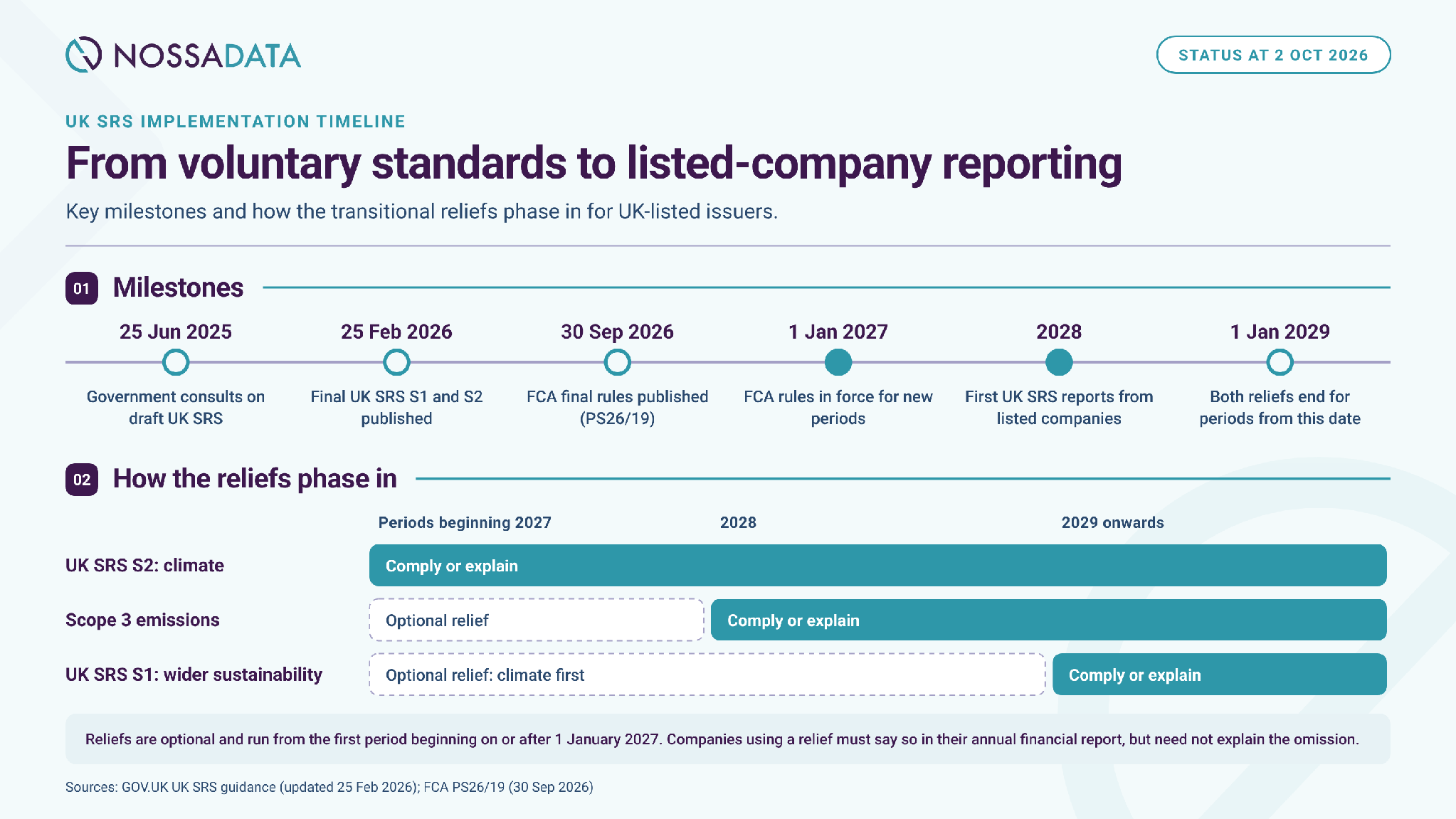
The dates below come from the government, the FCA and the FRC.
Transitional reliefs
In the standards themselves, the reliefs have no time limit. The government removed them following its January 2026 letter, leaving regulators to set the duration. Voluntary users can use the reliefs indefinitely, the FRC confirms.
For listed companies, the FCA has set two optional reliefs, running from the first period beginning on or after 1 January 2027:
- Scope 3 emissions: 1 year.
- Climate first: 2 years. Companies can report on climate only, leaving out wider sustainability topics under UK SRS S1.
Companies using a relief must say so in their annual financial report, but do not need to explain the omission. A company reporting on climate only cannot claim compliance with UK SRS S1, but can still claim compliance with UK SRS S2 if it discloses the reliefs used (UK SRS S1, paragraph 73A).
What will companies need to disclose?
UK SRS ask for an overview of how sustainability affects the business.
Governance. Disclose who oversees sustainability-related risks and opportunities: which board committee, how often it is briefed, and management's role. If executive pay is linked to climate performance, say so.
Strategy, risks and opportunities. Identify the risks and opportunities that could affect your prospects, and over what time periods. Explain their effect on your business model, value chain and strategy, and their current and expected financial effects. Numbers are expected. If you cannot provide them, explain why. For example, a food manufacturer might identify water scarcity in sourcing regions, describe a shift to drought-tolerant suppliers, and estimate the effect on input costs.
Climate resilience and scenario analysis. Test your strategy against different climate futures, such as a rapid transition and a high-warming pathway, and explain what you found. The work should be in proportion to your exposure.
Risk management. Explain how you identify, assess and monitor these risks, and how this fits into your overall risk management.
Metrics and targets. UK SRS S2 requires cross-industry metrics, including:
- Scope 1, 2 and 3 greenhouse gas emissions
- assets or activities vulnerable to transition and physical risks
- capital deployed towards climate-related risks and opportunities
- internal carbon prices, if used
- how climate is factored into executive pay
You also need to describe climate targets, progress against them and any planned use of carbon credits.
Transition plans. UK SRS S2 does not require a transition plan, but if you have one you must disclose information about it. Separately, the FCA rules require most listed companies to state whether they have a transition plan and where to find it, or why they do not have one.
Disclosures go in the annual financial report, with cross-references allowed where UK SRS S1 permits.
UK SRS vs IFRS S1 and IFRS S2
UK SRS stay very close to the ISSB baseline. The main UK changes are:
| Area | IFRS S1/S2 | UK SRS |
|---|---|---|
| Effective date | 1 January 2024 | None in the standards; set by UK regulation or law |
| Climate-first and Scope 3 reliefs | 1 year each | No time limit in the standards; the FCA sets 2 years and 1 year for listed companies |
| Publishing after the financial statements in year one | Permitted | Not permitted |
| SASB Standards | Companies "shall" consider them | Companies "may" consider them (S1 paras 55 and 58; S2 paras 12, 23 and 32) |
| Financed emissions | Requirements in IFRS S2 | Financial institutions that cannot report on time must explain why and how they will catch up (S2 para B59A) |
| ISSB amendments of December 2025 | Amend IFRS S2 | Built into UK SRS S2 |
In practice, ISSB guidance and educational material remain useful for UK SRS. Future ISSB standards, such as the planned standard on nature, will need UK endorsement before they apply.
UK SRS vs TCFD: what changes for UK reporters?
UK SRS replace the FCA's TCFD-aligned listing rules. UK SRS S2 includes the four TCFD pillars and 11 recommended disclosures, so mature TCFD reporters start from a good place. The main differences are:
- Beyond climate. Once the relief ends, UK SRS S1 covers all material sustainability-related risks and opportunities.
- Required metrics, including Scope 3 after the first year.
- Financial effects, quantified where possible, which needs closer work with finance.
- Same scope and timing as the financial statements.
- Explanations that cover specific points.
Companies also covered by the Companies Act CFD rules do not need to report twice. According to the FRC, the government has confirmed that UK SRS S2 is a national reporting framework, so companies can use it to meet their CFD obligations if they reference it clearly. Emissions reporting under Streamlined Energy and Carbon Reporting (SECR) is still required separately for now.
UK SRS vs CSRD
| UK SRS | CSRD / ESRS | |
|---|---|---|
| Materiality | Financial materiality | Double materiality: financial effects plus impacts on people and the environment |
| Scope | UK-listed issuers; voluntary for others | Large EU companies (over 1,000 employees and €450m turnover) and certain non-EU groups with over €450m EU turnover |
| Climate | UK SRS S2 | ESRS E1 |
| Wider topics | Any material sustainability risk or opportunity | Topic standards across environment, social and governance |
| Requirements | Comply or explain; no mandatory assurance | Mandatory; limited assurance required |
| Audience | Investors | Investors and wider stakeholders |
If you already report under CSRD, much of your climate data and governance information will carry over. The main shift is framing: UK SRS focus on financial effects on the company rather than the company's impacts.
Will UK SRS reporting require assurance?
Not at present. Listed companies that do obtain assurance must disclose who provided it, its level (limited or reasonable), the standards used and where the report can be found. The FCA will keep mandatory assurance under review. The government is setting up a voluntary registration regime for assurance providers, run by the FRC.
How should companies prepare for UK SRS?
For calendar-year companies, the first reporting period starts on 1 January 2027. That leaves about a year to put data, owners and controls in place.
- Check whether you're in scope and decide whether to use the reliefs.
- Map what you already report (TCFD, CDP, ISSB or CSRD) against UK SRS S1 and S2.
- Find the gaps, such as financial effects, scenario analysis and Scope 3.
- List the data you need and where it comes from.
- Assign an owner to each disclosure across sustainability, finance, risk and legal.
- Review controls over how data is collected, checked and approved.
- Gather evidence behind every number and claim.
- Prepare draft disclosures using 2026 data as a dry run.
- Get ready for assurance, even if you don't plan to obtain it yet.
This is where most teams spend their time: chasing data, tracking which requirements are covered and keeping evidence in one place. Nossa Data helps sustainability teams map requirements such as UK SRS, IFRS S1 and S2 and ESRS, collect data and evidence, identify gaps and prepare disclosures in one platform.
Frequently asked questions
What does UK SRS stand for?
UK Sustainability Reporting Standards. There are two: UK SRS S1 (general requirements) and UK SRS S2 (climate).
Is UK SRS mandatory?
For in-scope UK-listed companies, yes, on a comply or explain basis from accounting periods beginning on or after 1 January 2027. For other companies, UK SRS are voluntary.
Who needs to report under UK SRS?
Companies listed in the commercial companies, transition, non-equity and non-voting shares, international secondary listing and depositary receipt categories.
When does UK SRS take effect?
The standards could be used voluntarily from 25 February 2026. The FCA rules apply from 1 January 2027 accounting periods, with first reports in 2028.
What is UK SRS S2?
The climate standard, covering climate risks and opportunities, scenario analysis, Scope 1, 2 and 3 emissions and climate targets.
What is the difference between UK SRS and ISSB?
Very little. UK SRS have no built-in effective date, no time limits on reliefs, no late-publication relief, optional use of SASB Standards and an explanation requirement for financed emissions.
Does UK SRS replace TCFD?
Yes, for listed companies, from 2027 accounting periods.
How does UK SRS differ from CSRD?
UK SRS use financial materiality and are aimed at investors. CSRD uses double materiality, covers more topics and requires assurance.
Preparing for UK SRS? Nossa Data helps sustainability teams manage disclosure requirements, data, evidence and reporting in one platform. Book a demo.
Sources
- UK Sustainability Reporting Standards (guidance page), UK government, first published 19 Sep 2024; last updated 25 Feb 2026
- UK SRS S1 (PDF), UK government, February 2026 (published 25 Feb 2026)
- UK SRS S2 (PDF), UK government, February 2026 (published 25 Feb 2026)
- Letter from DBT to the FCA (PDF), Department for Business and Trade, 5 Jan 2026 (added to GOV.UK 8 Jan 2026)
- Sustainability reporting developments: FAQs, Financial Reporting Council, last updated 26 Feb 2026
- PS26/19 (web page), FCA, 30 Sep 2026
- PS26/19 (PDF, including made rules), FCA, September 2026; instrument made 24 Sep 2026
- UK SRS timeline, uksrs.org.uk (independent site), accessed 2 Oct 2026
- Modernising Corporate Reporting consultation (PDF), UK government, 7 Sep 2026 (closes 30 Nov 2026)
- Government response on UK SRS, UK government, 25 Feb 2026
- Government response on assurance oversight, UK government, 30 Jan 2026