
The UK’s climate-related financial disclosure (CFD) regulations require large private companies, LLPs and AIM companies to report on climate risk in their annual report. If your business has more than 500 employees and turnover above £500m, there’s a good chance you’ve been doing this since 2022. The rules, set out in The Companies (Strategic Report) (Climate-related Financial Disclosure) Regulations 2022, took TCFD-style reporting beyond the listed market for the first time.
Several reporting cycles in, we still hear the same questions. Is CFD the same as TCFD? Who exactly is in scope? Can we leave parts out? What is the FRC looking for? And now that UK SRS is coming for listed companies, what happens to CFD?
Below, we go through the government’s official guidance and answer each of these in turn.
What are the CFD regulations?
The climate-related financial disclosure (CFD) regulations are UK rules that require large companies and LLPs to report on climate-related risks and opportunities in their annual report. They amend the Companies Act 2006 and cover four areas: governance, risk management, strategy, and metrics and targets.
The requirements are based on the TCFD recommendations, but the government rewrote them as eight legal requirements so they would work in UK law. That means the two frameworks overlap without being identical, as the comparison below shows.
The rules apply to financial years starting on or after 6 April 2022, and there are no transitional reliefs.
CFD vs TCFD: what’s the difference?
CFD and TCFD cover the same ground, but you can’t treat them as interchangeable. In its 2025 review, the FRC found that some companies following TCFD had missed parts of CFD for exactly this reason.
| CFD | TCFD (FCA Listing Rules) | |
|---|---|---|
| Legal basis | Companies Act 2006, mandatory | FCA rule, comply or explain |
| Who it applies to | Listed, AIM, banking and insurance companies, large private companies and LLPs | Listed companies |
| Number of disclosures | 8 requirements, (a) to (h) | 11 recommended disclosures |
| Can you leave parts out? | Only (e) to (h), with a clear and reasoned explanation | Any disclosure, with an explanation |
| Where it goes | The annual report, signposted from the Non-Financial and Sustainability Information Statement | Usually the annual report, with some room to cross refer to other documents |
| Scenario analysis | At least qualitative, normally renewed every three years | No set refresh cycle |
| Greenhouse gas emissions | Not specifically required (SECR covers emissions reporting) | Scope 1 and 2 recommended, Scope 3 where appropriate |
Who is in scope?
Almost every route into CFD starts with the same test: more than 500 employees. After that, it depends on what kind of entity you are.
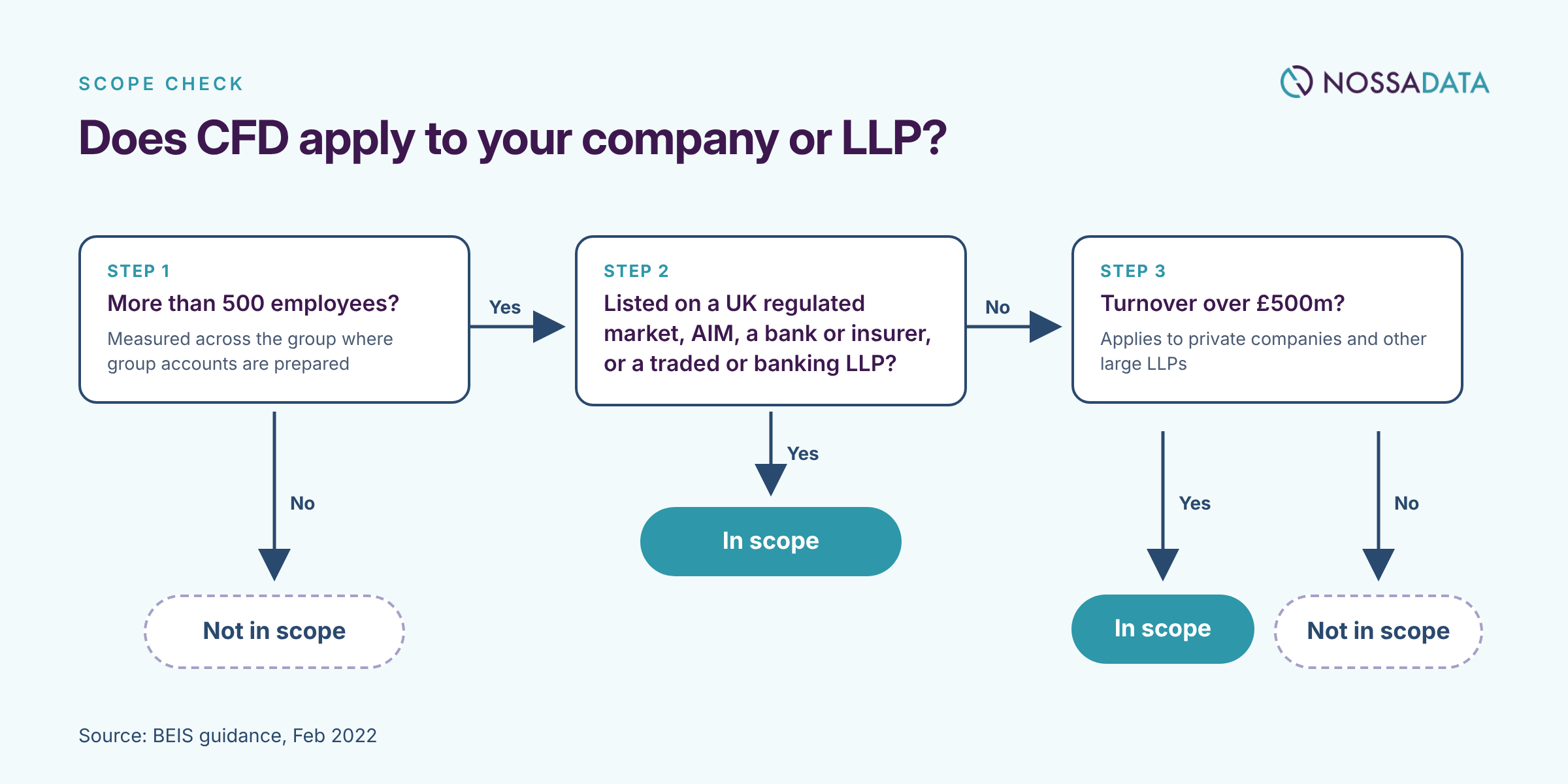
Companies with securities on a UK regulated market, banks, insurers, AIM companies, and traded or banking LLPs only need to pass the employee test. Everyone else, including private companies and other large LLPs, also needs turnover above £500m.
A few points are worth checking:
- If the parent prepares group accounts, you apply the thresholds to the group as a whole. Subsidiaries covered by that group report don’t need to report separately.
- A UK group reports on climate risk across all its operations, including overseas subsidiaries.
- Having an overseas parent doesn’t get you out of it. A UK company that meets the thresholds still reports, even if its parent publishes consolidated climate disclosures abroad.
- The Financial Reporting Council (FRC) enforces the rules. It reviews strategic reports and can go to court to have one revised. Auditors also have to flag any uncorrected material misstatement in the climate disclosures.
What do you have to disclose?
The regulations list eight requirements, labelled (a) to (h). They line up with the four TCFD pillars, which makes them easier to picture.
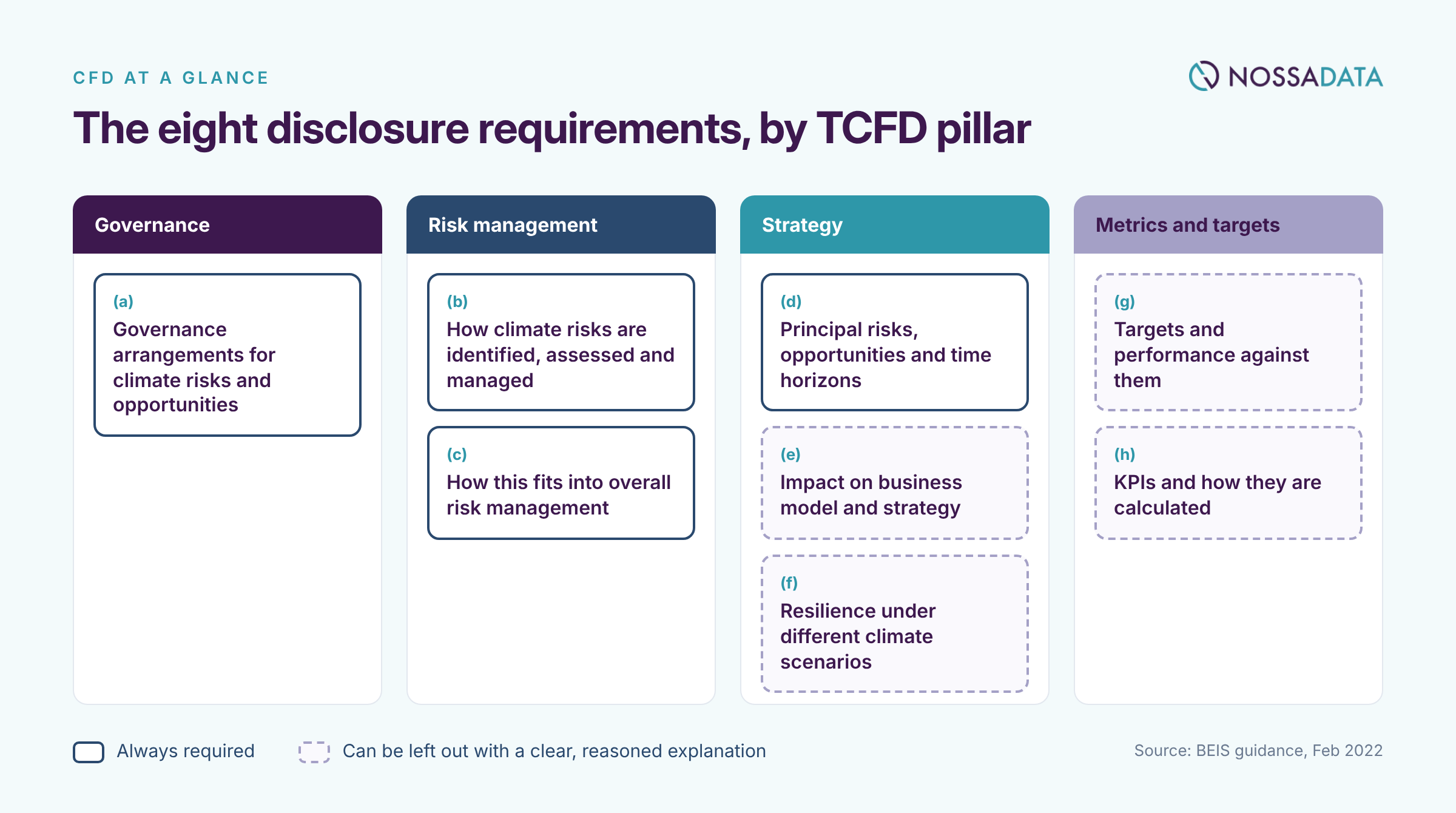
Here is what the guidance expects under each one.
| Requirement | What the guidance expects |
|---|---|
| (a) Governance | Who is responsible for climate risks and opportunities, how often they look at them, and how the board is involved |
| (b) Identifying, assessing and managing risks | The systems and processes you use, whether risks are picked up at group or subsidiary level, and how often you refresh them |
| (c) Integration into overall risk management | How climate risk sits alongside your other principal risks, and what resources it gets |
| (d) Principal risks, opportunities and time horizons | Your main physical and transition risks and opportunities over the short, medium and long term, plus how you chose those time periods |
| (e) Impact on business model and strategy | Specific effects on the business, what you’re doing about them now, and your contingency plans |
| (f) Resilience under climate scenarios | How well your business model and strategy hold up under different climate scenarios |
| (g) Targets | The targets you use, their timeframes, and how you’re performing against them |
| (h) KPIs | The KPIs behind those targets and how you calculate them |
You don’t need a climate model for scenario analysis
Requirement (f) worries people most, but the guidance is fairly relaxed about it. Scenario analysis has to be at least qualitative, so a set of well reasoned narratives about how different climate futures could affect the business is enough. Quantitative modelling is welcome, but it isn’t required.
Pick scenarios that are relevant to your business and different enough to cover a real range of outcomes. The guidance suggests examples such as a gradual versus a sudden cut in emissions, a 1.5°C pathway, or business as usual. Then explain why you chose them and what you assumed.
You also don’t have to redo it every year. The guidance expects a refresh at least every three years, or sooner if your assumptions or the science change significantly.
Physical and transition risks
For requirement (d), the guidance splits climate risk into two types. Physical risks are the direct effects of a changing climate, from one-off events like floods and heatwaves to slower shifts like rising sea levels. Transition risks come from the move to net zero, through new policy and technology, changing markets, reputational damage and legal claims.
Where do the disclosures go?
Companies put them in the Non-Financial and Sustainability Information Statement, which sits in the strategic report. You can keep the detail elsewhere in the annual report, for example in a dedicated climate section, as long as the statement points readers to it.
LLPs use the Energy and Carbon Report, or the strategic report if they prepare one.
There’s no set format, so the disclosures need to make sense on their own.
Can you leave anything out?
Yes, but only requirements (e) to (h), and only with a good reason. If the directors believe that information isn’t needed to understand the business, they can omit it as long as they give “a clear and reasoned explanation” of why.
Requirements (a) to (d) always have to be reported. The general test also still applies: a reader should be able to understand how climate risks and opportunities affect the business, and you can’t leave out anything that would influence an investor’s decision. A one-line statement that climate risk is “not material” won’t get you there.
How does CFD fit with other UK rules?
- Listed companies with more than 500 employees fall under both CFD and the FCA’s TCFD rules. The guidance says that reporting in line with all the TCFD recommendations is likely to meet CFD as well.
- SECR still applies. CFD sits alongside Streamlined Energy and Carbon Reporting, so you keep reporting energy use and emissions there.
- Your climate disclosures should line up with the estimates and judgements in your financial statements.
- You can use consultants and data providers, but the directors remain legally responsible for what’s disclosed.
What about UK SRS?
UK SRS S1 and S2, the UK’s versions of the ISSB standards, were published in February 2026. In PS26/19, the FCA confirmed that listed companies will report against them on a comply or explain basis for accounting periods starting on or after 1 January 2027. Our guide to UK SRS covers this in detail.
For private companies and LLPs, nothing has changed yet and CFD still applies. The government plans to consult on extending UK SRS to “economically significant” non-listed companies as part of its Modernising Corporate Reporting work. UK SRS S2 is built on the same TCFD foundations as CFD, so the work you put into CFD now will carry over.
Common CFD mistakes, and what the FRC found
In January 2025, the FRC published its first review of CFD reporting by AIM and large private companies. It found the quality was inconsistent and asked companies for disclosures that are “more consistent, coherent and concise”. These are the issues it raised, along with a few we often see ourselves.
- Several companies gave no resilience analysis at all, and others gave analysis that wasn’t specific to the business. Name your scenarios and the assumptions behind them.
- Only half of the companies reviewed gave all the required information on targets and KPIs. Every target in (g) needs a matching KPI in (h).
- Most companies described their climate risks, but opportunities and time frames were often missing.
- Some companies put their disclosures in a separate ESG report. That doesn’t count, because CFD has to be in the annual report.
- Companies following TCFD sometimes missed parts of CFD, because the two aren’t identical.
- Generic risks such as “extreme weather” and “carbon pricing” don’t tell a reader much unless you explain which sites, products or customers are exposed.
- Leaving out (e) to (h) needs an explanation specific to the company, not a stock sentence.
- Climate assumptions should match the impairment and going concern judgements in the accounts. Auditors and the FRC will notice when they don’t.
Getting ready for your next report
- Check scope at group level using group headcount and turnover, and confirm which subsidiaries the group report covers.
- Compare last year’s disclosure against (a) to (h) and decide whether any omissions still hold up.
- Name the board committee and management roles responsible for climate risk, and record how often climate comes up.
- Make climate risk part of your main risk register, with the same time horizons used across the business.
- If your scenario analysis is more than three years old, or the business has changed, schedule a refresh.
- Give every target a KPI, a baseline and a written methodology.
- Keep evidence for every figure and statement as you go, so directors can sign off with confidence.
- Build processes that will scale to UK SRS, rather than rewriting the narrative from scratch every year.
Frequently asked questions
What does CFD stand for?
In UK sustainability reporting, CFD stands for climate-related financial disclosures. It refers to the Companies (Strategic Report) (Climate-related Financial Disclosure) Regulations 2022 and the equivalent rules for LLPs. It has nothing to do with contracts for difference.
Is CFD reporting mandatory?
Yes. For companies and LLPs in scope, CFD is a legal requirement under the Companies Act 2006. Only requirements (e) to (h) can be left out, and only with a clear and reasoned explanation.
When did CFD come into force?
The rules apply to financial years starting on or after 6 April 2022, so the first CFD reports covered financial years ending in 2023.
Does CFD apply to subsidiaries?
A subsidiary doesn’t need to report separately if it’s included in a UK parent’s group report that covers CFD. The thresholds are applied at group level.
Do you need scenario analysis for CFD?
Yes, unless the directors justify leaving out requirement (f). The analysis can be qualitative and should normally be refreshed at least every three years.
Who enforces CFD?
The Financial Reporting Council. It reviews annual reports and can apply to court to have a strategic report revised.
Will UK SRS replace CFD?
Not yet. UK SRS applies to listed companies from 1 January 2027 under FCA rules. The government plans to consult on extending it to large non-listed companies, but for now CFD is still the requirement for private companies and LLPs.
How Nossa Data can help
CFD reporting pulls in governance, risk, finance and sustainability teams, and coordinating them every year takes time. Nossa Data helps you map the requirements, assign owners, collect data and evidence, and keep an audit trail. The same groundwork then supports UK SRS when it arrives.
Book a demo to see how it works.
Sources
- Mandatory climate-related financial disclosures by publicly quoted companies, large private companies and LLPs: non-binding guidance, BEIS, February 2022
- FRC reviews Climate-related Financial Disclosures (CFD) by AIM and large private companies, FRC, January 2025
- FRC thematic review: climate-related financial disclosures by AIM and large private companies, RPC
- CFD vs TCFD: spot the difference, Deloitte
- Sustainability reporting requirements and regulations for UK companies, BDO
- UK Sustainability Reporting Standards: UK SRS S1 and UK SRS S2, DLA Piper
- UK SRS: FCA confirms comply or explain approach, Linklaters