
KPMG published its ESRS handbook in late November. At 277 pages it's long, but it's the first Big Four guide to cover every one of the revised standards, topical ones included, so it's worth the time.
The revised ESRS were adopted in July and published in the Official Journal in September. They apply to financial years starting on or after 1 January 2027. Meanwhile the Omnibus Directive has cut CSRD scope back to companies with more than 1,000 employees and over EUR 450m in net turnover. A lot of reporting teams are now preparing a first statement under rules that are only a few months old.
We read the handbook with that in mind. Below we pull out what matters for issuers and compare it with the EY and PwC examples we reviewed in our earlier piece.
What's in it
The handbook is interpretive guidance: it works through the standards in order, cites the ESRS paragraph behind each point, and assumes you have the standards open next to it. KPMG has also published a materiality how-to guide and a GHG emissions reporting handbook to go with it.
- 1 Introduction (pages 1–4): the 12 standards, the legal basis, and the draft ESRS for non-EU groups (ESRS-40a)
- 2 Foundational concepts, ESRS 1 (pages 5–70): reporting entity, value chain, double materiality, estimates, comparatives, reliefs
- 3 General disclosures, ESRS 2 (pages 71–125): governance, strategy, financial effects, resilience, IRO management, policies, actions, metrics and targets
- 4 Topic-specific standards (pages 126–221): E1 climate (by far the longest), E2–E5, S1–S4, G1
- 5 Supplemental guidance (pages 222–231): transition plans and scenario analysis
- 6 Presentation and reporting (pages 232–249): layout, connectivity, cross-referencing, effective dates and transition reliefs
Most chapters follow the same pattern. There's a short explanation of the requirement, then "insights" that answer the questions preparers actually ask, then worked examples using made-up companies. The insights are the part to read closely. That's where KPMG sets out how it reads the grey areas, and audit teams are likely to read them the same way.
What issuers should take from it
Your boundary is the group in your accounts
The sustainability statement covers the same group as the consolidated financial statements. KPMG points out that a subsidiary too small to matter for the accounts can still be the source of a material impact, so it can't be left out because of its size.
A top-down DMA is fine, as long as you document it
Revised ESRS 1 lets you start with topics, rule out the ones that clearly aren't material, and reach conclusions at topic or subtopic level. That should save a lot of work. The catch is that one site or IRO can change a conclusion. KPMG's example is a single water-stressed site under an otherwise immaterial water topic. Scoring thresholds also can't be used to screen out material information, and the assessment needs to be documented well enough to stand up to a hindsight challenge.
Smaller suppliers can say no
Under the value chain cap, suppliers and customers with up to 1,000 employees can refuse requests that go beyond the datapoints in the voluntary standard (VSME), wherever they're based. There's no minimum number of suppliers you have to assess. Even so, KPMG notes that material impacts often sit further upstream, in raw materials or manufacturing.
"Undue cost or effort" has limits
You only need information you can get without undue cost or effort. But if the data is already used for budgeting, risk management or due diligence, KPMG's view is that it counts as available.
Reliefs don't stop you claiming compliance
You can only state compliance with ESRS if every applicable requirement is met. Using a relief the standards allow, such as leaving out E4 for the first two years, doesn't count against you, as long as you disclose it.
Financial effects can wait
The anticipated financial effects disclosures can be left out entirely in years one and two, and the figures can be left out until year four (a few E1 paragraphs excepted). KPMG also says you don't need to build forecasts just for this disclosure.
More freedom on layout, less on cross-referencing
You can now include an executive summary and put EU Taxonomy disclosures in their own appendix. You can't point readers to a separate sustainability report, though an EMAS report is allowed.
Wave-one companies have a choice for 2026
Companies already reporting can stay on ESRS Set 1 (with the 2025 "quick fix" amendments), adopt the revised standards early, or stay on Set 1 while using some of the new reliefs, such as the top-down DMA. Whichever you choose, the statement has to say so.
The phase-in timetable
If your first mandatory year starts on or after 1 January 2027, these reliefs are available. You have to disclose each one you use.

Five examples worth studying
The handbook has about 100 worked examples, and they're the fastest way into a dense document. We picked five that deal with questions almost every first-year preparer runs into. For each one we've included KPMG's example as it appears in the handbook, followed by what we think it means for your own statement.
1. A well-managed impact still has to be reported (Example 2.2.70)
A common argument in DMA workshops is that an impact doesn't need reporting because it's under control. KPMG's example tests that with a factory discharging treated effluent into a river.
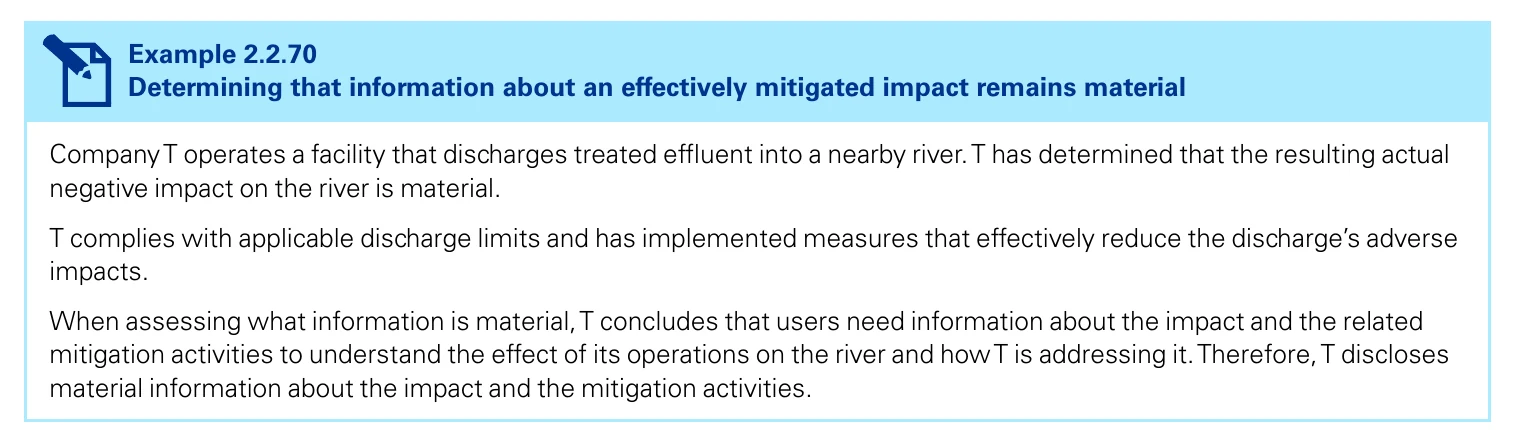
Source: KPMG, ESRS handbook, Example 2.2.70, page 35.
What it means for you. Company T meets its discharge limits and its controls work, yet the impact is still material, so readers need to hear about both the impact and the mitigation. EY reaches the same conclusion in its Good Bank DMA, where strong controls don't make an impact immaterial. Treat a well-managed impact as a chance to show your controls rather than a reason to drop the disclosure. KPMG's materiality how-to guide walks through how to get from a material IRO to the information you report about it.
2. Report metrics where the impact happens (Example 2.3.120)
Many groups assume that once a topic is material, every metric has to cover the whole group. This example shows when you can narrow it.

Source: KPMG, ESRS handbook, Example 2.3.120, page 69.
What it means for you. The "no significant driver" relief (ESRS 1.90) lets Company R limit its water metrics to the cement plants in water-stressed regions, leaving out offices and chemical sites. The relief only works because R describes the impact precisely: the activity, product, location and source. If you can't explain why the excluded sites don't drive the impact, the relief won't stand up to an auditor. It's worth testing for water, pollution and site-specific biodiversity metrics, where a handful of sites often account for most of the result.
3. When you can't put a number on financial effects (Examples 3.1.110 and 3.1.140)
Company K, a technology business, is replacing some roles with AI and could face litigation under labour laws that are still changing. In Example 3.1.110, KPMG agrees that the uncertainty is too high for any figure to be useful. Example 3.1.140 then shows what K discloses instead.
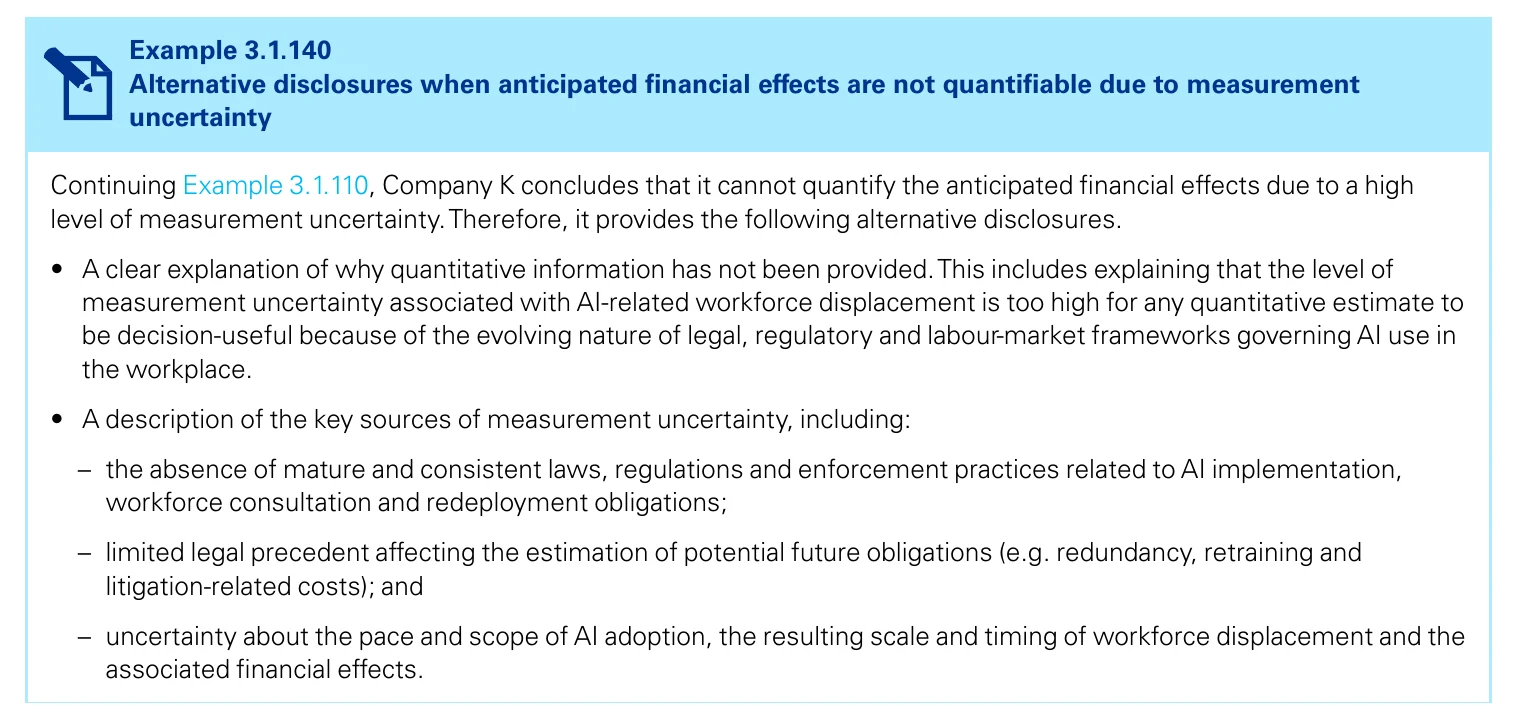
Source: KPMG, ESRS handbook, Example 3.1.140, page 102.
What it means for you. "We can't quantify it" is an acceptable answer, but it isn't a blank. On the following page the example goes on to list the assumptions K used, the financial statement line items likely to be affected (employee costs, restructuring, provisions), and a qualitative description of the likely effects. That makes a useful template for any risk you can't yet put a number on. Keep in mind that the phase-in relief for anticipated financial effects runs out, so this reasoning will be needed for real eventually.
4. Intensity targets need absolute figures beside them (Example 4.1.110)
Intensity targets are popular with growing businesses, because they can show progress while total emissions rise. ESRS doesn't let that go unexplained.
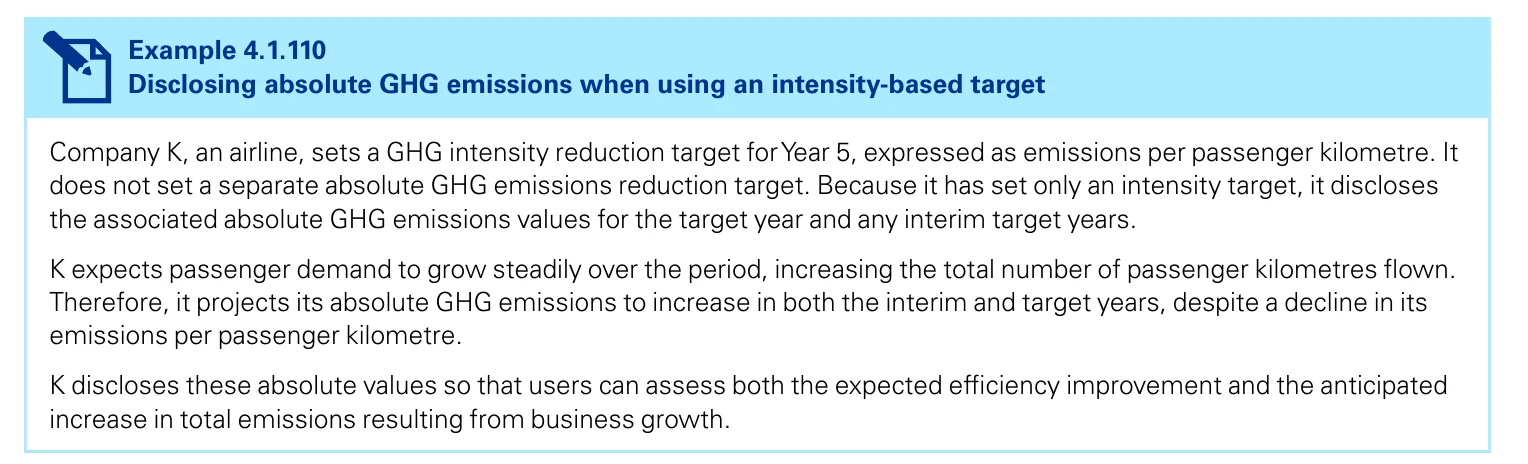
Source: KPMG, ESRS handbook, Example 4.1.110, page 153.
What it means for you. Because the airline has only an intensity target, it has to disclose the absolute emissions expected in the target year and any interim years. Its absolute emissions are projected to rise, and that has to be shown. If your targets are intensity-only, prepare the numbers and the explanation together, and agree internally on how you'll present a rising absolute figure. For the measurement side, KPMG's GHG emissions reporting handbook goes into much more detail.
5. Keeping your trend line in the first mandatory year (Example 6.2.10)
Companies that reported voluntarily before often worry that the first ESRS year breaks their history. This example shows how to keep it.
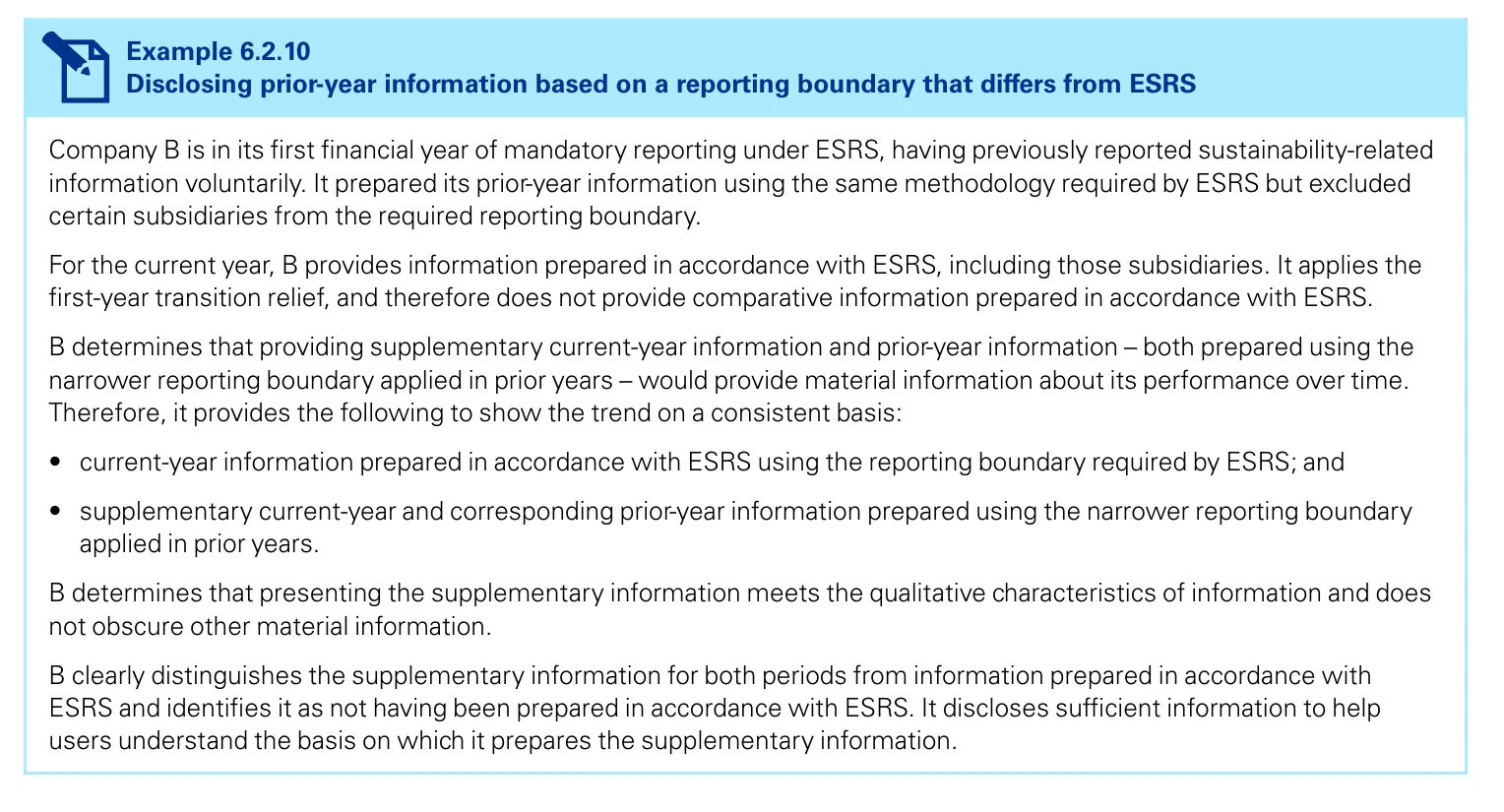
Source: KPMG, ESRS handbook, Example 6.2.10, page 244.
What it means for you. Company B uses the first-year relief and gives no ESRS comparatives, because its earlier figures left out some subsidiaries. It still shows the trend by adding current- and prior-year figures on the old, narrower boundary, clearly labelled as not prepared under ESRS. If you do this, keep the two sets of figures visibly apart, explain the basis, and don't suggest the periods are directly comparable. KPMG covers the same rules in Insight 6.2.10.
KPMG, EY and PwC side by side
The three firms haven't published the same kind of thing, which is useful. EY gives you finished example statements, PwC explains its reasoning, and KPMG now has the widest coverage of the topical standards. We covered EY and PwC in more depth in our earlier article.
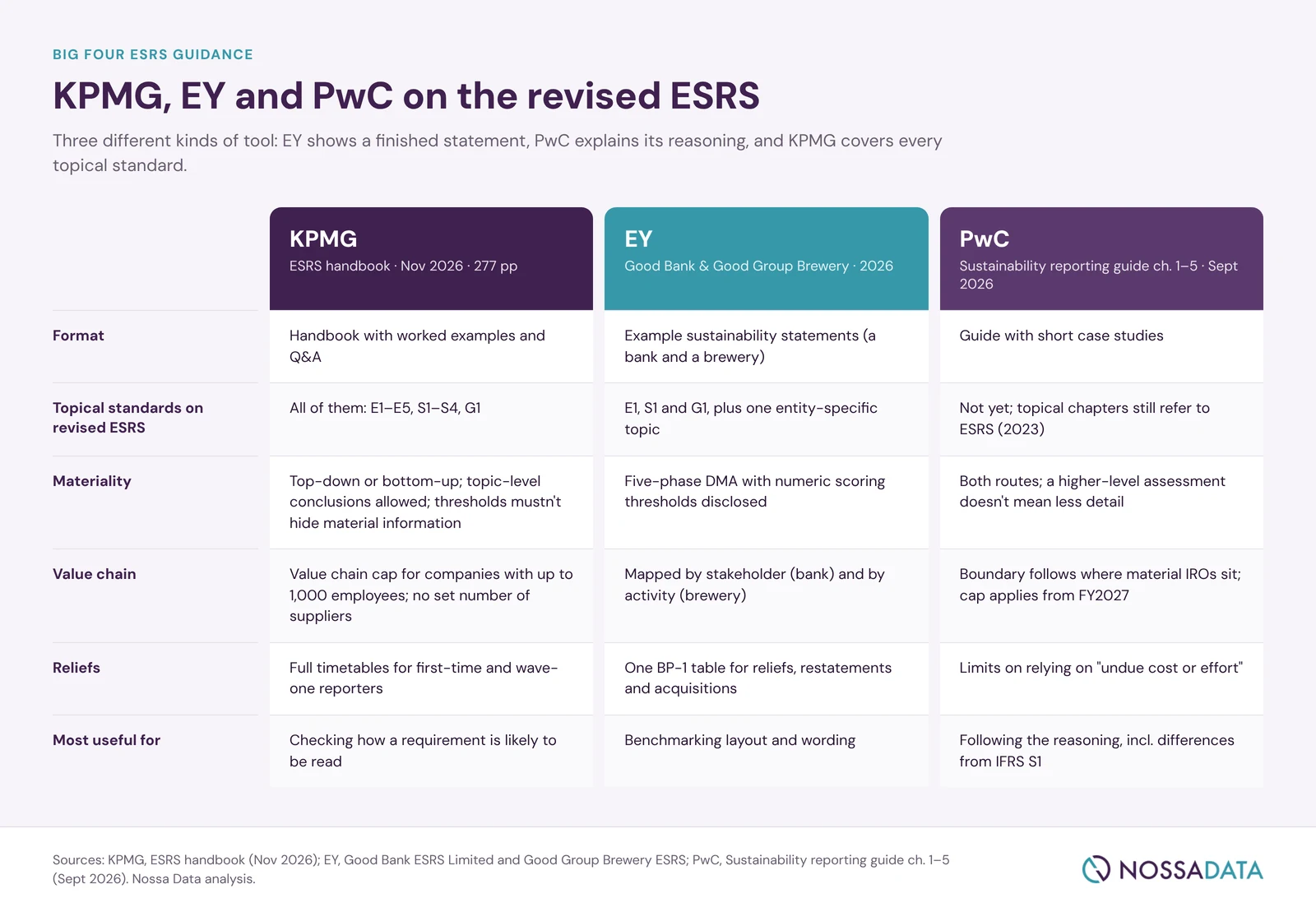
The source documents: KPMG's ESRS handbook, EY's Good Bank ESRS Limited and Good Group Brewery ESRS, and PwC's Sustainability reporting guide, chapters 1–5.
All three stick to the four-part ESRS 1 structure, put the DMA at the centre of the statement, and push hard on links to the financial statements. EY's Good Bank example does this with flood risk and credit loss figures, and PwC uses its Seaside PLC case.
KPMG's handbook stands out for its breadth. It's the only one of the three to cover E2 to E5 and S2 to S4 in detail under the revised standards, and the only one to set out the wave-one options and the full phase-in timetable in one place.
One thing to watch: EY's example scores IROs against numeric thresholds. That's a reasonable approach, but it isn't required, and KPMG's warning about thresholds hiding material information still applies. If you borrow EY's layout, you'll need to explain why your thresholds suit your business. Our guide to running a DMA that passes limited assurance covers how to do that.
Where to start
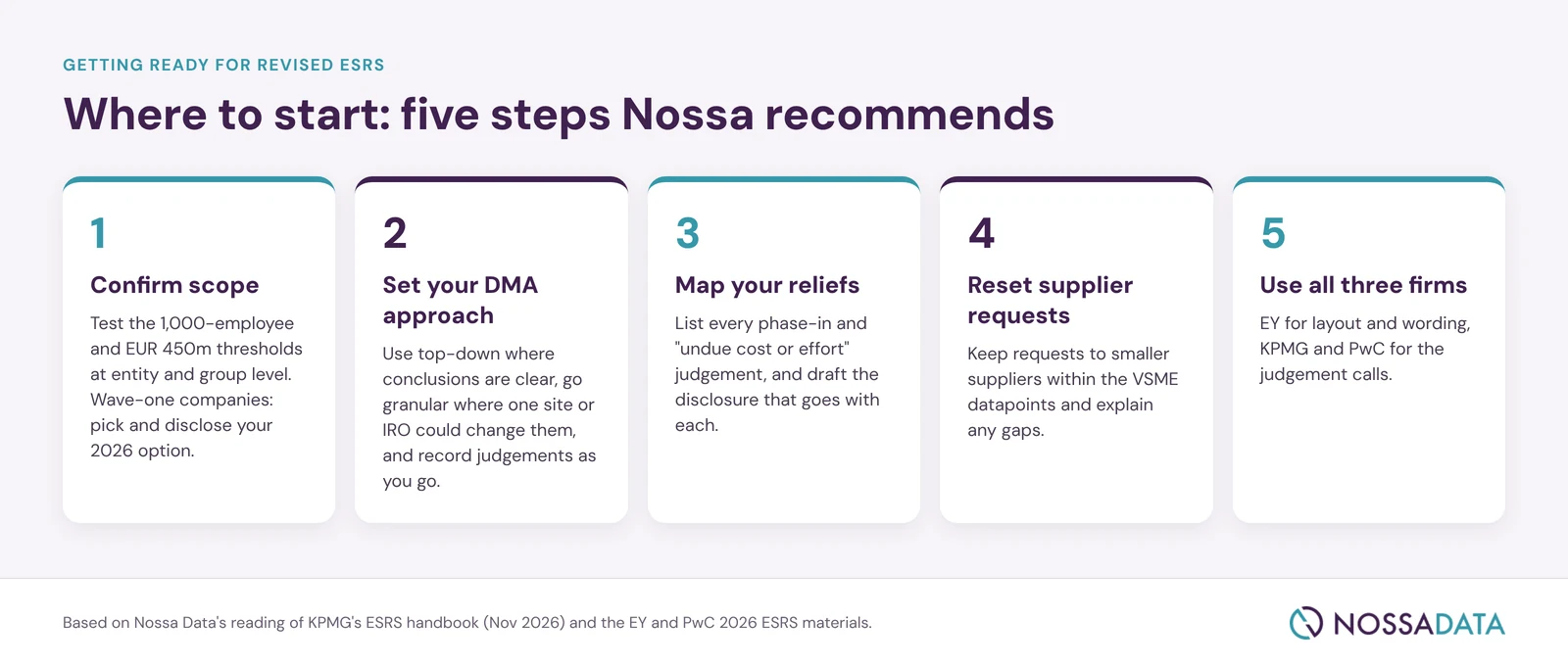
If you're preparing a first statement under the revised ESRS, Nossa recommends:
- Check whether you're in scope against the 1,000-employee and EUR 450m tests, at both entity and group level. If you're a wave-one company, decide which 2026 option you'll use.
- Choose your DMA approach and record the judgements as you go, not after.
- List the reliefs you plan to use and draft the disclosure for each one.
- Rework supplier data requests so smaller suppliers aren't asked for more than the VSME datapoints.
- Use the three firms' material together: EY for layout, KPMG and PwC for the judgement calls.
At Nossa Data we map your existing disclosures to every ESRS datapoint, flag the gaps, and draft answers linked back to source evidence so your auditor can follow the trail. Book a demo or read more on our CSRD / ESRS page.
Sources
- KPMG, ESRS handbook, November 2026
- KPMG, Materiality for sustainability reporting – How-to guide
- KPMG, GHG emissions reporting handbook
- EY, Good Bank ESRS Limited – Illustrative Sustainability Statement in accordance with 2026 ESRS
- EY, Good Group Brewery ESRS
- PwC, Sustainability reporting guide, chapters 1–5, September 2026
- Nossa Data, EY and PwC example CSRD reports: what the 2026 ESRS illustrations teach listed companies
- Nossa Data, How to complete a CSRD double materiality assessment that passes limited assurance