On 25 September 2026 the Committee of European Auditing Oversight Bodies (CEAOB) adopted its technical advice on the standard for limited assurance on sustainability reporting, and five days later it handed that advice to the European Commission. The document runs to 239 pages and sets out, paragraph by paragraph, how ISSA 5000 should be adapted before it becomes the binding EU standard for assuring CSRD sustainability statements.
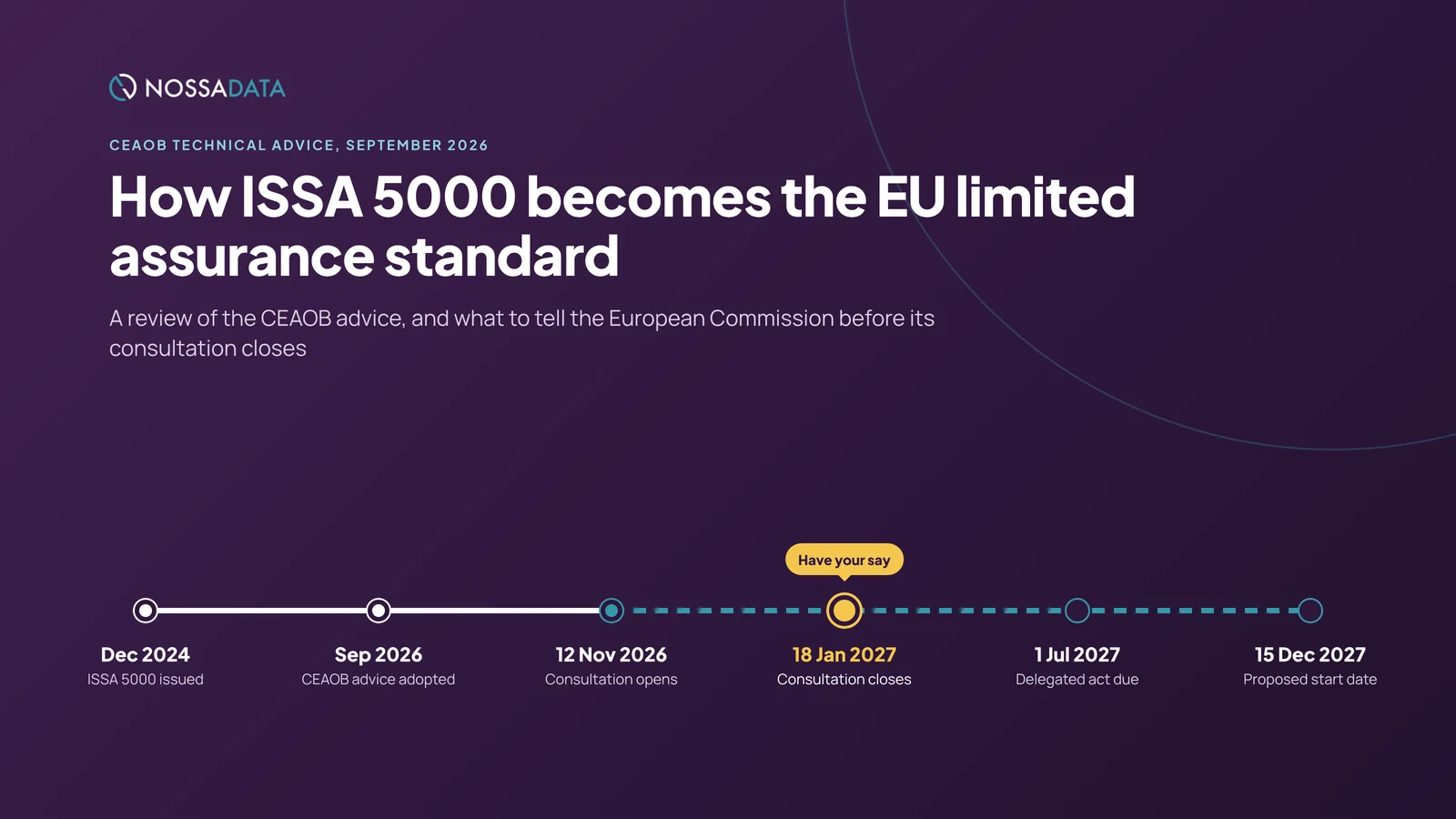
The Commission has since opened a targeted consultation on the advice, running from 12 November 2026 until 18 January 2027. What comes out of that process will feed straight into the delegated act the Commission has to adopt by 1 July 2027, so now is the time for preparers and assurance providers to read the detail and say what works and what does not.
We covered the bigger picture for issuers in our CSRD limited assurance guide. This article is written for the people who will live with the standard day to day, such as sustainability controllers, assurance practitioners and audit committee members, and it works through the advice at paragraph level. Wherever we quote a paragraph number, it follows the numbering in the CEAOB document, which deliberately mirrors ISSA 5000.
Where the EU limited assurance standard comes from
The legal basis is Article 26a(3) of the Audit Directive (2006/43/EC), as amended by the Omnibus I Directive ((EU) 2026/470). It requires the Commission to set out limited assurance standards in a delegated act by 1 July 2027, covering engagement planning, the way risks are considered and responded to, and the type of conclusion that goes into the assurance report.
Rather than write a European standard from scratch, the Commission wrote to the CEAOB on 27 January 2026 asking for advice on the EU specific add-ons and carve-outs that would need to be layered onto ISSA 5000, which the IAASB issued in December 2024. Omnibus I had already confirmed that CSRD reporting will stay at limited assurance, and the Commission is clear that this choice, the assurance requirement itself and the content of the revised ESRS are not up for discussion in the consultation.
The timeline below shows how things have unfolded so far and what is still to come.
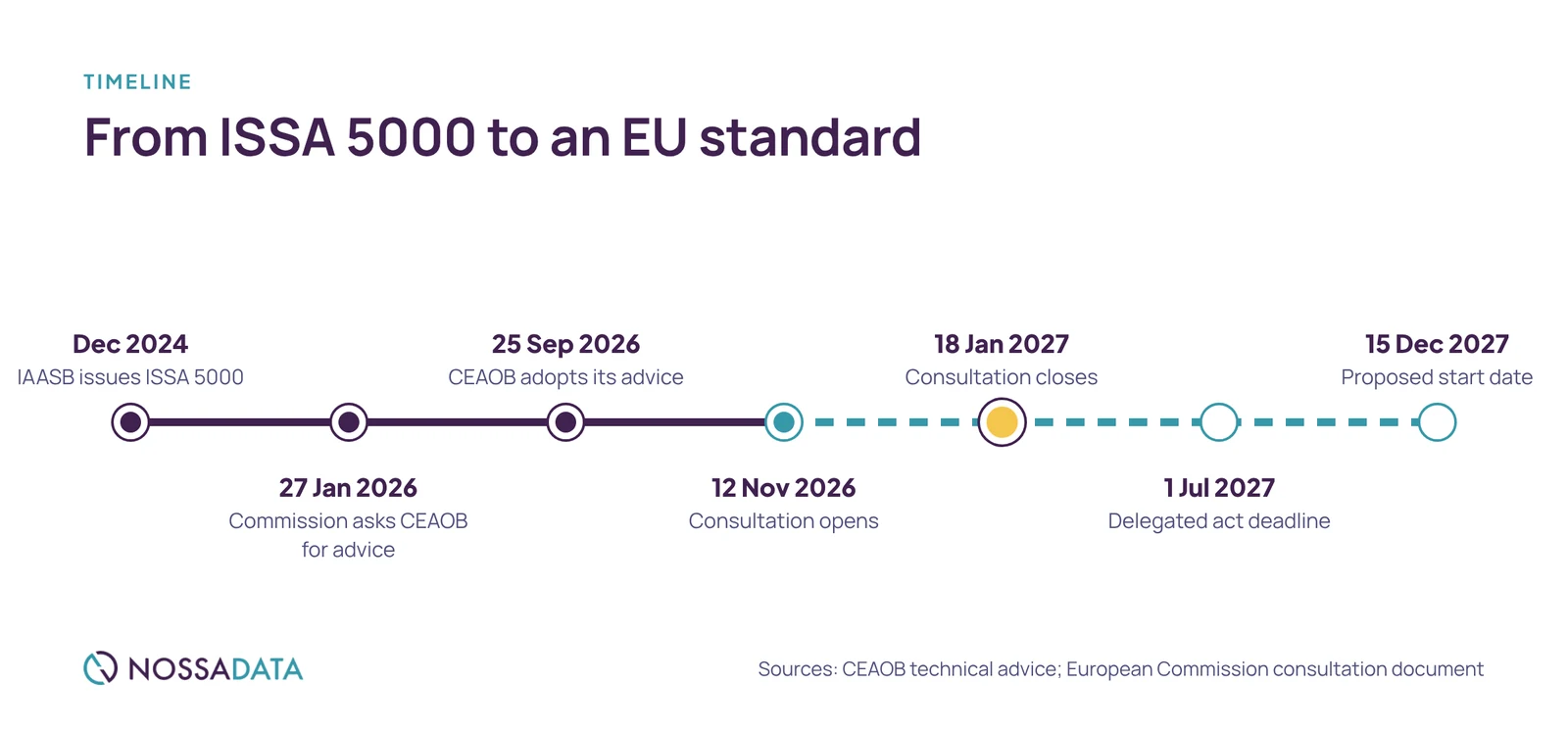
It is worth noticing that ISSA 5000 itself applies to periods beginning on or after 15 December 2026, but the CEAOB suggests the EU version should start a year later (paragraph 15 M). Early application would still be allowed, and the Commission is asking stakeholders whether that timing is realistic.
How the CEAOB document is put together
The advice is laid out as a two column table. The left column reproduces the November 2024 text of ISSA 5000 and the right column shows the CEAOB's EU version of each paragraph. Because the paragraph numbers stay identical to ISSA 5000 (paragraph 0.2 ADD), firms that have already built their methodology around ISSA 5000 can map the changes across without much trouble.
Each paragraph in the right hand column carries a marker that tells you what has happened to it.
| Marker | What it means | Example |
|---|---|---|
| ADD | A new EU provision with no equivalent in ISSA 5000 | Paragraphs 177.1 to 177.13 ADD on ESEF mark-up |
| M | An ISSA 5000 paragraph whose substance has been modified | Paragraph 15 M moves the effective date to 15 December 2027 |
| T | A change of terminology ("standard" instead of "ISSA") or the removal of wording that only concerns reasonable assurance | Paragraph 9 T limits the scope to limited assurance |
| Unchanged | The ISSA 5000 text applies as written | Most of the risk assessment requirements |
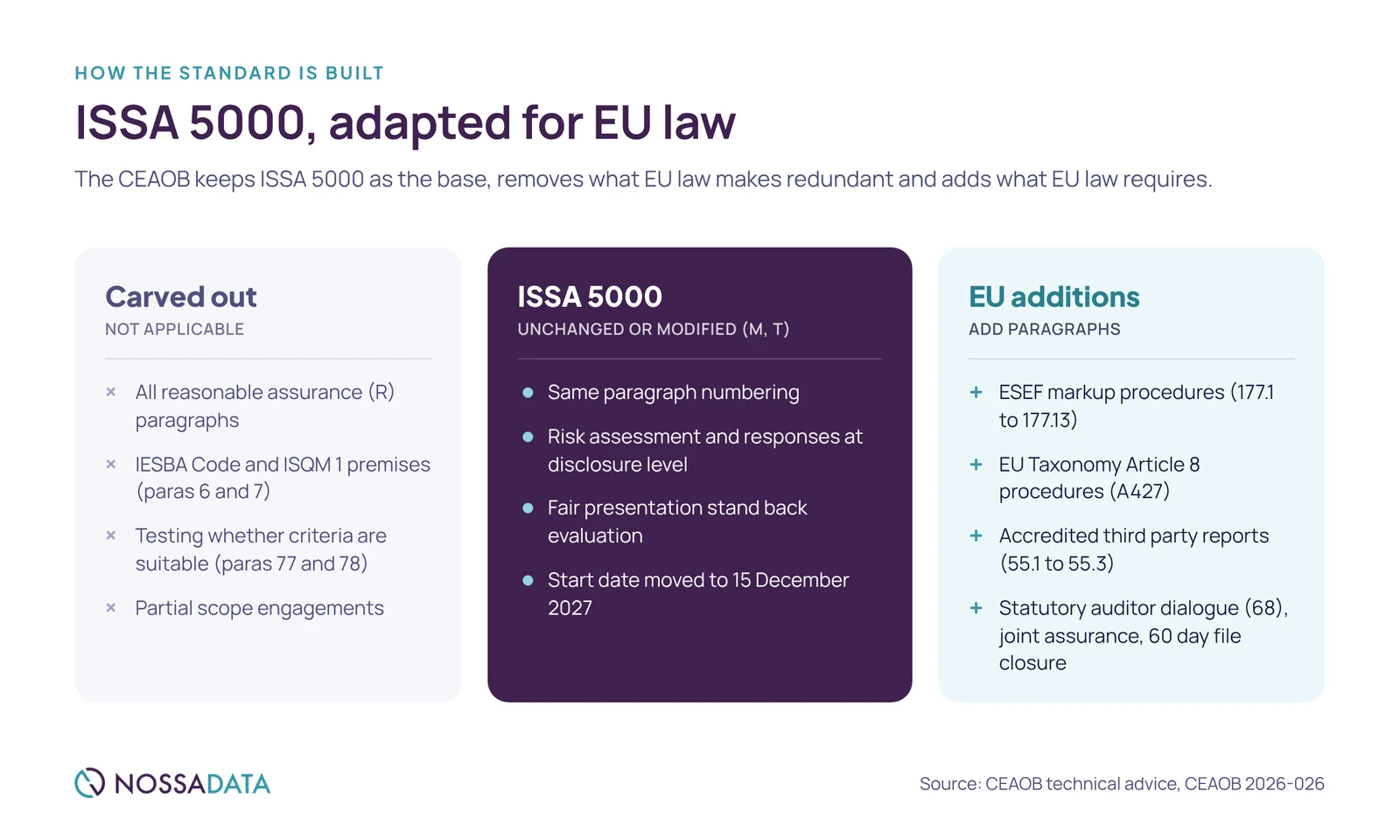
| Not applicable | Carved out, either because it only concerns reasonable assurance or because EU law already deals with it | Paragraphs 6 and 7 on the IESBA Code and ISQM 1, paragraphs 77 and 78 on the suitability of criteria |
Three broad choices run through the whole document and shape everything else in it. The first is that the standard covers limited assurance only, so every paragraph ISSA 5000 reserves for reasonable assurance (the "R" paragraphs such as 122R, 126R and 198R) is switched off and the "L" paragraphs carry the requirements. The second is that the engagement covers all of the sustainability information an undertaking has to report, rather than a slice of it such as its climate disclosures (paragraph 5 M).
The third is that ethics and quality management are left to EU and national law. The references to the IESBA Code and ISQM 1 in paragraphs 6 and 7 are removed, and the engagement leader must instead belong to a firm that applies the quality management requirements of the Audit Directive (paragraphs 7 ADD and 30 M). In keeping with the Directive's vocabulary, the engagement leader is also described as the "key sustainability partner" (paragraph 18.15 ADD).
What the EU adds to ISSA 5000
Applicable criteria: the ESRS and the Taxonomy Regulation
Paragraph 18.12 ADD defines the criteria as all of the provisions of the ESRS together with all of the provisions of the Taxonomy Regulation. The advice treats the ESRS as a fair presentation framework and the Taxonomy Regulation as a compliance framework, which matters because the conclusion is worded differently for each. Since both sets of criteria are written into EU law, the practitioner is not asked to judge whether they are suitable (paragraph 107 ADD), and paragraphs 77 and 78 of ISSA 5000 fall away. A simple reference to the ESRS or the Taxonomy Regulation in the sustainability statement counts as an adequate description of the criteria (paragraph 162 ADD).
The double materiality assessment is part of the information system
For many preparers this is the most consequential point in the whole document. Paragraph A384 ADD says that the process an undertaking uses to decide what is material forms part of its information system for sustainability reporting. That brings ISSA 5000's guidance on understanding the information system (paragraphs A377 to A381) to bear on the double materiality assessment, and the ESRS element of the conclusion explicitly covers that process. In practice, assurance providers will want to see how impacts, risks and opportunities were identified, which thresholds were applied and who signed off the result, rather than just the list of material topics that came out at the end.
Digital tagging of the sustainability statement under ESEF
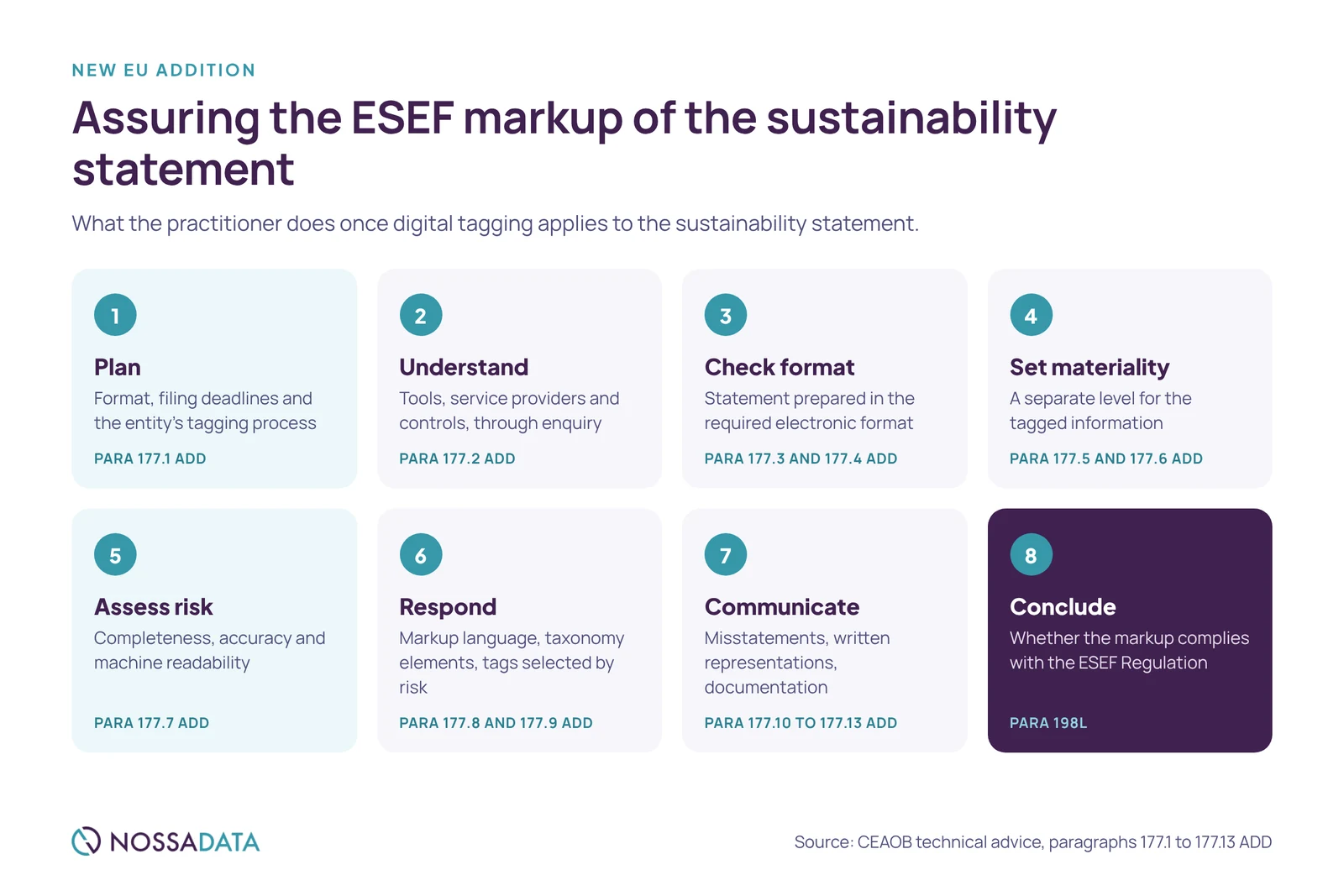
The longest add-on, paragraphs 177.1 to 177.13 ADD, deals with the mark-up of the sustainability statement in the European Single Electronic Format. Once tagging becomes mandatory, the practitioner has to plan around the format, the filing deadlines and the way the undertaking prepares its tagged report. They then need to understand that process through enquiry, including the IT tools used, any work outsourced to a service provider and the controls the undertaking relies on to catch errors.
Mark-up gets its own materiality level, set with both quantitative and qualitative factors in mind and with an eye on what users of machine readable data actually need (paragraphs 177.5 and 177.6). The risk assessment focuses on incomplete or inaccurate tags and on tagging choices that would impair machine readability (paragraph 177.7). The practitioner then responds by checking the mark-up language, the way the ESEF taxonomy elements have been applied and compliance with the relevant Delegated Regulation, choosing which tags to test according to the assessed risk (paragraphs 177.8 and 177.9). The remaining paragraphs cover communicating misstatements that are more than clearly trivial, deciding whether ESEF specific written representations are needed, and documenting the work.
Procedures for EU Taxonomy disclosures
Article 8 disclosures were never part of ISSA 5000, so the CEAOB has added application material in paragraph A427 ADD, linked to paragraph 126L M, with examples of procedures that may suit the risks identified at the level of the Taxonomy disclosures. These include checking that the format follows the Taxonomy reference framework, testing whether activities meet the alignment conditions and technical screening criteria, reviewing how the KPIs were calculated, reconciling the underlying accounting data to the financial statements (with input from the statutory auditor where that helps), and checking that the Taxonomy figures are consistent with the rest of the sustainability statement. Anyone who has prepared turnover, CapEx and OpEx KPIs will know that the reconciliation step is usually where most of the effort goes.
Reports by accredited independent third parties
Some EU laws require a report from an accredited independent third party on particular elements of the sustainability information. Paragraphs 55.1 to 55.3 ADD make clear that the practitioner does not redo that work. Instead, they read the third party report to see whether anything in it looks materially inconsistent with the evidence gathered during the engagement, and they may use it as evidence once satisfied that the third party is accredited and that the scope of its report meets the legal requirement. If an apparent material inconsistency comes to light, management or those charged with governance must be told. These reports are also excluded from the definition of "other information" (paragraph 18.39 ADD).
Working with the statutory auditor
Paragraph 68 ADD requires the assurance practitioner to talk to the statutory auditors of the undertaking, and of its subsidiaries where relevant, at suitable points during the engagement and before either report is signed. The conversation is meant to cover the connectivity between the financial statements and the sustainability statement, so that each side benefits from what the other has found. The same rule applies when one firm carries out both engagements under different key partners, and each party stays fully responsible for its own conclusion.
Joint assurance, supplementary information and closing the file
Alongside these, the advice makes three smaller additions that are still worth knowing about. Where an undertaking appoints more than one practitioner, Appendix 1 ADD requires each of them to be able to reach their own conclusion and to build their own understanding of the undertaking before agreeing a joint approach. Voluntary supplementary information prepared under ESRS rules is within scope, whereas information prepared under other laws, standards or frameworks is not, and the report may say so and point readers to where that information sits (paragraphs A20 ADD and A551 ADD). Finally, the engagement file has to be assembled and closed within 60 days of the date of the assurance report (paragraph 72 ADD).
How the EU standard differs from ISSA 5000
If you already know ISSA 5000 well, this comparison is probably the quickest way to see what will change for EU engagements.
| Topic | ISSA 5000 (2024) | CEAOB proposal for the EU | Paragraphs |
|---|---|---|---|
| Level of assurance | Reasonable or limited | Limited only | 9 T and all "R" paragraphs |
| Scope | All or part of the sustainability information | All information required by Article 34(1)(aa) of the Accounting Directive | 5 M, 8 M |
| Suitability of criteria | Evaluated by the practitioner, with framework criteria presumed suitable | Criteria set by law are suitable, so no evaluation is needed | 3 M, 107 ADD |
| Ethics and quality management | Built on the IESBA Code and ISQM 1 | Set by EU and national law, outside the standard | 6 and 7 not applicable, 7 ADD, 30 M |
| Digital tagging | Not covered | Full ESEF mark-up procedures and a conclusion on mark-up | 177.1 to 177.13 ADD |
| Taxonomy Article 8 | Not covered | Covered as a compliance framework | 18.12 ADD, A427 ADD |
| Effective date | Periods beginning on or after 15 December 2026 | Periods beginning on or after 15 December 2027 | 15 M |
| Conclusion | One conclusion on the sustainability information | One conclusion that addresses the ESRS, the Taxonomy and ESEF separately | 190(c)(vi), 198L |
| Naming the engagement leader | Required for listed entities, with a narrow security exception | Required for every undertaking, unless the law allows omission because of a significant personal security threat | 191 M |
| Reporting under two standards | Allowed where there is no conflict | Allowed, but every EU requirement still applies and the other standard's wording sits in a separate section | 197 M, 197.1 and 197.2 ADD |
One conclusion that covers three things
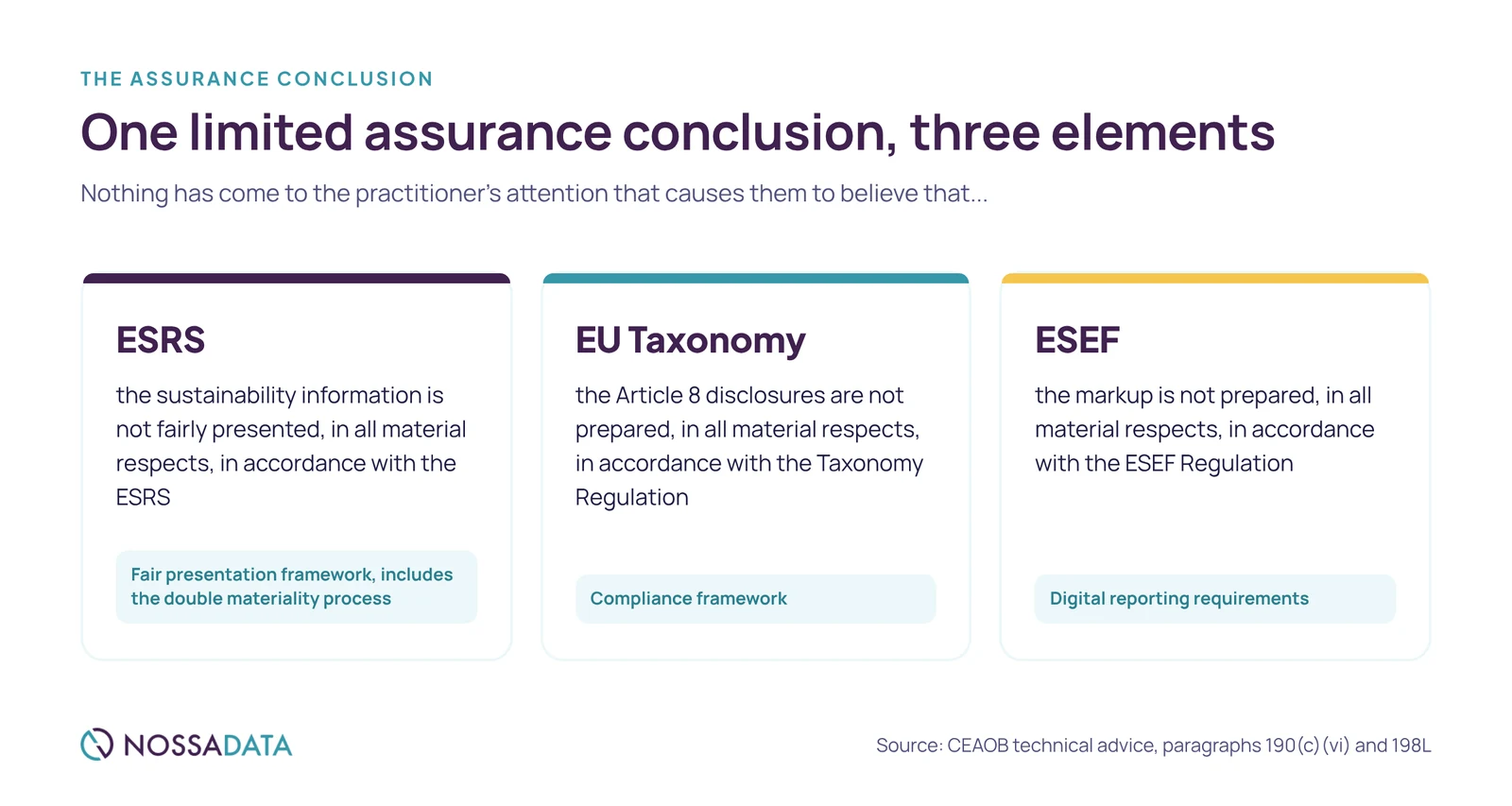
Under paragraph 198L, an unmodified conclusion states that nothing has come to the practitioner's attention that causes them to believe that the sustainability information is not fairly presented, in all material respects, in accordance with the ESRS. It goes on to say the same about the Taxonomy disclosures in their dedicated section, measured against the Taxonomy Regulation, and about the mark-up of the sustainability information, measured against the ESEF Regulation. It remains a single limited assurance conclusion, but it addresses each of the three elements separately, and the ESRS element includes the double materiality process the undertaking used to decide what to report.
What the assurance report looks like
The report has to be titled as an independent practitioner's limited assurance report, and the conclusion must appear in its first section. Where the report also deals with other legal and regulatory duties, the core content sits under the heading "Limited Assurance Report on the Sustainability Statement", followed by the "Report on Other Legal and Regulatory Requirements" (paragraph 195 M). Some national laws let a statutory auditor who also carries out the assurance engagement include the assurance report as a separate section of the audit report, and paragraph A537 ADD accommodates that approach.
Reporting under two standards at once
An undertaking can ask for its engagement to be performed under both the EU standard and another standard, with ISSA 5000 being the obvious choice for groups that have international investors. Paragraph 197 M allows this only where the two do not conflict. Paragraphs 197.1 and 197.2 ADD then add that any wording required by the other standard must sit in its own clearly titled section of the report, and that the complete EU documentation must be available to national competent authorities on request under Article 32 of the Audit Directive.
Inside the Commission's targeted consultation
The consultation document contains 11 numbered questions grouped into four areas, followed by an open section for anything else respondents want to raise. Each question points to the CEAOB paragraphs it relates to, and the Commission asks respondents to do the same, ideally supporting their views with data, practical examples and suggested wording.

| Question | What it asks about | CEAOB paragraphs | How you answer |
|---|---|---|---|
| 1 | ESRS and Taxonomy as the applicable criteria, with no suitability test | 18.12 ADD, 107 ADD, 77 and 78 | Appropriate, needs clarification, or not appropriate |
| 2 | How clear the "stand back" evaluation of fair presentation is | 181 to 183, A528 and A529 | Clear, partly clear, or not clear |
| 3 | What counts as "other information" | 18.39 ADD, 171 and 172 | Appropriate, needs clarification, or not appropriate |
| 4 | Relying on reports from accredited independent third parties | 18.1 ADD, 55.1 to 55.3 ADD | Appropriate, needs clarification, or not appropriate |
| 5 | Supplementary information that falls outside the criteria | 18.55, A20 ADD, A551 ADD | Appropriate, needs clarification, or not appropriate |
| 6 | Practical difficulties with the Taxonomy procedures | 126L M, A427 ADD | No, minor or significant difficulties |
| 7 | Practical difficulties with the ESEF mark-up procedures | 177.1 to 177.13 ADD | No, minor or significant difficulties |
| 8.1 and 8.2 | Paragraphs marked "not applicable" that should apply, and the reverse | Whole document | Yes or no, with the paragraphs listed |
| 9 | One conclusion covering the ESRS, the Taxonomy and ESEF | 190(c)(vi), 198L | Appropriate, needs clarification, or not appropriate |
| 10 | Engagements under the EU standard and another standard | 197 M, 197.1 and 197.2 ADD | Appropriate, needs clarification, or not appropriate |
| 11 | When the standard should become mandatory | 15 M | Financial years from 1 January 2027, from 1 January 2028, or later |
The open section invites comments on ten further topics: the balance between the double materiality process and its outcome, coordination with the statutory auditor, proportionality and cost, the difference in work effort between limited and reasonable assurance, the content of the assurance report, possible further add-ons, the application material, the introduction, the changes to definitions, and anything else respondents consider relevant.
Question 11 deserves a closer look, because the dates on offer do not quite line up with the advice. The CEAOB proposes periods beginning on or after 15 December 2027, while the questionnaire offers financial years starting on 1 January 2027, on 1 January 2028, or later. For calendar year reporters the 2028 option and the CEAOB proposal land in the same place, but the Commission also wants an estimate of how long methodology changes, training and IT preparation will take, so a reasoned answer will carry far more weight than a ticked box.
How to respond
Responses can only be submitted through the EUSurvey questionnaire, and the deadline is 18 January 2027 at 23:59 CET, so anything sent by email or post will not be counted. The Commission wants to hear from preparers, auditors and independent assurance service providers, investors and other users, standard setters, oversight bodies and civil society, and it is perfectly fine to answer only the questions that are relevant to you. Questions about the process itself can go to DG FISMA Unit C1 at fisma-csrd@ec.europa.eu.
What reporting teams can do now
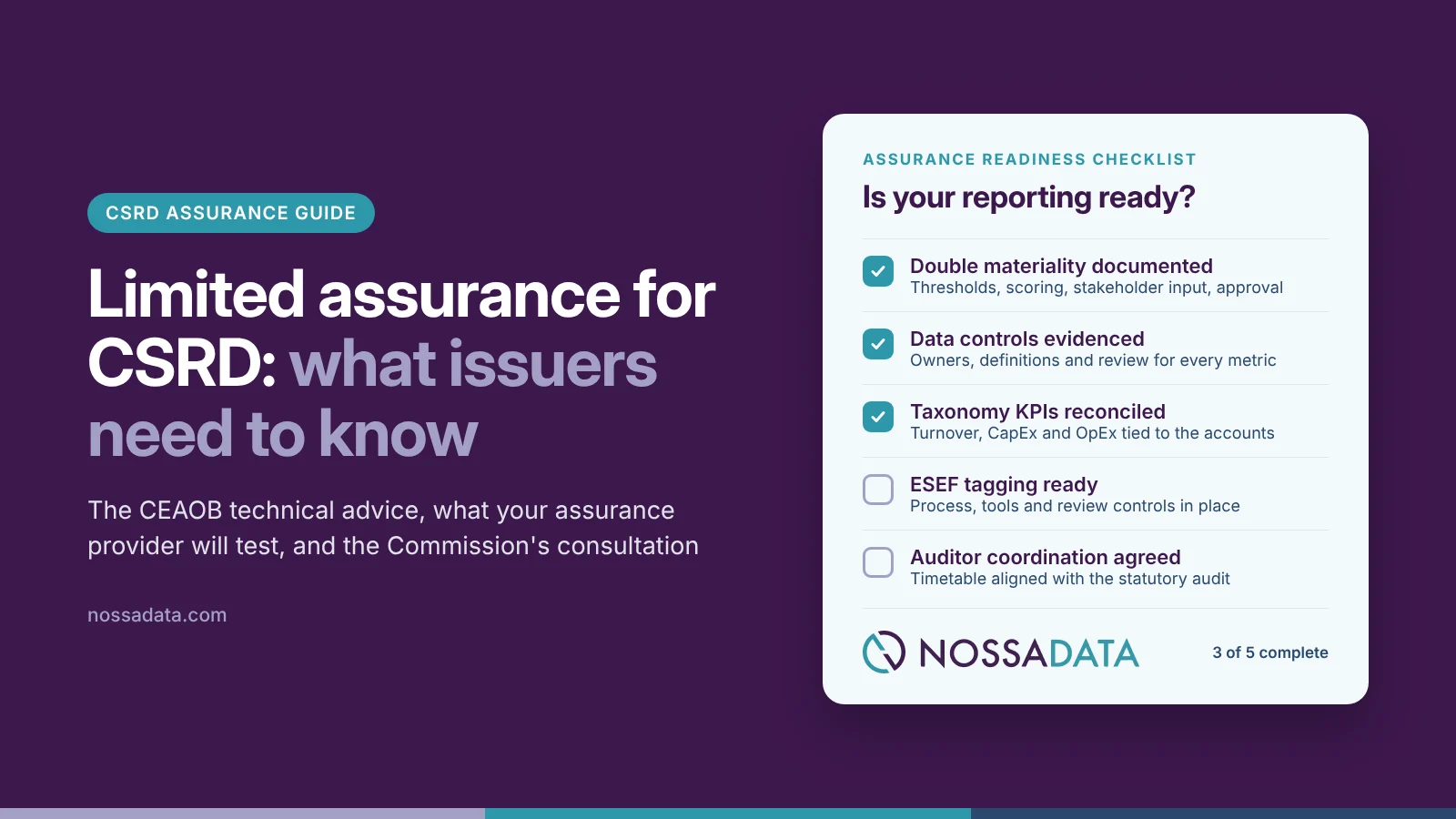
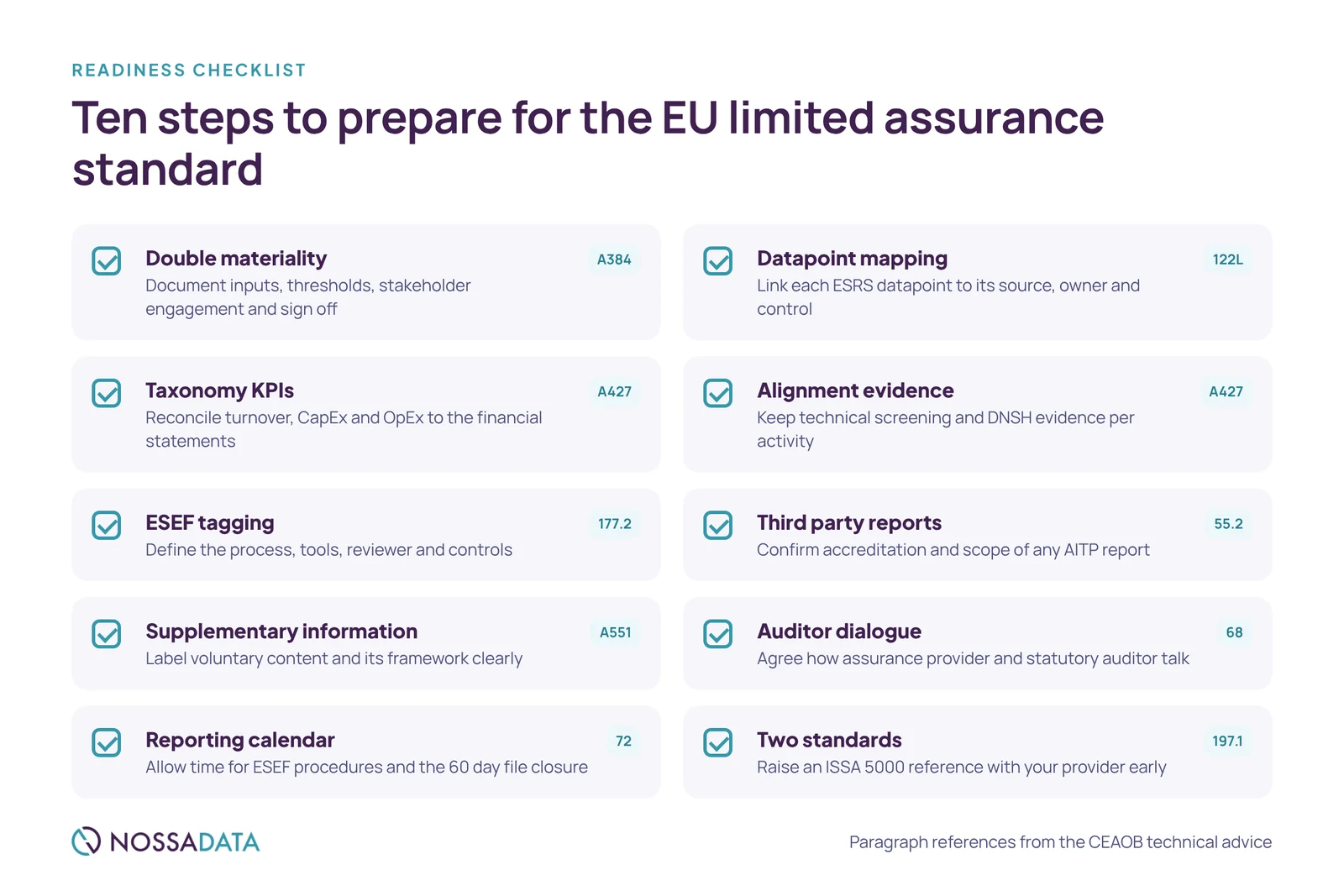
Taken together, the add-ons pull assurance into areas that many reporting teams still treat as secondary, namely digital tagging, Taxonomy calculations and the audit trail behind the double materiality assessment. None of these can be fixed in the weeks before a report is signed, which is why we would start on them well before the standard applies. The checklist below ties each step to the paragraph that drives it.
- Document the double materiality process as part of your information system, including the inputs, the impact and financial thresholds, the stakeholder engagement and the sign off (A384 ADD).
- Map every ESRS datapoint to its source system, owner and control, so that risk procedures at disclosure level have a clear trail to follow (122L M).
- Build Taxonomy KPI workpapers that reconcile turnover, CapEx and OpEx to the financial statements (A427 ADD, point d).
- Keep evidence of the technical screening criteria and the do no significant harm assessment for each aligned activity (A427 ADD, point b).
- Define your ESEF tagging process, the tools, the reviewer and any service provider involved, along with documented controls over completeness and accuracy (177.2 and 177.7 ADD).
- Identify any reports by accredited independent third parties that EU law requires of you, and check their accreditation and scope (55.2 ADD).
- Label supplementary information prepared under other frameworks clearly, with references, so that it can be scoped out of the engagement (A551 ADD).
- Agree how your sustainability assurance provider and your statutory auditor will communicate on connectivity matters (68 ADD).
- Plan your reporting calendar around the practitioner's ESEF procedures and the 60 day file closure (177.1 and 72 ADD).
- If investors expect a reference to ISSA 5000, raise the idea of a report under both standards with your provider early (197.1 ADD).
Much of this list comes down to traceability. When every disclosure, tag, calculation and piece of evidence is linked in one place, answering an assurance provider's questions becomes far less painful, and that is exactly the problem we built Nossa Data to solve.
Getting ready for the EU limited assurance standard? See how Nossa Data keeps your disclosures, evidence and Taxonomy workings ready for your assurance provider. Book a demo →
Frequently asked questions
Is the EU limited assurance standard the same as ISSA 5000?
Not quite, because it is ISSA 5000 with EU add-ons, modifications and carve-outs. The paragraph numbering stays the same, the paragraphs that only concern reasonable assurance are removed, and new procedures are added for ESEF mark-up, Taxonomy disclosures, reports by accredited independent third parties and joint assurance.
When will the EU limited assurance standard apply?
The CEAOB proposes that it should apply to periods beginning on or after 15 December 2027, with early application allowed. The Commission has to adopt the delegated act by 1 July 2027 and is asking for views on the start date in question 11 of its consultation.
Will the assurance provider check our ESRS digital tagging?
Yes, once ESEF mark-up applies to the sustainability statement. Paragraphs 177.1 to 177.13 ADD require a separate materiality level, a risk assessment focused on completeness, accuracy and machine readability, and a conclusion on whether the mark-up complies with the ESEF Regulation.
Does limited assurance cover the double materiality assessment?
It does, because the ESRS element of the conclusion includes the process the undertaking used to identify what to report, and paragraph A384 ADD treats that process as part of the information system the practitioner has to understand.
Can an assurance report refer to both ISSA 5000 and the EU standard?
Yes, if the undertaking asks for it and the two standards do not conflict. Every EU requirement still applies, and any wording the other standard requires has to sit in a separately titled section of the report (paragraphs 197 M and 197.1 ADD).
How do we respond to the Commission's consultation?
You can only respond through the EUSurvey questionnaire, and the deadline is 18 January 2027 at 23:59 CET. The most useful responses cite the CEAOB paragraph numbers and back up their views with evidence or practical examples.
Where can I find a broader introduction to CSRD assurance?
Our CSRD limited assurance guide for issuers covers the fundamentals, including how limited assurance differs from reasonable assurance and what issuers should prepare first.
Sources
- CEAOB technical advice on the standard for limited assurance on sustainability reporting (CEAOB 2026-026, September 2026)
- European Commission, Targeted consultation on limited assurance standard
- Consultation document: Limited assurance standard (12 November 2026)
- EUSurvey questionnaire for the consultation
- Call for evidence on corporate sustainability reporting limited assurance standards