When a DMA runs into trouble at assurance, the cause is usually mundane. The process described in the report isn't quite the process that was run, the scoring file has no written reasons behind the numbers, or nobody can show when the board signed off. Under limited assurance the auditor isn't there to second-guess your judgements. They want to see that you followed the method you describe, that you kept the evidence, and that everything you found material ends up in the sustainability statement.
This guide is written for sustainability and finance teams preparing CSRD reports. It covers what a DMA is, what the CSRD and ESRS require, how auditors approach it, and an eight-step process with the evidence to keep at each stage, and ends with three examples, each a fictional company taking a different route. Throughout, it draws on the 2025 annual reports of four wave 1 companies (Novo Nordisk, Ørsted, DSV and Heineken), all of which received unmodified limited assurance conclusions. It reflects the rules as of November 2026, including the revised ESRS adopted in July 2026.
What a double materiality assessment is
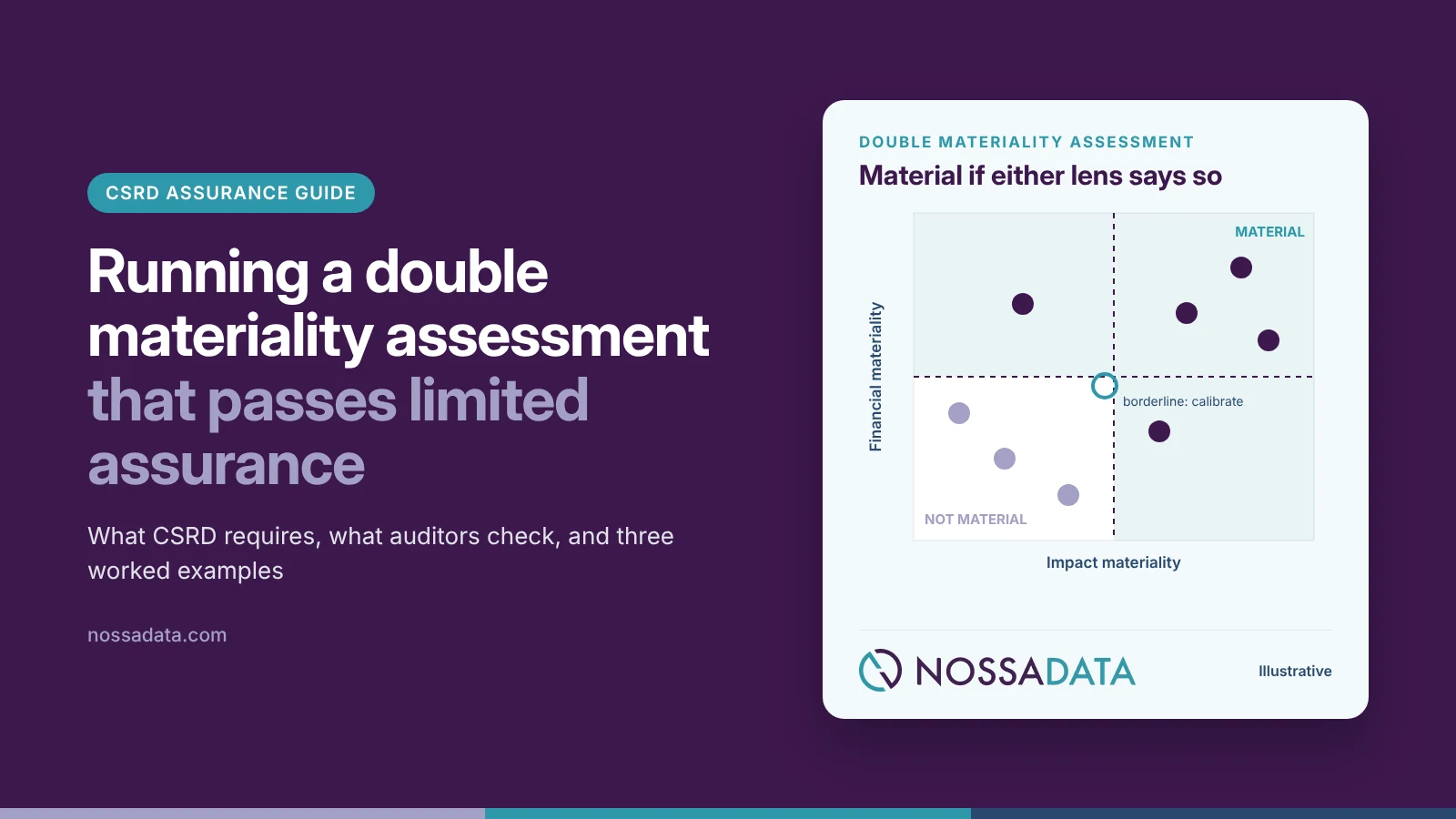
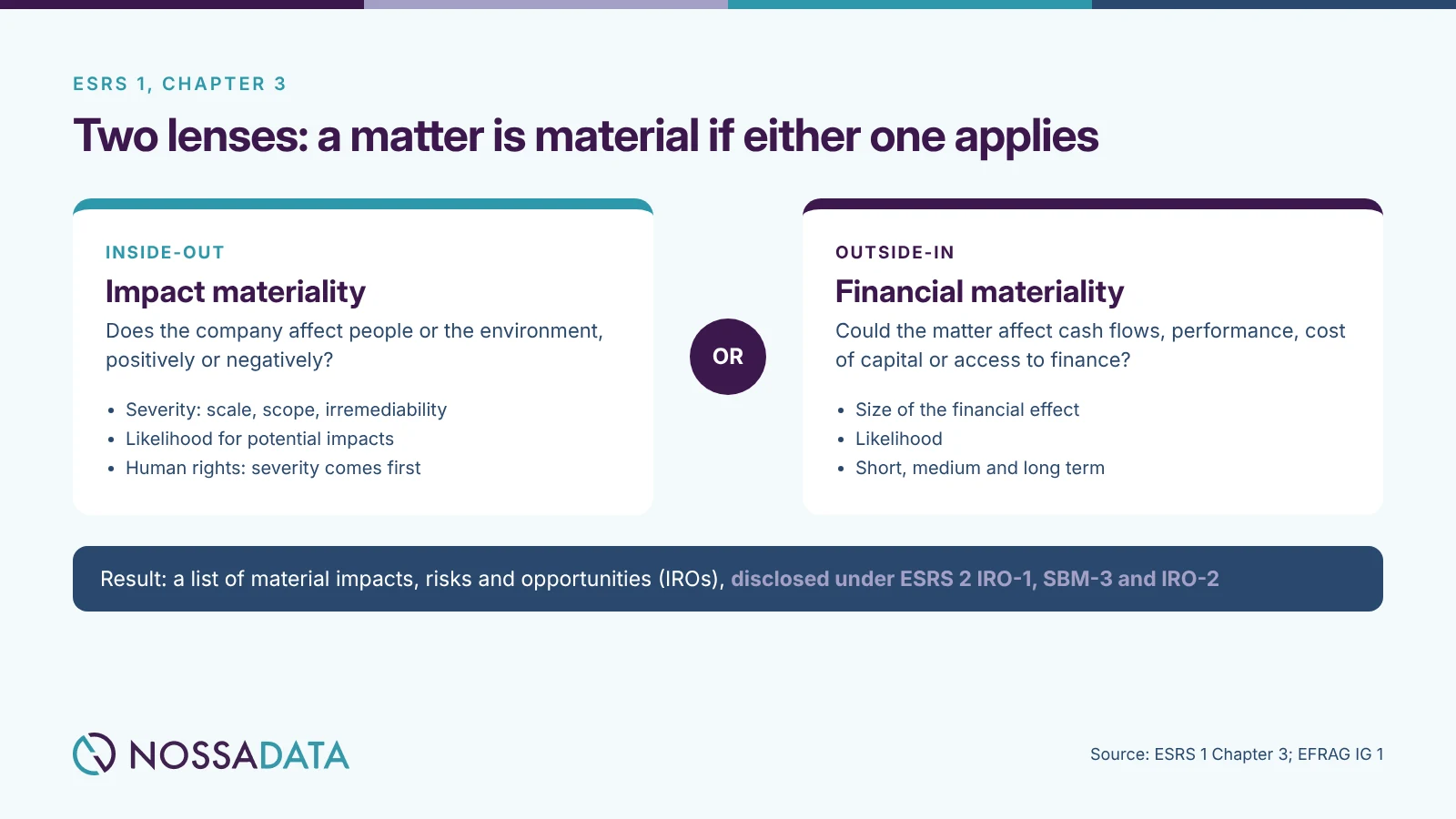
The DMA is how a company decides what it has to report under the ESRS. A sustainability matter is material if it matters from either of two angles.
| Perspective | The question | How ESRS 1 says to assess it |
|---|---|---|
| Impact materiality (inside-out) | Does the company have, or could it have, a significant effect on people or the environment, positive or negative? | Negative impacts: severity (scale, scope and how irremediable the harm is), plus likelihood for potential impacts. Positive impacts: scale, scope and likelihood. For potential human rights impacts, severity outweighs likelihood. |
| Financial materiality (outside-in) | Could the matter affect the company's cash flows, performance, position, cost of capital or access to finance? | Likelihood and size of the financial effect over the short, medium and long term. |
Heineken's report explains the two dimensions in one line each: impact materiality covers topics that "can significantly affect the economy, environment and people", and financial materiality covers topics that "can significantly influence HEINEKEN's development, performance or financial value".
A few terms come up again and again. The unit of analysis is the impact, risk or opportunity (IRO), and one topic can produce several. Ørsted's 2025 DMA, for example, found 31 material IROs: 6 positive impacts, 15 negative impacts, 8 risks and 2 opportunities. The assessment has to cover your own operations and your upstream and downstream value chain. ESRS 1 sets the time horizons: short term is the reporting period, medium term runs to five years, and long term is anything beyond that. Stakeholders fall into two groups: affected stakeholders (employees, value chain workers, communities, consumers, and nature as a "silent" stakeholder) and users of the report, such as investors and lenders. Impact materiality also draws on the human rights and environmental due diligence set out in the UN Guiding Principles and the OECD Guidelines.
The result is a list of material IROs. That list drives which topical standards and datapoints you report, and you disclose it under ESRS 2 SBM-3 and IRO-2. Novo Nordisk presents its list as a single table showing each IRO's position in the value chain, its time horizon and the page where it is discussed.

Novo Nordisk Annual Report 2025, p. 50. Each IRO is numbered, placed in the value chain, given a time horizon and linked to the page where it is managed. It also lists the topics found not material in a footnote.
CSRD and ESRS requirements for the DMA
Double materiality is required by law. The CSRD (Directive (EU) 2022/2464) amended the Accounting Directive so that companies report both their impacts on sustainability matters and how those matters affect the business. The ESRS turn that into specific requirements.
Where the requirements sit
| Source | What it asks for |
|---|---|
| ESRS 1, Chapter 3 | The double materiality principle, the impact and financial criteria, the role of stakeholders and how thresholds are set |
| ESRS 1, Chapters 4-6 | Due diligence, value chain coverage and time horizons |
| ESRS 2 IRO-1 | A description of the process used to identify and assess material IROs: methodology, stakeholder input, thresholds and changes from last year |
| ESRS 2 SBM-3 | The material IROs, where they sit in the value chain and how they affect strategy and the business model |
| ESRS 2 IRO-2 | The disclosure requirements covered by the statement, and materiality conclusions for datapoints required by other EU law |
| ESRS 2 SBM-2 | How you engage stakeholders and how their views feed into strategy |
| EFRAG IG 1 (May 2024) | Non-binding guidance with four illustrative steps (context, identification, assessment, reporting) and FAQs |
What changed in 2026
The Commission adopted simplified ESRS on 3 July 2026 (Delegated Regulation (EU) 2026/1463). They came into force on 10 November 2026 and apply to financial years starting on or after 1 January 2027. For FY2026 you can stay on the original ESRS (Delegated Regulation (EU) 2023/2772), adopt the revised version early, or use the original standards with selected reliefs. Whichever you choose, you have to say so.
For the DMA, five changes matter most:
- You can now reach a top-down conclusion that a topic or sub-topic is, or is not, material based on your strategy, business model, sectors, geographies and value chain. Where the answer isn't obvious you still need to assess at IRO level, and you can mix the two approaches.
- You can rely on reasonable and supportable information that's available without undue cost or effort. Not every topic needs full quantitative scoring.
- A full DMA isn't required every year, but you must revisit it when something significant changes. Heineken already works this way: it ran a full assessment in 2023, does targeted reviews in between, and has its next full assessment scheduled for 2026.
- The revised standards also settle the gross-versus-net question. Remediation in the current period doesn't reduce an actual negative impact. Prevention and mitigation reduce a potential impact only where you can reasonably assume they work, and IRO-1 has to explain how you handled this.
- Conclusions need reasonable evidence and documented judgements, especially where you've decided something is not material.
The Omnibus I Directive ((EU) 2026/470) also narrowed CSRD scope to groups with more than 1,000 employees and more than EUR 450 million net turnover. It confirmed limited assurance as the permanent level and dropped the planned move to reasonable assurance. Member States must transpose it by 19 March 2027.
The new rules mean less work, but more of the result rests on judgement. If you rule a topic out top-down, expect the auditor to ask how you got there.
How limited assurance of the DMA works
The assurance conclusion covers the DMA, and every wave 1 auditor's report says so. PwC's conclusion on DSV, for example, refers by page number to the section where the process is described:

DSV Annual Report 2025, p. 147 (PwC). The conclusion covers "the process carried out by Management to identify the information reported" and ties it to the description on pages 46-48.
Deloitte's report on Novo Nordisk and PwC's on Ørsted use the same structure. KPMG's report on Heineken lists among its procedures "considering whether the description of the double materiality assessment process in the sustainability statements made by the Executive Board appears consistent with the process carried out by the Company". The CEAOB's September 2026 technical advice keeps this approach for the future EU standard (para. 190 M).
Which standards apply
| Period | Standard | What it says about the DMA |
|---|---|---|
| Now (FY2024-FY2026 reports) | ISAE 3000 (Revised) or national standards, with the CEAOB Guidelines on limited assurance (30 September 2024, non-binding) | Section 8: understand the process, check the description matches what was done, and design procedures against ESRS 1 Chapter 3, ESRS 2 IRO-1 and EFRAG guidance |
| From periods starting on or after 15 December 2027 (proposed) | EU limited assurance standard, a delegated act based on ISSA 5000, due by 1 July 2027 | The DMA is part of the entity's information system that the practitioner must understand (CEAOB advice para. A384 ADD, applying ISSA 5000 paras. 117(a) and A377-A382) |
The Commission's consultation on the EU standard closes on 18 January 2027. Our CSRD limited assurance guide covers the draft standard and the consultation in more detail.
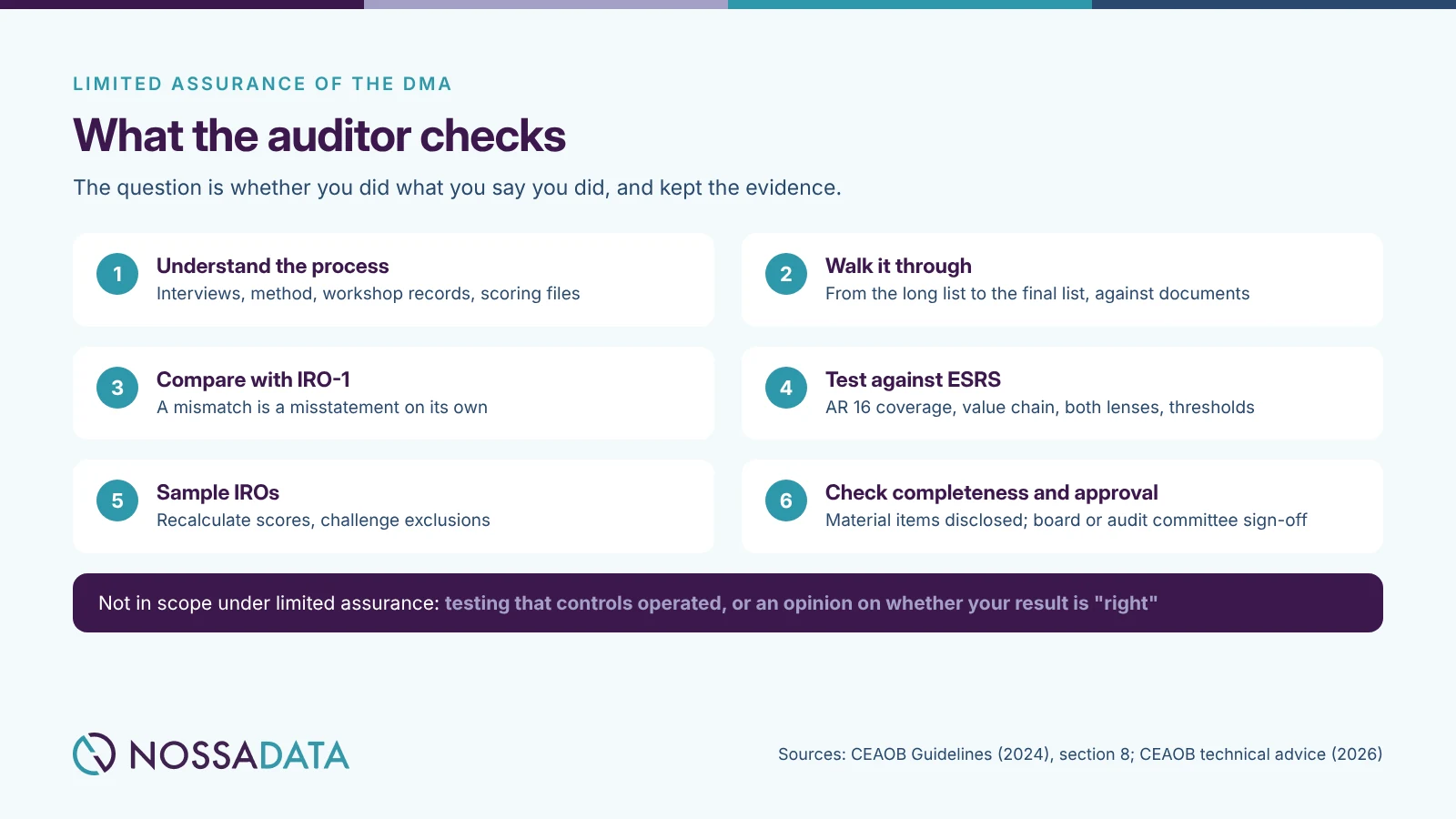
What the auditor actually does
Procedures depend on risk and judgement, but for the DMA you can expect most of the following:
- Interviews with the people who ran the DMA, and a look at the methodology, workshop records and scoring files.
- A walkthrough from the long list to the final list of IROs, checked against documents.
- A comparison of your IRO-1 text with what really happened. If they don't match, that is a misstatement on its own.
- Checks against the ESRS: was the AR 16 list considered, is the value chain covered, were both impact and financial materiality assessed, did stakeholders inform the result, and were thresholds applied as stated?
- Sample testing of individual IROs: recalculating scores, tracing them to evidence and challenging the reasoning, particularly for topics you've excluded.
- A check that what the DMA found material actually appears in the statement, and whether entity-specific disclosures are needed.
- Evidence of approval by management and the audit committee or board.
Under limited assurance the auditor doesn't test whether your controls operated effectively and doesn't give a view on whether your result is "correct". But the CEAOB guidelines say that if the process misses material matters, the conclusion should reflect it. A poorly designed process that leaves out or obscures material information can lead to a qualified or adverse conclusion.
Two kinds of materiality
Double materiality decides what you report. Assurance materiality is the auditor's view of which errors could change a reader's decisions. Most DMA errors are qualitative (an inaccurate process description, a missing topic), so auditors weigh them individually and together rather than adding them up the way they would financial errors.
Step by step: a DMA that holds up at assurance
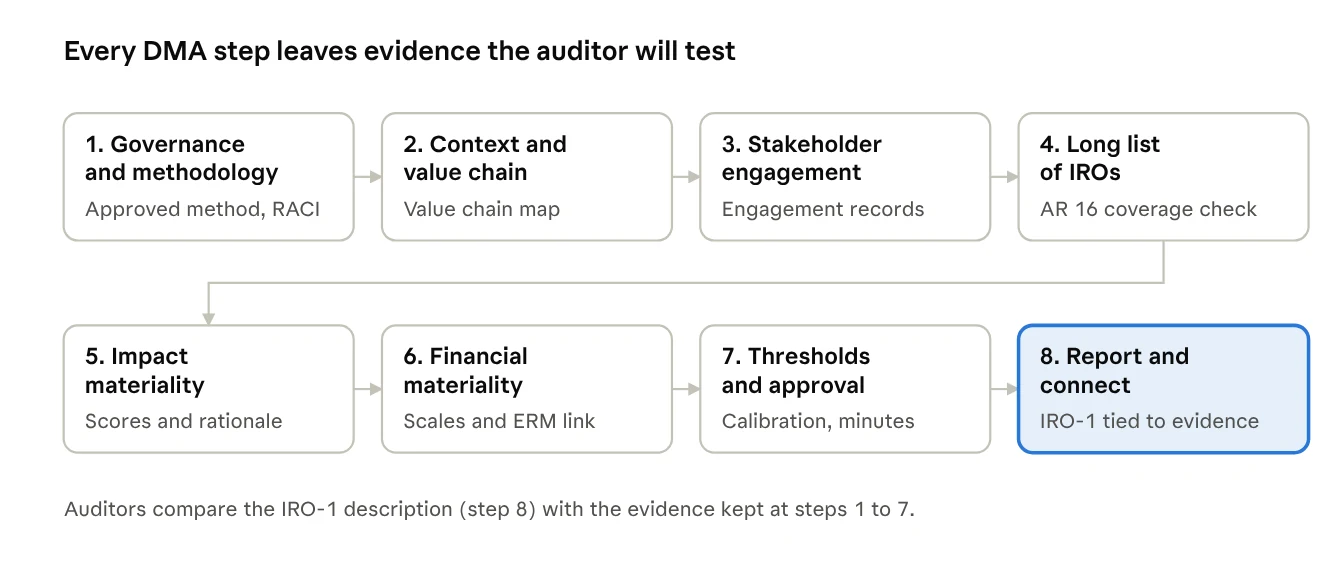
The process below follows the four stages in EFRAG IG 1 (context, identification, assessment, reporting), with governance added at the front and approval before reporting. There's no single right number of steps. DSV describes three (mapping, identification, rating), Ørsted five and Heineken six. What matters is that you write your steps down, follow them and describe them as they happened.
Step 1: Agree the method and who owns it
Write the method down and get it approved before you start. Auditors compare three things: what you planned, what you did and what you describe in IRO-1.
The method should name a process owner and the subject-matter experts (SMEs) for each topic. It should also set out the scoring scales, thresholds, gross/net approach, time horizons and aggregation rules, say whether you'll use top-down conclusions, bottom-up scoring or both, and explain how the DMA links to enterprise risk management (ERM).
Heineken shows its method as a simple six-phase graphic, and each phase then gets its own explanation in the text. A reader, or an auditor, can check each phase against evidence.

Heineken Annual Report 2025, p. 163.
Keep: a versioned methodology document, a RACI chart, and the approval record.
Step 2: Understand the business and its value chain
Document what the company does and where: activities, products, sites, markets and business relationships. Then map the value chain upstream (supplier categories, tiers and countries) and downstream (distribution, use and end-of-life). Confirm the DMA covers the same entities as the consolidated financial statements.
Heineken grouped its operations and relationships into upstream, operational and downstream activities and then mapped each shortlisted topic against them. Ørsted says plainly where it focused: on the upstream value chain, "focusing on sourcing of materials and exposure to certain geographies that might give rise to a heightened risk of adverse human and labour rights impacts and of environmental impacts". An auditor can check a statement like that.
Keep: the context analysis, value chain map and a reconciliation of the DMA scope to the consolidation list.
Step 3: Bring in stakeholder views
The ESRS don't prescribe an engagement method, but you have to disclose whether and how you consulted affected stakeholders. The four companies took different routes, and all passed assurance:
- Heineken engaged directly. It ran 25 in-depth interviews with NGOs, investors, governments, customers and trade associations, then surveyed 119 stakeholders in 15 markets (60% response rate) to check the results.
- Ørsted and Novo Nordisk relied mainly on internal SMEs as proxies for stakeholder views. Ørsted calls its SMEs "a valid proxy for bringing the interests and views of our stakeholders into the DMA" and backs this up with community engagement and investor input at calibration. Novo Nordisk supplemented SME input with external value chain insights gathered in 2024.
- DSV combined stakeholder dialogue with data sources: due diligence findings, peer and sector studies, media monitoring, risk surveys and scientific research.
Using proxies is fine as long as you explain why and describe it accurately. Heineken also explains a deliberate gap: it did not consult affected communities on pollution "as we found no indications of communities being directly impacted by pollution". Auditors look for reasons like this.
Keep: a stakeholder map with reasons for inclusion, engagement records, and a matrix showing which engagement findings fed which IRO decisions.
Step 4: Build the long list
Auditors push hardest on whether the long list is complete. Start from the sustainability matters in ESRS 1 AR 16 and work through every topic, sub-topic and sub-sub-topic. Ørsted states that it "considered all the sub-sub-topics listed in ESRS 1". Add entity-specific matters from sector standards, peers, media, regulatory developments and your own due diligence (grievance data, supplier audits). For each IRO, record whether it's an impact, risk or opportunity, positive or negative, actual or potential, where it sits in the value chain and over what time horizon.
Show how the list was narrowed. Heineken started with 30 topics, combined and removed some to reach a draft shortlist of 17, and confirmed 15 with 30 SMEs. It also explains individual decisions, such as excluding animal welfare as "relevant for peers but not necessarily for HEINEKEN" and treating innovation as an enabler rather than a topic. Under the revised ESRS you can also conclude top-down that a topic is clearly in or out, but the reasoning still needs to be written down.
Keep: the long list with an AR 16 coverage check, your screening sources, and the reasons for each exclusion or merger.
Step 5: Assess impact materiality
Score negative impacts on scale, scope and irremediable character, and positive impacts on scale and scope. Add likelihood for potential impacts. For potential human rights impacts, severity takes precedence. Use data where you have it, such as emissions, water risk or injury rates.
Ørsted's methodology shows the level of detail auditors expect. It defines each parameter in plain terms (scope is "how widespread the impact is, e.g. the number of sites it relates to") and says that likelihood is weighted evenly with severity, except for human rights impacts. It also explains its gross/net choice: for actual negative impacts it took account of mitigation actions, including the "licence to operate" conditions set by authorities. DSV adds a rule of its own: positive impacts are rated only where they reflect "a net benefit beyond standard practice". Whatever your choices, state them and apply them consistently.
Keep: a scoring file with criteria definitions, each score, who scored and reviewed it, when, and a written reason.
Step 6: Assess financial materiality
Score risks and opportunities on likelihood and size of financial effect over the short, medium and long term. Define what each point on the size scale means (for example as a share of revenue or EBIT, plus qualitative effects on reputation and access to finance). Look at dependencies on natural, human and social resources, and pass anything that could affect the accounts to the finance team.
Auditors often find gaps between the DMA and ERM, and all four companies deal with it. Heineken took financial materiality inputs from its yearly Risk Assessment Cycle. Ørsted assessed financial effects through scenario-based stress tests and aligned risks with its enterprise risk framework. DSV went further in 2025 and added two risks long managed in ERM, employee attraction and retention and non-compliance with sustainability regulation, to the DMA so the two processes match.
Keep: the financial scoring sheet, the definitions behind your magnitude scale, a reconciliation to the ERM register and notes of discussions with Finance.
Step 7: Apply thresholds, calibrate and get approval
Apply the thresholds you agreed, aggregate scores using your stated rules, take borderline cases to a management calibration session, and get the result approved.
Heineken's report walks through each of these. It set the threshold at 2.5 out of 5 for both dimensions, "as this represents the median value on the 5-point scoring table". The Executive Board then used its judgement to move two topics just below the line, labour practices and human rights, and diversity, equity and inclusion, into the material group. In 2025 it reassessed business conduct because the 2023 financial score had been close to the threshold, and the reassessment brought non-compliance with laws and regulations into scope. Every one of these decisions is written up in the report.
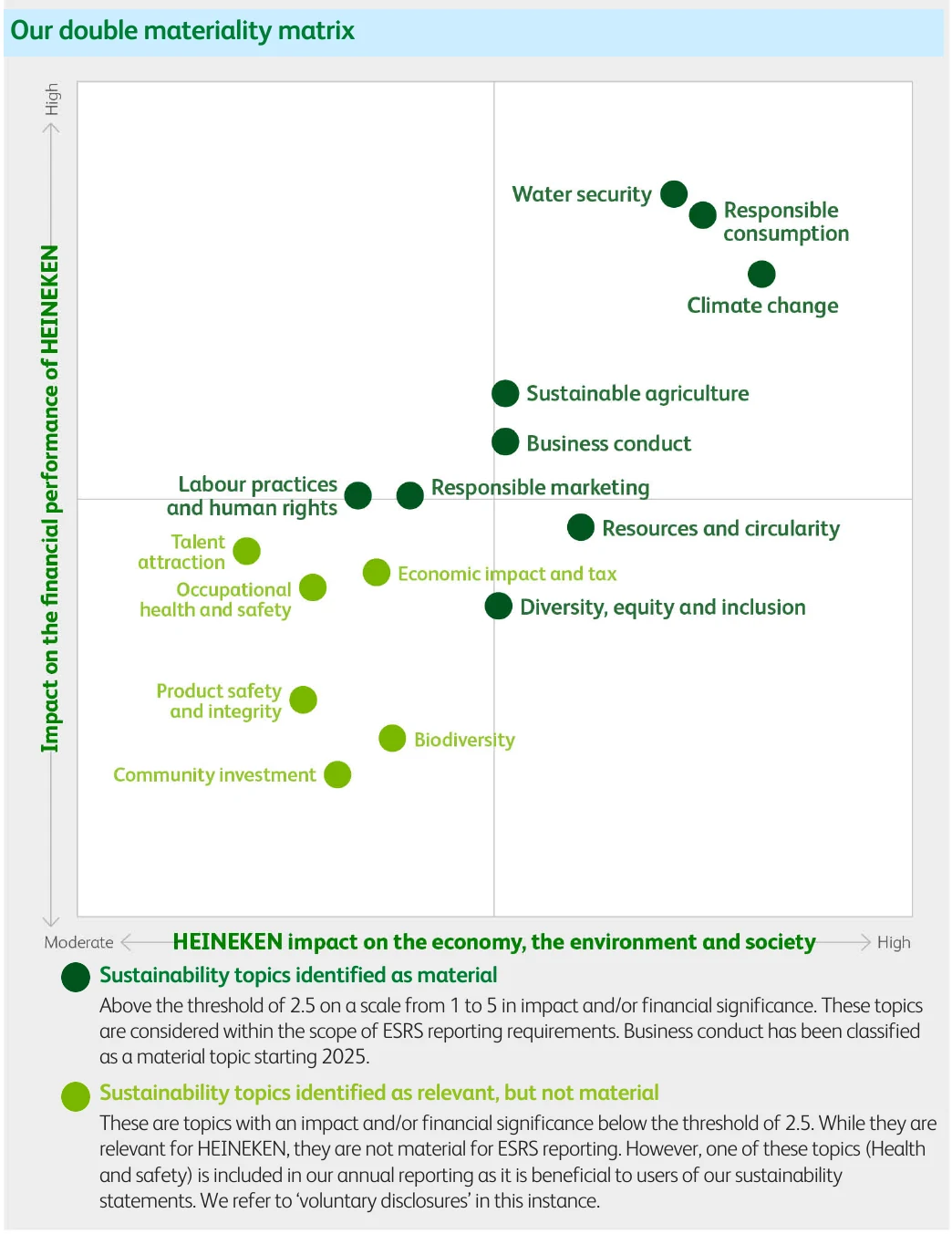
Heineken Annual Report 2025, p. 159. Topics above 2.5 on either axis are material. Health and safety sits below the threshold but is reported voluntarily, which Heineken labels as such.
Ørsted presents its result as a quadrant view of topics rather than individual scores, with a count of IROs by type under each topic. It also explains year-on-year changes: IROs merged from 40 to 31, the threshold unchanged, and no topic moving above or below the line.
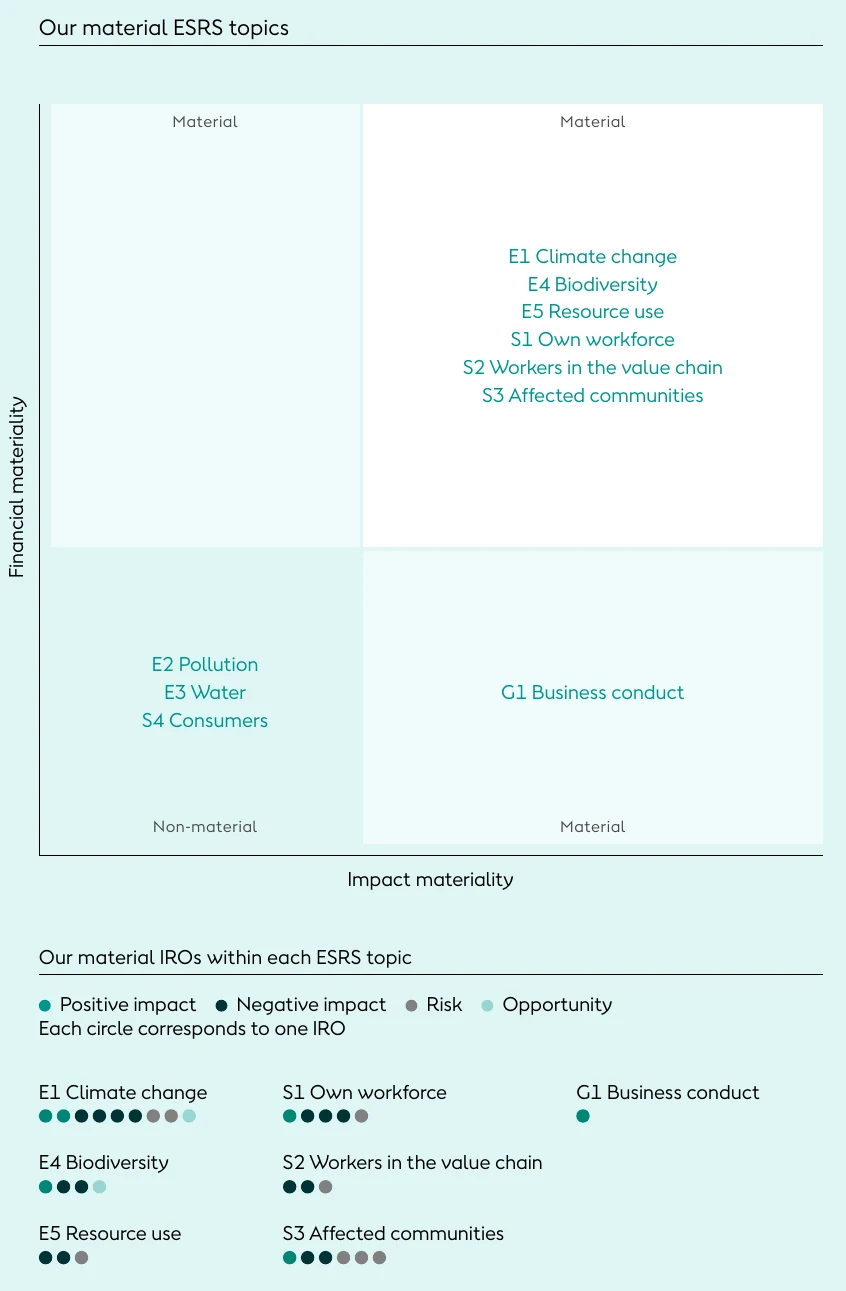
Ørsted Annual Report 2025, p. 65.
Approval should sit with a governance body. At DSV the final list is reviewed by SMEs and the Executive Board and approved by the Audit Committee. At Ørsted it is approved by the Group Executive Team; at Heineken by the Executive Board; at Novo Nordisk the process ends with an Audit Committee review.
Keep: the threshold rationale, aggregation workings, calibration minutes with a log of borderline cases, and the approval papers and minutes.
Step 8: Report, and connect the DMA to the rest of the statement
Write IRO-1 to describe the process you actually ran. Disclose material IROs under SBM-3 and the list of covered disclosure requirements under IRO-2. Map every material IRO to its topical disclosures and add entity-specific disclosures where no ESRS covers a matter.
DSV's table is a good model for an SBM-3 summary. It shows each material topic, whether the impact is positive or negative, whether it sits in own operations or the value chain, and whether it is actual or potential.
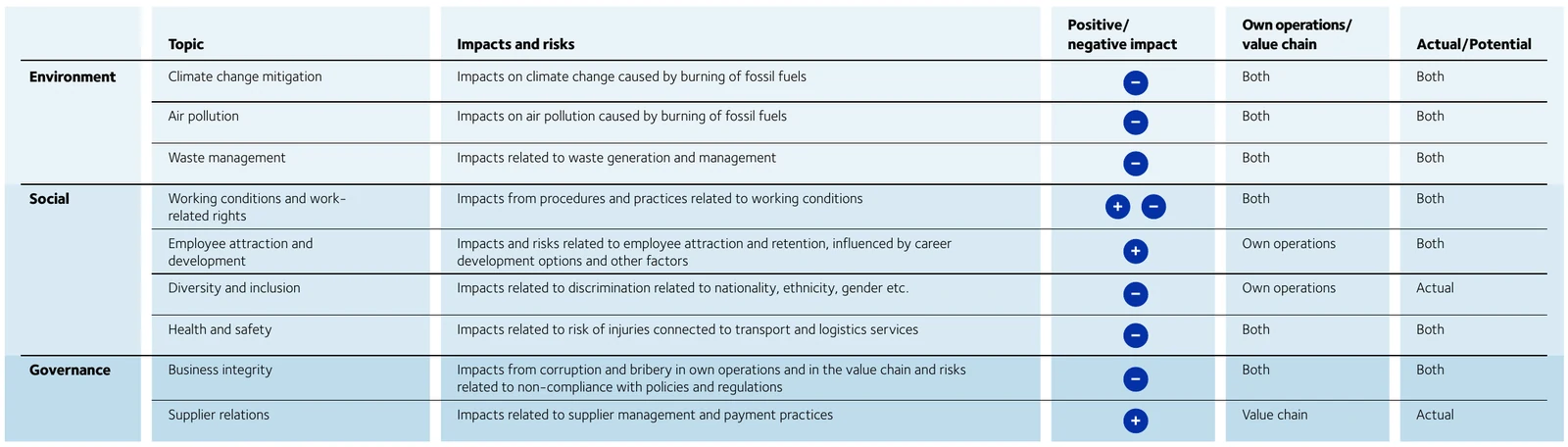
DSV Annual Report 2025, p. 47.
Explain what you left out, too. Ørsted explains why it omitted E2 Pollution and E3 Water (the IROs fell below the threshold because of the high minimum environmental standards authorities impose) and states that it found no IROs at all for S4 Consumers. DSV explains why its material topics didn't change after it acquired Schenker: the two companies are in the same industry, with similar business models and regions.
Keep: an IRO-1 draft mapped line by line to evidence, your ESRS index, a log of omissions with reasons, and a comparison with last year's list.
Getting ready for the auditor
The CEAOB expects an auditor's file to be clear enough that an experienced practitioner who wasn't involved could follow the work and the conclusion (Guidelines, section 21). Hold your DMA file to the same standard. Someone new should be able to pick it up and trace the path from method to final list.
Controls worth having
| Control | What it guards against | Evidence |
|---|---|---|
| SME sign-off on each IRO score and reason | Scores nobody can explain | Sign-off column in the scoring file |
| Review of scores by the process owner | The same scale used differently by different teams | Review log with name and date |
| Management calibration of borderline cases | Inconsistent decisions near the threshold | Calibration minutes |
| Version control after approval | The list changing after sign-off without anyone noticing | File history and change log |
| IRO-1 text mapped to evidence | A description that doesn't match what happened | Annotated IRO-1 draft |
| Audit committee or board approval | Judgements made without oversight | Committee papers and minutes |
| Internal audit or second-line review | Weaknesses found late by the external auditor | Review memo and remediation tracker |
These controls also feed your ESRS 2 disclosure on internal controls over sustainability reporting. Novo Nordisk, for instance, describes an annual risk assessment of sustainability data, a central repository of risks and controls, quarterly Disclosure Committee and Audit Committee review, and independent testing by Group Internal Audit.
The evidence pack
Put together and index the following before the auditor's interim visit:
- Approved method and governance documents
- Context analysis, value chain map and scope reconciliation
- Stakeholder map, engagement records and traceability matrix
- Long list with AR 16 coverage and screening sources
- Impact and financial scoring files with reasons
- Threshold rationale, aggregation and calibration records
- Approval minutes
- IRO-1, SBM-3 and IRO-2 drafts mapped to evidence
- Last year's findings and how they were fixed
Rehearse the walkthrough
The process owner should be able to talk through each step in about an hour, pull up the right document at each point, and answer "why" for a sample of IROs, including at least one topic you decided wasn't material. Try it first with internal audit or a colleague who wasn't involved.
Where DMAs usually fall down
- IRO-1 describes surveys or external engagement that never took place, or a scoring method that changed partway through.
- Scores have no written reason, or a topic is marked not material with nothing to back it up. This is the most common gap, and the revised ESRS single it out.
- AR 16 sub-topics or parts of the value chain were never looked at, or entity-specific matters are missing.
- Different SMEs applied the same criteria differently and nobody reviewed it.
- Risks in the DMA don't match the risk register, or the other way round, with no explanation.
- The board approved the result after the statement was already drafted, or there's no record of approval.
- A topic is material but nothing in the statement covers it.
The four reports in this guide have a few things in common. They name their steps, give reasons for their thresholds and exclusions, explain what changed from last year and say who approved the result.
A suggested timeline for a calendar-year reporter
Aim to finish the DMA well before year end, so the auditor can review it at the interim visit and you have time to fix anything they find. A rough plan for FY2027, the first year the revised ESRS are mandatory:
- Q1 2027: Decide how you'll transition (revised ESRS; top-down, bottom-up or both). Update and approve the method. Agree scope and timing with your auditor.
- Q2 2027: Refresh the context and value chain analysis, run stakeholder engagement and update the long list.
- Q3 2027: SME scoring workshops, alignment with ERM, calibration of borderline items.
- Early Q4 2027: Audit committee approval, auditor's interim review and walkthrough, and fixes.
- Q4 2027 to Q1 2028: Map material IROs to disclosures; draft IRO-1, SBM-3 and IRO-2; year-end assurance; publication with the annual report.
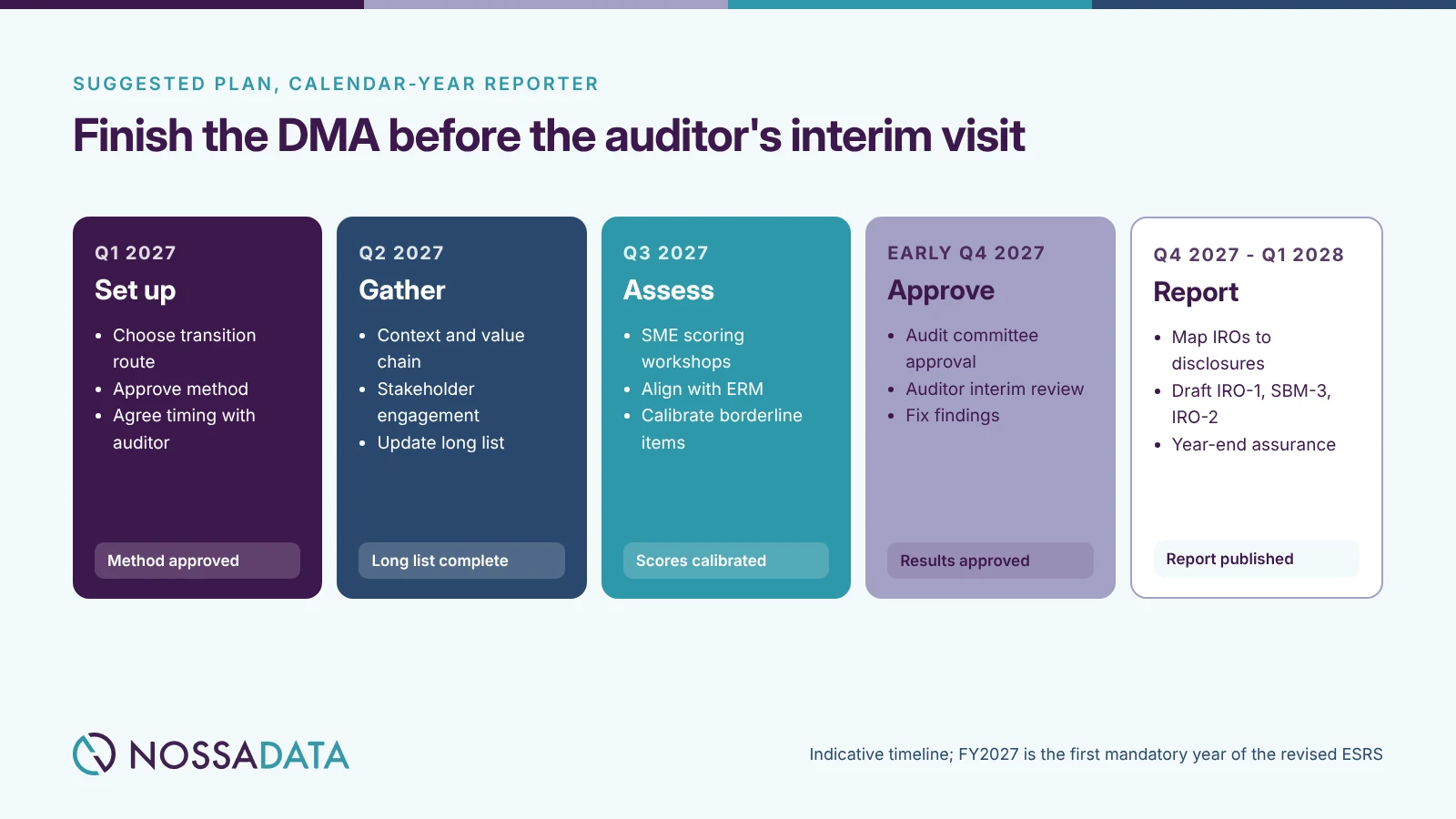
In later years you can refresh the DMA rather than rerun it in full, as Heineken does between its three-yearly assessments. Just record why nothing significant changed. DSV's note on the Schenker acquisition is a good example of how to do that briefly.
Example 1: a coffee-shop chain running its first DMA
The three examples that follow show the steps in practice, each taking a different route. The first is a simple business running its first full DMA. The company and all figures are made up.
Harbour Coffee runs 180 cafés in the Netherlands, Belgium and Germany, with about 1,400 staff and EUR 480 million turnover, so it is just inside the post-Omnibus CSRD scope. It buys green coffee from importers who source from farms in Brazil, Colombia and Ethiopia, roasts it in one plant near Rotterdam, and sells drinks, pastries and sandwiches. Most staff are baristas on hourly contracts.
Method and context (steps 1 and 2)
The Head of Sustainability writes a six-page method in January. It sets a 1-5 scale for every criterion and a threshold of 3.0 for both impact and financial materiality. For potential impacts, the score is the average of severity and likelihood, except for human rights impacts, where severity alone counts. It also says that topics clearly irrelevant to a café business can be ruled out top-down with a written reason. The CFO signs it off and the audit committee notes it in February.
The team then maps the value chain on one page: coffee farms and importers upstream; the roastery, cafés and office in own operations; and customers and waste collection downstream. The map covers all three country subsidiaries, matching the consolidation list.
Stakeholders and the long list (steps 3 and 4)
Harbour Coffee can't interview coffee farmers directly, so it uses two of its importers' farm audit reports and a 2025 NGO study on labour conditions in coffee as proxies, and writes down why. It surveys baristas in all three countries, holds a session with its works council, and asks its two main lenders what they care about.
The team works through every topic in ESRS 1 AR 16. It rules out three top-down, recording a sentence for each. Pollution (E2): no manufacturing beyond roasting, and roastery emissions are well within permit limits. Affected communities (S3): no land use or large sites near communities. Marine resources (part of E3): no link to its activities. Everything else goes on the long list as individual IROs.
Scoring and calibration (steps 5 to 7)
Three SME workshops score the long list. A shortened version of the result:
| IRO | Topic | Type | Score (1-5) | Result |
|---|---|---|---|---|
| Emissions from dairy and coffee supply chain | E1 Climate | Negative impact, actual, upstream | Impact 4.0 | Material |
| Drought pushing up green coffee prices | E1 Climate | Risk, medium to long term | Financial 4.0 | Material |
| Single-use cups sent to incineration | E5 Resource use | Negative impact, actual, downstream | Impact 3.3 | Material |
| Forced or child labour on coffee farms | S2 Value chain workers | Negative impact, potential, human rights | Impact 3.7 (severity only) | Material |
| Allergen incidents with customers | S4 Consumers | Negative impact, potential | Impact 3.5 | Material |
| Barista scheduling and pay | S1 Own workforce | Negative impact, actual | Impact 2.7 | Material after calibration |
| Water use in coffee growing | E3 Water | Negative impact, actual, upstream | Impact 2.3 | Not material |
| Deforestation linked to coffee | E4 Biodiversity | Negative impact, potential, upstream | Impact 2.7 | Not material |
| Demand for plant-based menu | E1/S4 | Opportunity | Financial 2.5 | Not material |
Two items needed judgement, and both are written up. Barista scheduling scored 2.7, below the threshold. At the calibration meeting the COO pointed to 60% annual staff turnover and complaints raised through the works council, so management moved it into scope and minuted why. Deforestation also scored 2.7. The team checked importer data showing most of its coffee comes from established farms with no recent land conversion, kept it out of scope, and noted that it will be reviewed again once EU Deforestation Regulation checks are complete.
The audit committee approves the final list of six material IROs in October, before drafting starts.
Reporting (step 8)
Harbour Coffee's IRO-1 disclosure is short and matches what happened. An extract:
We assessed all sustainability matters in ESRS 1 AR 16 across our value chain. Three topics were ruled out because they are not relevant to our activities, with reasons documented. Remaining impacts, risks and opportunities were scored by internal experts on a 1-5 scale, with a threshold of 3.0. We could not engage coffee farm workers directly; we used importer audit reports and independent research as proxies. One topic below the threshold, barista scheduling and pay, was included by management because of high staff turnover. The audit committee approved the results in October 2027.
Each material IRO is then linked to its ESRS disclosures: E1 for emissions and the coffee price risk, E5 for cups, S2 for farm labour, S4 for allergens and S1 for barista conditions.
What the auditor did
In November the auditor interviewed the Head of Sustainability, walked through the process using the evidence pack, recalculated scores for five IROs and asked for the reasoning behind the deforestation and barista decisions. They found one problem: the draft IRO-1 said baristas were surveyed "across all markets", but the German survey covered only 40 of 60 cafés. The wording was corrected before publication, and the conclusion was unmodified.
Harbour Coffee's evidence pack held 14 documents: the method and its approval, the value chain map, survey results, works council notes, the two importer audit reports and the NGO study, the AR 16 checklist with top-down reasons, the scoring file, calibration minutes, audit committee minutes and the IRO-1 draft annotated with document references.
Example 2: a software company refreshing its DMA
This example shows a different route: a company that has already reported for two years, uses the revised ESRS to refresh rather than rerun its DMA, and concludes that climate change is not material. The company and figures are made up.
Northlane Software sells payroll and HR software to mid-sized employers. It has about 2,100 staff in offices in Sweden, Poland, Spain and Ireland, and EUR 620 million turnover. Its software runs on a large public cloud provider, so it owns no data centres. In March 2027 it buys a small Portuguese firm that analyses sickness absence data for clients.
Deciding not to start from scratch
Northlane ran full DMAs in 2024 and 2025. For FY2027 its method, updated in January, says the DMA will be refreshed unless there is a significant change in business model, footprint or value chain. The acquisition counts as a trigger, so the team scopes a targeted review: what new impacts, risks or opportunities could the Portuguese business bring?
For everything else, the team writes a two-page refresh memo. It compares headcount, countries, products, customer base and suppliers with 2025 and concludes nothing has changed enough to alter the results. Each comparison points to a source: the HR system, the customer list and the supplier register.
Top-down conclusions
Under the revised ESRS, Northlane rules out six topics top-down. Each gets a one-line reason:
| Topic | Conclusion | Reason recorded |
|---|---|---|
| E2 Pollution, E3 Water, E4 Biodiversity | Not material | Offices only; no production; no sites in or near protected areas |
| E5 Resource use | Not material | Main outflow is laptops, already returned to a certified refurbisher |
| S2 Value chain workers | Not material | Suppliers are cloud, software and office services in low-risk countries; checked against supplier register |
| S3 Affected communities | Not material | No physical operations affecting communities |
| E1 Climate change | Not material after scoring | See below |
Climate change gets more than a sentence, because ESRS 2 expects a detailed explanation when a company concludes it is not material. Northlane scores it bottom-up. Its 2027 footprint is about 9,000 tCO2e, mostly from cloud hosting and business travel, and its cloud provider has a published plan to run on renewable electricity. The impact scores 2.4 against a threshold of 3.0. Financial risks also score low: the main exposure is a modest rise in cloud costs. The two lenders consulted didn't raise climate as a concern. All of this goes into a one-page explanation that is published in the statement.
What changed after the acquisition
The targeted review finds no new topic, but it does change one score. The Portuguese firm handles health-related absence data, which is more sensitive than payroll data. The privacy impact on clients' employees (S4) rises from 3.8 to 4.4, and the related regulatory risk under the GDPR rises from 3.2 to 3.9. Both were already material. The team also notes that the acquired firm's 60 staff are now included in the S1 assessment.
The final material list is the same as 2025: data privacy and security for end-users (S4), talent attraction and retention (S1) and employee wellbeing (S1). The audit committee approves it in September.
What the auditor did
The auditor spent most of their time on the refresh memo and the climate conclusion. They checked the memo's comparisons against the HR system and supplier register and found them supported. On climate, they noticed that the first draft of the explanation used 2025 emissions data. Northlane updated it with 2027 figures, including the acquired company, and the score didn't change. The conclusion was unmodified.
A refresh saves a lot of work, but deciding that nothing significant changed is a judgement too, and it needs evidence like any other.
Example 3: a furniture manufacturer with several sites
The third example is a manufacturer that runs a full bottom-up assessment across several sites, uses an external consultant, and ties financial materiality to its risk register. Again, the company and figures are made up.
Fjord & Pine makes flat-pack and solid wood furniture for retailers. It has 3,200 staff, EUR 900 million turnover and four subsidiaries: a sawmill and two factories in Poland, a lacquering and finishing plant in Portugal, and a sales company in Germany. It buys timber from forests in Poland, the Baltics and Ukraine.
Using a consultant without handing over the judgement
Fjord & Pine hires a consultancy to run the workshops and build the scoring tool. Its method makes clear that management owns the conclusions: each site manager and functional head reviews and signs the scores for their area, and the sustainability lead reviews the consolidated result. The auditor later asks for this evidence specifically, because they need to see that the company, not the consultant, made the calls.
Scoring site by site
Because the four sites do very different things, the team scores each one separately and then aggregates. The method sets the rule in advance: a topic is material for the group if it is material at the group level or at any site that accounts for more than 10% of headcount or revenue.
That rule matters for air pollution. At the group level it scores 2.6, below the 3.0 threshold. But the Portuguese finishing plant uses solvent-based lacquers and scores 3.6 on its own, and it accounts for 18% of headcount. So air pollution (E2) is material for the group, and the reason is written into the IRO-1 disclosure.
| Topic | Poland sawmill | Poland factories | Portugal plant | Group result |
|---|---|---|---|---|
| E4 Timber sourcing and deforestation | 4.1 | 3.2 | 2.0 | Material |
| E1 Emissions (energy and transport) | 3.4 | 3.5 | 3.1 | Material |
| E5 Wood inflows and offcut waste | 3.8 | 3.6 | 2.2 | Material |
| E2 Air pollution from lacquers | 1.5 | 2.0 | 3.6 | Material (site rule) |
| S1 Health and safety | 3.9 | 3.7 | 3.3 | Material |
| S2 Forestry workers | 3.5 | n/a | n/a | Material |
| S3 Noise and dust near the Portugal plant | n/a | n/a | 2.4 | Not material |
For S3, Fjord & Pine didn't rely on proxies. It met the parish council near the Portuguese plant and reviewed two years of local complaints (four, all about lorry traffic). That evidence supported a score below the threshold.
Linking to the risk register
Fjord & Pine defines financial magnitude in money terms: 1 means an effect below 0.5% of EBIT, 5 means more than 10%. During calibration, Finance spotted a problem. The enterprise risk register listed timber supply and EU Deforestation Regulation compliance as a top-five risk, but the DMA scored it 2.5, below the threshold. The scorers had looked only at fines, not at the cost of losing certified supply. After re-scoring with Finance, using the EBIT scale, it came out at 3.6 and became material. The calibration minutes record why the score changed.
The board's audit committee approved eight material IROs across six topics in October.
What the auditor did
The auditor tested the aggregation rule by recalculating the group results from the site scores, checked the site managers' sign-offs, and compared the DMA risks with the enterprise risk register. Because the deforestation risk had already been reconciled during calibration, they found no differences. The conclusion was unmodified.
If you score by site, settle the aggregation rule before scoring starts. And compare the results with your risk register yourself, before the auditor does.
What the three examples show
| Example 1: Harbour Coffee | Example 2: Northlane Software | Example 3: Fjord & Pine | |
|---|---|---|---|
| Route | First full DMA | Refresh with a targeted review | Full bottom-up, site by site |
| Stakeholder input | Proxies for farm workers; staff survey; works council; lenders | Customer advisory board; employee survey; lenders | Direct meetings with community; site staff; Finance |
| Use of top-down | Three topics ruled out | Most environmental topics ruled out | None |
| Key judgement | Barista pay included below threshold | Climate change not material | Air pollution material because of one site |
| Auditor focus | Accuracy of IRO-1 wording | Evidence for "nothing changed" | Aggregation and link to risk register |
Sources
Regulation and guidance
- Directive (EU) 2022/2464 (CSRD) - EUR-Lex
- Commission Delegated Regulation (EU) 2023/2772 (ESRS Set 1) - EUR-Lex
- Revised ESRS delegated act, adopted 3 July 2026 - IAS Plus summary and EY EU Sustainability Developments, July 2026
- Commission staff working document SWD(2026) 500 on the revised ESRS
- EFRAG IG 1 Materiality Assessment Implementation Guidance (May 2024)
- CEAOB Guidelines on limited assurance on sustainability reporting (30 September 2024)
- CEAOB technical advice: standard for limited assurance on sustainability reporting (CEAOB 2026-026, September 2026)
- European Commission targeted consultation on the limited assurance standard (closes 18 January 2027)
- IAASB, ISSA 5000 General Requirements for Sustainability Assurance Engagements (November 2024)
Company examples (2025 annual reports, wave 1 reporters)
- Novo Nordisk A/S, Annual Report 2025: double materiality assessment pp. 49-50; Deloitte limited assurance report pp. 123-124
- Ørsted A/S, Annual Report 2025: double materiality assessment and methodology pp. 65-66; stakeholders p. 67; PwC limited assurance report pp. 215-216
- DSV A/S, Annual Report 2025: double materiality assessment pp. 46-48; PwC limited assurance report pp. 147-148
- Heineken N.V., Annual Report 2025: double materiality matrix p. 159; DMA process pp. 163-164; KPMG limited assurance report pp. 270-271