If a customer has asked you to get an EcoVadis rating, you're far from the only one. EcoVadis ratings are used in more than 1,000 global finance and commerce value chains, across 220+ industry categories and 180+ countries (EcoVadis Ratings Methodology Overview and Principles).
So how does EcoVadis work? In short, you answer an online questionnaire, back up each answer with documents, and EcoVadis analysts score your sustainability management out of 100. This guide walks through each stage, from registering to receiving your scorecard, working on your Corrective Action Plan and, hopefully, earning a medal. Everything in it is taken from EcoVadis' own published material, including the methodology changes they've made during 2026.
Who is EcoVadis and what is a sustainability assessment?
EcoVadis is a sustainability ratings company based in Paris. More than 1,000 global finance and commerce value chains use its ratings, which cover over 220 industry categories in more than 180 countries.
An EcoVadis assessment doesn't just ask what your company believes about sustainability. It checks how you actually manage it. EcoVadis looks at three things: the policies you've committed to, the actions you've put in place (including any certifications), and the results you can show through metrics and reporting.
Analysts score these using seven indicators: Policies, Endorsements, Measures, Certifications, Coverage, Reporting and 360° Watch Findings. That last one covers what outside sources, such as NGOs, trade unions, regulators and the press, are saying about your company.
The questions themselves are organised around 21 sustainability criteria, split across four themes:
| Theme | Criteria assessed |
|---|---|
| Environment | Energy Consumption & GHGs; Water; Biodiversity; Air Pollution; Materials, Chemicals & Waste; Product Use; Product End-of-Life; Customer Health & Safety; Environmental Services & Advocacy |
| Labor & Human Rights | Employee Health & Safety; Working Conditions; Social Dialogue; Career Management & Training; Child Labor, Forced Labor & Human Trafficking; Discrimination & Harassment; External Stakeholder Human Rights |
| Ethics | Corruption; Anticompetitive Practices (now assessed via 360° Watch only); Responsible Information Management |
| Sustainable Procurement | Supplier Environmental Practices; Supplier Social Practices |
EcoVadis based this model on recognised international standards, including the UN Global Compact's Ten Principles, ILO conventions, GRI standards, ISO 26000, the CERES Roadmap and the UN Guiding Principles on Business and Human Rights.
One thing to understand: EcoVadis only gives you credit for what you can prove. If you tick an answer but don't attach a document that backs it up, it won't count towards your score.
How does EcoVadis work? The assessment process step by step, and what it costs
From the moment you're invited to the day your scorecard is published, a standard EcoVadis process usually takes around 12 to 16 weeks (EcoVadis Help Center). Here's how it runs.
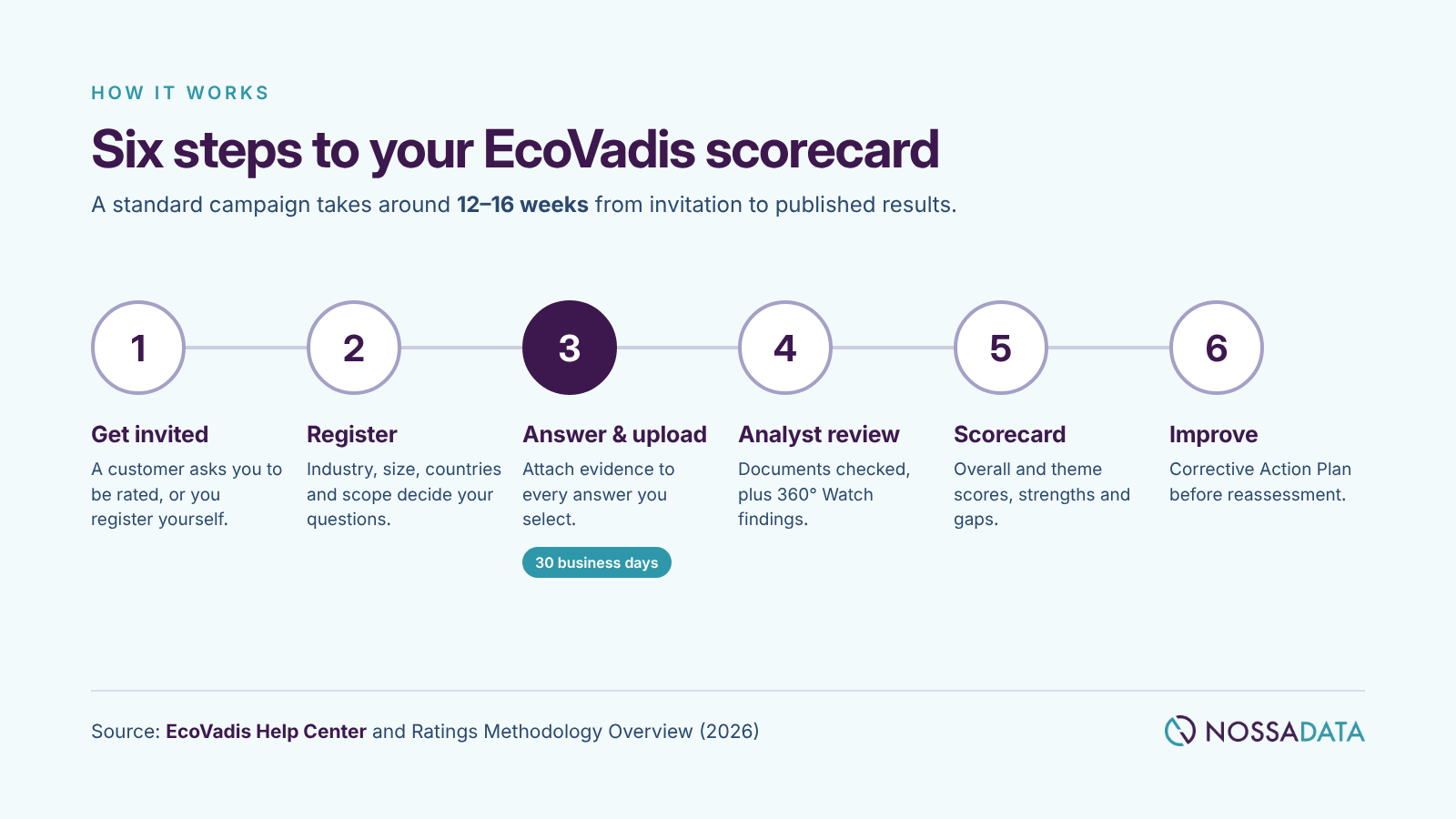
- You get invited, or sign up yourself. Most companies hear about EcoVadis because a customer asks them to be rated, but you can also register on your own.
- You register your company. You'll confirm your industry (ISIC code), size, the countries you operate in and the scope of the assessment (Group, Entity or Site). The details you select at this time decide which questions you get.
- You fill in the questionnaire. For every answer you select, you attach a document that proves it. The default deadline is 30 business days, and EcoVadis says it can take anywhere from a few hours to a few days depending on how organised your documents are (EcoVadis Help Center). In Nossa's experience, most responses take about 1–2 weeks to answer, and it can take longer once you factor in documentation requirements.
- EcoVadis analysts review it. They go through each document you've attached and also look at 360° Watch findings from outside sources such as NGOs, trade unions and regulators. Note that EcoVadis can reject your documentation, so just because you submitted it doesn't mean you will get credit.
- Your scorecard is published on the EcoVadis platform.
- You work on improvements. The Corrective Action Plan and EcoVadis Academy courses help you prepare for your next assessment. You can also engage with EcoVadis Training Partners like Nossa Data to advise on how to improve your score.
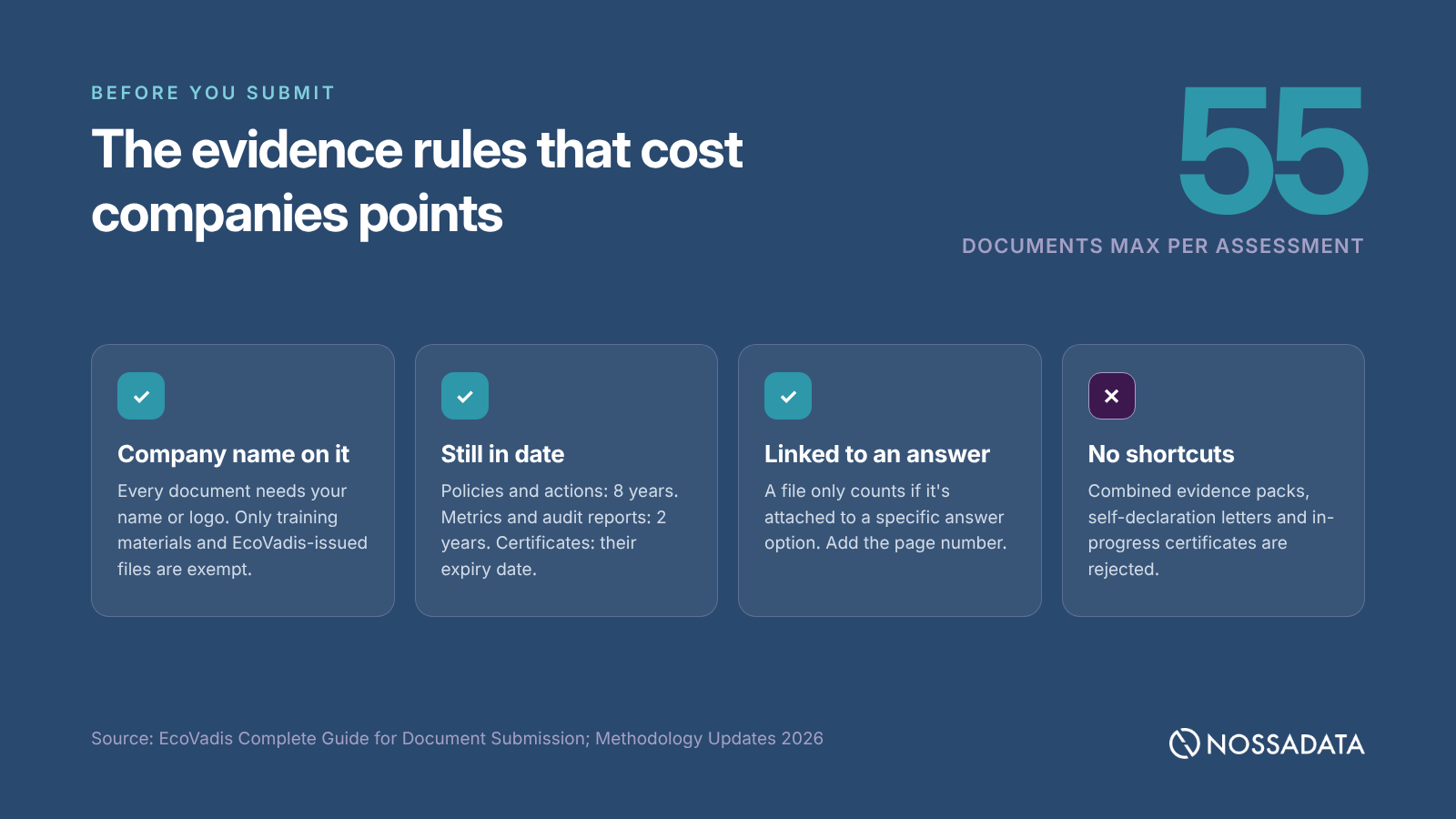
The EcoVadis Complete Guide for Document Submission is an important document to consider before you start. Most lost points come down to evidence. The main rules are:
- You can upload a maximum of 55 new documents per assessment, however big your company is.
- Each document needs your company name or logo on it. Training materials and documents issued by EcoVadis are the only exceptions.
- Documents have an expiration date. Policies and actions are valid for 8 years, metrics and external audit reports for 2 years, and certificates until the expiry date printed on them.
- A document is only looked at if it's linked to a specific answer, so add the page number too and ideally a comment.
- EcoVadis will reject combined "evidence packs", self-declaration letters and AI-generated text that hasn't been tailored to your business.
What does an EcoVadis assessment cost?
There's no single price list. What you pay depends on your company's size, where you're based and the plan you choose, and prices are quoted excluding VAT (EcoVadis Subscription Costs). You can get an estimate from the EcoVadis Plans and Pricing page, and plans are available on 1-year or 3-year terms.
| Plan | Key inclusions |
|---|---|
| Basic | Industry-specific assessment and scorecard; sharing inside the EcoVadis network only; improvement tools; up to 3 e-learning users |
| Premium | Everything in Basic, plus peer benchmarking, medals and badges (if eligible), sharing outside the network and live news monitoring |
| Select | Everything in Premium, plus priority assessment, pre-filled questionnaire (if eligible), orientation call, 90-minute scorecard presentation and a dedicated account manager |
| Corporate | Everything in Premium, plus group and entity scorecard management and cross-entity document sharing |
For pricing, EcoVadis groups companies into four sizes: XS (up to 25 employees), S (26 to 99), M (100 to 999) and L (1,000 or more). Some companies get up to six weeks to fill in the questionnaire for free, but you'll need a paid subscription before you can submit it.
How do you know what the EcoVadis questionnaire will ask?
The questions you see depend on your industry, your size and where you operate, all of which you give EcoVadis when you register. EcoVadis uses this to decide which of the 21 criteria matter for a company like yours, and switches on ("activates") only those. That's why a small office-based business ends up with a much shorter questionnaire than a manufacturer.
EcoVadis gives an example comparing a plastics manufacturer with a software company:
| Criterion | Plastic products manufacturer | Software company |
|---|---|---|
| Energy Consumption & GHGs | Activated | Activated |
| Air Pollution | Activated | Not activated |
| Materials, Chemicals & Waste | Activated | Activated (waste only) |
| Customer Health & Safety | Activated | Not activated |
| Child Labor, Forced Labor & Human Trafficking | Activated | Not activated |
| Employee Health & Safety | Activated | Activated |
The questions also change within each criterion. A construction firm and a consultancy will both be asked about employee health and safety, but the answer options they choose from look very different.
You can get a good idea of what's coming before you start:
- Look up your industry risk profile on the EcoVadis platform. It shows which criteria are activated for you, how important each one is and how much weight (from 1 to 4) each theme carries.
- Get familiar with the layout. The questionnaire goes theme by theme (Environment, Labor & Human Rights, Ethics, Sustainable Procurement), then by indicator, then question by question (Understanding my questionnaire).
- Stick to your activated criteria. EcoVadis specifically advises against answering criteria that aren't activated for you.
- Read EcoVadis' Document Guide and Scoring Principles, which explain the evidence they expect for each indicator.
Example EcoVadis questions
Most questions follow the same pattern. You tick the practices your company has in place, then attach a document for each one as proof. The examples below come from EcoVadis' published methodology and guidance, though the exact wording you see will depend on your company profile.
1. "What actions are in place regarding employee health and safety?"
This sits under Labor & Human Rights. A construction company would see options like regular health check-ups, protective equipment, fall prevention, protection in confined spaces, risk assessments and an emergency action plan. A consultancy gets a different list, covering things like stress and psychological wellbeing, an emergency plan, health and safety training and workstation ergonomics.
2. What policies and targets do you have?
Each theme asks about your commitments. If you've set a target, EcoVadis will only give you credit for it if it has a measurable goal, a baseline year and a future deadline. For example: "reduce energy consumption by 5% by 2030 compared with 2023".
3. What are your energy and greenhouse gas figures?
Under Environment, you'll report figures such as total energy use in kWh. Since May 2026 the Scope 2 question asks for two numbers: your total gross location-based and market-based Scope 2 emissions (Methodology Updates Q1 2026). Any figures you report need a reporting year and a unit, and can't be more than two calendar years old.
4. Which certifications do you hold?
You'll be asked about certifications such as ISO 14001, ISO 45001, ISO 27001, ISO 37001, SA8000 or B Corp. They need to come from an accredited body, and since April 2026 EcoVadis no longer accepts certificates that are still "in progress".
5. How prepared are you for environmental risks?
This one is new for 2026. Two questions ask whether you carry out external environmental risk assessments and how you'd deal with environmental disruption. Your answers won't change your score, but they will show up as Strengths or Improvement Areas on your scorecard.
How does EcoVadis scoring work, and how do you see your results?

Once the analysts have finished, you'll get an EcoVadis scorecard on the platform. It shows an overall score out of 100, a score for each of the four themes, and a list of your Strengths and Improvement Areas.
Here's how the score is worked out. Analysts give each of the seven indicators a score of 0, 25, 50, 75 or 100 for every theme. These combine into a theme score, with policies counting for 25%, actions for 40% and results for 35%. Your overall score is then an average of the four themes, weighted from 1 to 4 depending on your industry, size and location. EcoVadis uses this scale to describe what the overall score means:
| Overall score | Performance level | Likely outcome |
|---|---|---|
| 85–100 | Outstanding | High opportunity |
| 65–84 | Advanced | Medium opportunity |
| 45–64 | Good | Engaged |
| 25–44 | Partial | Medium risk |
| 0–24 | Insufficient | High risk |
Alongside the scores, each theme lists your Strengths and Improvement Areas, with a suggested priority for each improvement. How many you get doesn't affect your score. During 2026 EcoVadis has been replacing its broader Improvement Areas with more specific feedback, so it's now clearer what to work on.
Since mid-2026, you get to see your scorecard on your own for two business days before your customers do. If you spot a factual mistake, such as wrong company details or a document applied to the wrong answer, you can report it in that window. You can't use it to challenge your score, and the scorecard publishes automatically once the two days are up (Methodology Updates Q2 2026).
What is the EcoVadis Corrective Action Plan?
The Corrective Action Plan (CAP) is the part of the EcoVadis platform where you plan and track the improvements suggested by your scorecard. EcoVadis describes it as "the only place where corrective actions can be tracked and updated."
When your scorecard is published, every Improvement Area automatically becomes a corrective action, carrying the same title. Each one has a priority based on how much the related theme and indicator affect your score, so a high-priority action in a heavily weighted theme matters more than one in a light theme.
Scorecards are valid for 12 months, and EcoVadis recommends being reassessed every year (Getting ready to start a reassessment).
Want support raising a score? Nossa Data helps companies understand and act on their gaps as a licensed EcoVadis advisor. See how we support EcoVadis responses.
Who might use the data you submit?
Your questionnaire answers are kept confidential. Customers see your results, but not the answers behind them (EcoVadis Help Center). Here's who can see what:
| Who | What they can see |
|---|---|
| EcoVadis analysts | All documents you upload, for assessment purposes only |
| The customer who requested your assessment | Your scorecard results, plus any later results |
| Other trading partners on EcoVadis | Your company name and basic details in the directory; your results only after a sharing request |
| Partners outside the EcoVadis network | Your scorecard, if you share it by email or PDF (Premium, Select and Corporate plans) |
A few more things to be aware of. If a trading partner asks to see your results, the request is accepted automatically unless you decline it within seven calendar days (How can I share my EcoVadis Scorecard?).
Your documents stay private unless you choose otherwise. When you upload a file, you mark it as Private (only EcoVadis analysts see it) or Public (your requesting customers can see it, but it isn't published online). Documents you add to your Corrective Action Plan are shown to your requesting customers unless you mark them private.
As for who actually uses the ratings, EcoVadis says they're used by procurement, finance, investment and banking teams to keep track of the sustainability performance of their suppliers, portfolios and trading partners.
What are EcoVadis medals and badges?
EcoVadis medals go to the top 35% of rated companies. Your position is worked out as a percentile against every company EcoVadis has rated in the previous 12 months, across all industries rather than just yours (EcoVadis Medals and Badges).
| Recognition | Who qualifies |
|---|---|
| Platinum medal | Top 1% (99th percentile and above) |
| Gold medal | Top 5% (95th percentile and above) |
| Silver medal | Top 15% (85th percentile and above) |
| Bronze medal | Top 35% (65th percentile and above) |
| Committed badge | Overall score of at least 45 ("Good") |
| Fast Mover badge | Score of 34–44 with an improvement of at least 6 points on the previous assessment within 18 months |
There are a few conditions. To get a medal you need a score of at least 30 in each of the four themes, so one weak theme can hold you back even if your overall score is high. If you earn a medal you won't also get a badge, and negative 360° Watch findings can stop you getting either.
Some industries can't receive medals at all, including tobacco, weapons and ammunition manufacturing, and coal or lignite mining. And you can only promote your medal or badge publicly if you're on a Premium, Select or Corporate plan.
What is the EcoVadis Gold medal threshold?
The EcoVadis Gold medal goes to companies in the top 5% of all rated companies, meaning the 95th percentile or above. There is no fixed Gold score. EcoVadis says "score thresholds for medals are not published, as they may shift" (Understanding EcoVadis Medals and Badges).
That's because medals are relative, not absolute. Your percentile is set on the day your scorecard is published, by comparing your overall score with every company EcoVadis has assessed in the previous 12 months, across all industries. If other companies improve, the score you need for Gold goes up with them.
To be eligible for Gold, you also need to:
- score at least 30 in every one of the four themes (Environment, Labor & Human Rights, Ethics and Sustainable Procurement);
- avoid serious 360° Watch findings: a 360° Watch score of 0 in any theme, or 25 in two or more themes, rules you out of a medal, with some exceptions;
- not be in an excluded industry, such as tobacco, weapons and ammunition, or coal and lignite mining.
A Gold medal, like the scorecard behind it, is valid for 12 months and shows the month and year it was published. To keep it, you'll need to be reassessed, and you'll be ranked against the latest 12 months of results again.
If you're aiming for Gold, the practical route is to focus your evidence on your highest-weighted themes, fix any theme sitting near the 30-point floor, and work through the high-priority actions in your Corrective Action Plan before reassessment.
What is the EcoVadis Vitals Questionnaire?
Vitals is a free, short questionnaire that buyers send to their suppliers to get a quick picture of sustainability risk (EcoVadis Vitals Questionnaire). It isn't the same thing as a full EcoVadis rating, and the differences are worth knowing:
| Vitals Questionnaire | Full EcoVadis Rating | |
|---|---|---|
| Cost to you | Free | Paid subscription |
| Time to complete | Under 30 minutes | A few hours to a few days |
| How you start | Invitation from a business partner | Invitation or self-registration |
| Evidence | Optional documents (e.g. environmental certificate, code of ethics) | Document required for each selected answer |
| Result | Vitals dashboard within minutes | Analyst-reviewed scorecard, 0–100 |
| Frequency | Can be repeated annually | Reassessment under a 1- or 3-year plan |
Vitals is tailored to your industry, comes in 14 languages and highlights where you may fall short of key regulatory requirements. You don't have to attach documents, but if you do, EcoVadis reviews them, they count towards your Vitals result and they're shared with the customer who invited you (What is the EcoVadis Vitals process?).
EcoVadis calls Vitals "the first step" towards a full rating. So if a customer has sent you Vitals, it's a good moment to start pulling your policies and evidence together, because you'll need the same material if they ask for a full assessment later.
Have there been relevant methodology changes in 2026?
Yes, quite a few. The EU's new ESG Ratings Regulation started to apply in July 2026, and EcoVadis has been updating how it handles evidence, questions and scorecards throughout the year. EcoVadis says the regulation doesn't change its core rating methodology (ESG Ratings Regulation: What It Means for EcoVadis). The changes most likely to affect you are listed below, newest first.
| Date (2026) | Change | What it means for you |
|---|---|---|
| Jul 29 | Country risk update | Carbon risk levels changed for ten countries (e.g. Poland and Turkey lowered, Paraguay raised), which may move scores |
| Jul 15 | More granular Improvement Areas for Water, Biodiversity and Air Pollution | Clearer, sector-specific guidance on what to fix |
| Jul 15 | Select Check Up and Score Drop consultation phased out (under 50,000 employees) | Fewer pre-publication touchpoints for Select subscribers |
| Jul 10 | Scope 2 targets must state market- or location-based method | Align targets with the GHG Protocol; no scoring change |
| Jul | EU ESG Ratings Regulation applies; ESMA applications due Nov 2026 | More public methodology disclosure and formal complaint procedures |
| Q2 | Two-day scorecard preview before publication | Chance to report factual errors before customers see results |
| May 7 | Scope 2 reporting split into location-based and market-based | Calculate and report both figures |
| Apr 15 | "In-progress" management system certificates no longer accepted | Only submit issued, valid certificates |
| Apr 15 | Sustainability and certification audit reports accepted as evidence for Policies, Actions and Reporting | Audit reports work harder for you |
| Apr 15 | Invoices or certifier correspondence accepted as certification evidence where a public database exists | More ways to prove certification |
| Apr 15 | Turnover removed from site-level coverage; 80% / 95% thresholds now by employees or sites | Check site coverage by headcount |
| Apr 15 | CSDDD Annex II wording in Environment; new option on offshore waste discharge | Review your Environment answers |
| Apr 15 | New environmental risk preparedness questions (not scored) | New Strengths and Improvement Areas |
| Apr 14 | GRI "with reference" reporting can now score 75 | Credit for GRI-referenced reports |
| Apr 1 | Methodology disclosure documents and versioning published for all products | Methodology is more transparent |
Sources: Methodology Updates Q1 2026 and Methodology Updates Q2 2026.
How can Nossa Data help you with your EcoVadis assessment?
Whether you want to maintain your existing score or get an upgrade, Nossa Data can help you on your EcoVadis journey. For highly rated companies we help you save time tracking down the right evidence, attaching it to the right answer and staying under the 55-document limit. If you would like advisory support to join you on your journey, our trained team can help check evidence for you along the way. A few things you can do:
- You can import your EcoVadis questionnaire into Nossa Data, so everyone working on it can see each activated question, who owns it and when it's due.
- Our AI reads the policies, reports and certificates you already have, and suggests which document (and which page) supports each answer.
- Before you submit, you can see where evidence is missing or out of date, such as metrics more than two years old, and which indicators are pulling your score down.
- We help you prioritise documents for your most heavily weighted themes, and catch the things EcoVadis rejects, like combined files, missing company names and in-progress certificates.
- The same evidence can be reused for other ratings and customer questionnaires, so you're not starting again every time.
Preparing for your next EcoVadis assessment? Book a demo with Nossa Data.
EcoVadis assessment FAQs
How does EcoVadis work?
You register, answer an online questionnaire tailored to your industry, size and location, and attach evidence for each answer. EcoVadis analysts review your documents and outside sources, then publish a scorecard out of 100 that your customers can see.
What score do you need for an EcoVadis Gold medal?
There is no fixed score. Gold goes to the top 5% of companies rated in the previous 12 months, and EcoVadis doesn't publish the score thresholds because they shift. You also need at least 30 in every theme.
Does the Corrective Action Plan change my EcoVadis score?
No. It shows your customers what you're working on, but your score only changes when you're reassessed.
How long is an EcoVadis scorecard valid?
12 months from publication, and the same applies to medals and badges.
How long does an EcoVadis assessment take?
A standard campaign takes about 12–16 weeks; the questionnaire deadline is 30 business days by default.
How much does EcoVadis cost?
It depends on company size, location and plan (Basic, Premium, Select or Corporate). Use the EcoVadis Plans and Pricing tool for an estimate.
What is a good EcoVadis score?
45–64 is "Good", 65–84 "Advanced" and 85–100 "Outstanding". A score of 45 earns the Committed badge; medals depend on your percentile.
How many documents can I upload?
Up to 55 new documents per assessment, regardless of company size.
Is the Vitals Questionnaire the same as an EcoVadis rating?
No. Vitals is a free, 30-minute risk check; a rating is a full, analyst-reviewed assessment.
Can my customer see my answers?
No. They see your scorecard results and only the documents you mark as Public.
Sources
All sources are published by EcoVadis.
- EcoVadis Ratings Methodology Overview and Principles (2026, V2.7.1)
- EcoVadis Complete Guide for Document Submission
- EcoVadis Medals and Badges
- EcoVadis Vitals Questionnaire
- What is the EcoVadis Vitals process?
- EcoVadis Plans and Pricing
- EcoVadis Subscription Costs
- What is an assessment campaign, and how is it organized?
- How long does it take to complete the questionnaire?
- Understanding my questionnaire
- How do we handle your confidential information?
- How can I share my EcoVadis Scorecard?
- Methodology Updates Q1 2026
- Methodology Updates Q2 2026
- ESG Ratings Regulation: What It Means for EcoVadis and Our Customers
- How to use the Corrective Action Plan feature
- Understanding EcoVadis Medals and Badges
- Getting ready to start a reassessment