ChemSec published its ChemScore 2026 ranking on 25 November 2026, and Indorama Ventures is at the top again with 68 out of 100 points. At the other end of the list is Solstice Advanced Materials, which was spun off from Honeywell and is being assessed for the first time. It scored zero.
The ranking looks at 40 of the largest publicly listed chemical companies in the world and how they are working to reduce their hazardous chemical footprint. Across the group things are moving in the right direction, although slowly. The average score went up from 16.3 to 17.7 points and 13 companies now score 20 or more, compared with nine last year. Even so, more than two thirds of the companies are still below 20 points. The most notable change this year concerns PFAS, often called forever chemicals, where several large producers have started to openly acknowledge the risks.
In this article we explain who ChemSec is and how the ChemScore works, look at which companies are leading and lagging in 2026, and include the full ranking of all 40 companies.
What is ChemSec?
ChemSec, short for the International Chemical Secretariat, is an independent non-profit organisation based in Sweden. It works to replace toxic chemicals with safer alternatives, and it does this by working with chemical producers, the brands that buy from them, investors and policymakers.
Two of ChemSec's tools play a big part in the ChemScore. The first is the SIN List (short for Substitute It Now), which lists substances ChemSec considers hazardous and in need of replacement. ChemSec uses it to judge how hazardous each company's product portfolio is. The second is the Investor Initiative on Hazardous Chemicals, or IIHC, a group of more than 75 investors that together manage or advise on over 23 trillion US dollars in assets. The IIHC uses the ChemScore results in its conversations with chemical companies, especially around PFAS and other persistent chemicals.
What is a ChemScore and how is it calculated?
A ChemScore is the score out of 100 that ChemSec gives each company for how well it manages and reduces hazardous chemicals. The 100 points are split evenly across four categories, so each one is worth up to 25 points.
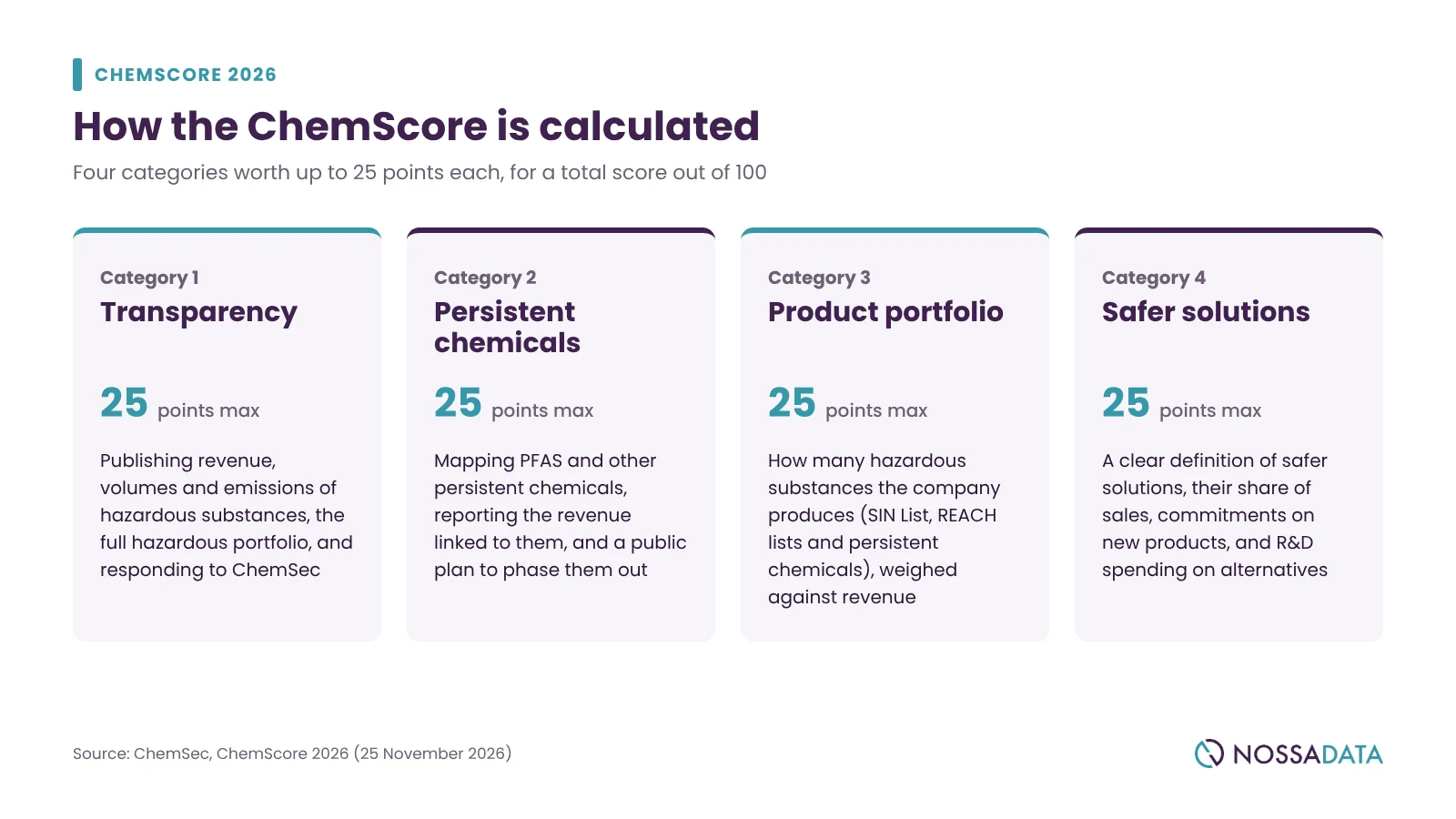
The first category is transparency. ChemSec checks whether a company publishes the revenue it makes from hazardous substances, the volumes it produces and emits, and its full global portfolio of hazardous substances. It also looks at whether the company responds to ChemSec at all.
The second category covers phasing out persistent chemicals, including PFAS. Companies earn points for mapping the persistent chemicals they produce, buy and sell, for reporting the revenue linked to them, for having a roadmap to phase them out, and for acknowledging that these substances have problematic properties.
The third category looks at the product portfolio itself. ChemSec counts how many hazardous substances a company produces, drawing on the SIN List, the REACH Candidate List, the REACH Authorisation List, persistent organic pollutants and other persistent chemicals, and weighs that against the size of the company's revenue.
The fourth category is about safer solutions. Here ChemSec looks for a clear definition of what the company counts as a safer solution, the share of sales those products bring in, commitments not to launch new products containing hazardous substances, independent verification, and how much R&D spending goes into safer alternatives.
ChemSec groups the results into colour bands, with green for 50 to 100 points, yellow for 20 to 50, orange for 10 to 20 and red for anything under 10. No company is anywhere near the maximum. If you took the best answer any company gave on each question and added them together, you would get a score of 83, which ChemSec points to as proof that much higher scores are already within reach.
It is worth remembering that the ChemScore only measures how a company handles hazardous chemicals. ChemSec is clear that a high score should not be read as an endorsement of the overall sustainability of a company's products.
Key findings from ChemScore 2026
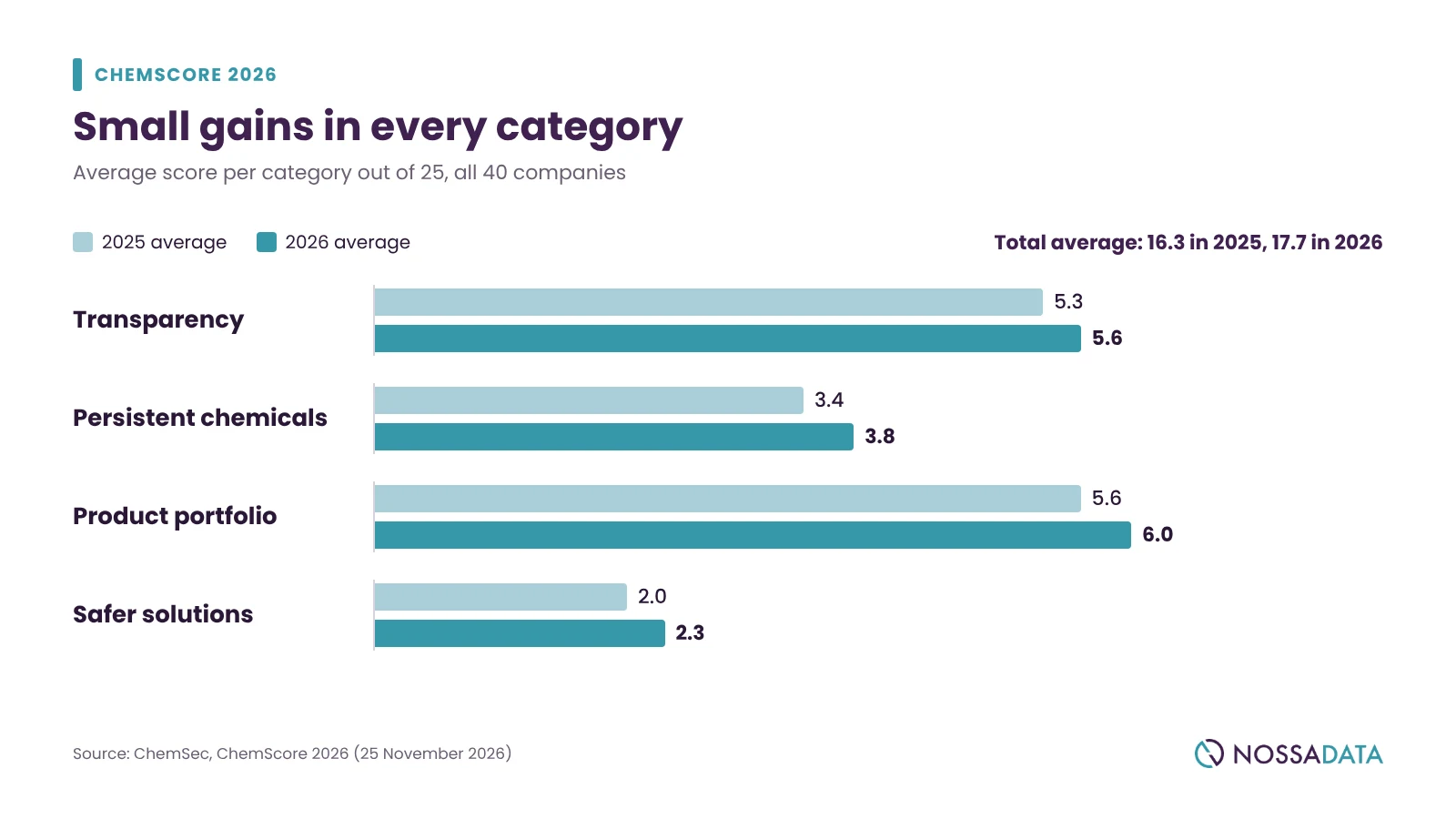
The average ChemScore rose by 1.4 points to 17.7 this year, and every category saw a small improvement. Safer solutions is still by far the weakest area, with companies averaging only 2.3 out of a possible 25.
Chemical companies change their stance on PFAS
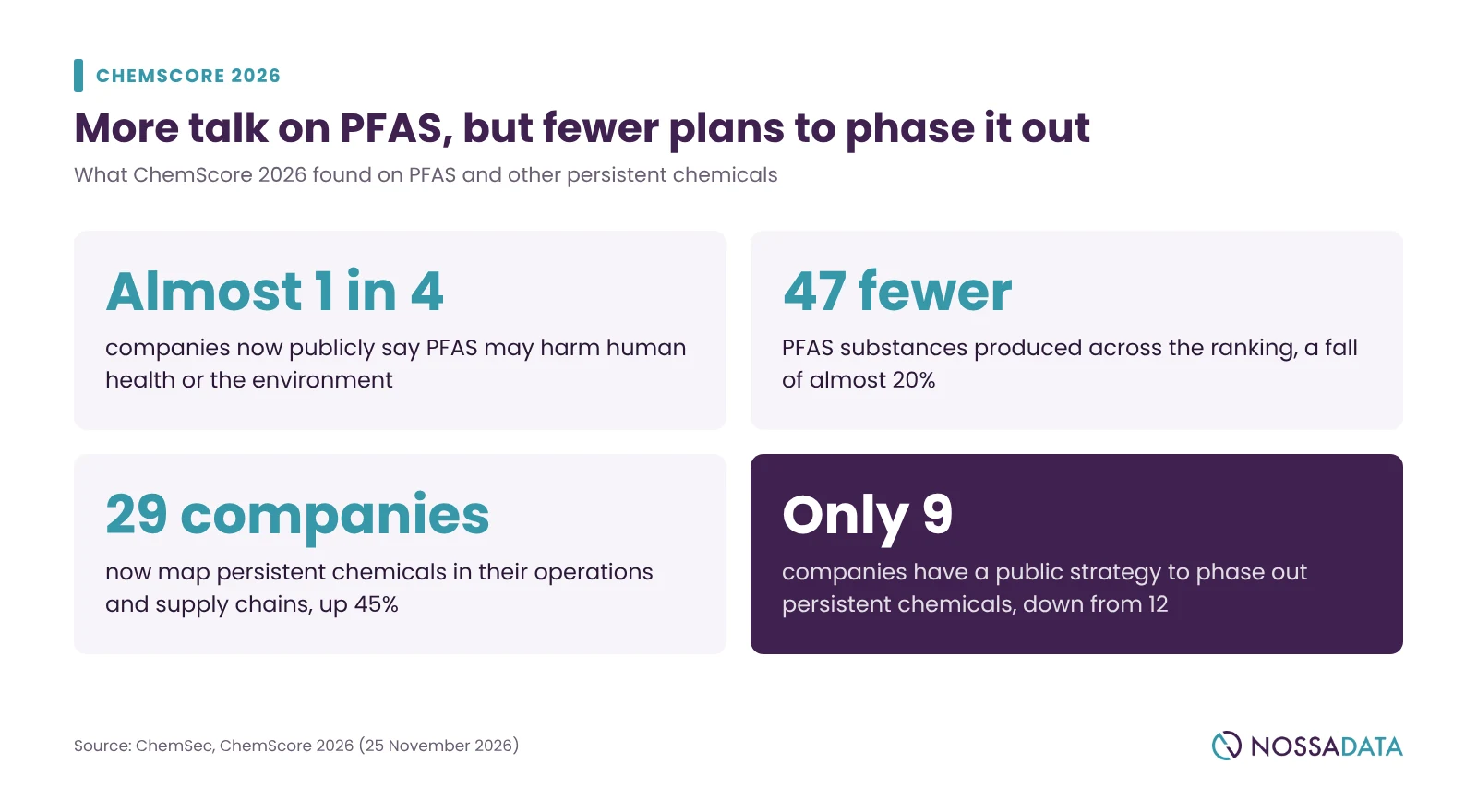
The biggest development in 2026 relates to PFAS. Almost a quarter of the companies in the ranking now say publicly that PFAS may harm human health or the environment, which is a real change after years in which the industry tended to play down these risks. Among them are Lanxess, Merck, AGC, Eastman Chemical, Evonik, LG Chem, Indorama Ventures, PPG Industries and SABIC.
There is movement on production as well. Fifteen companies reduced the number of PFAS they make while one increased it, and together they now produce 47 fewer PFAS substances than a year ago, a fall of almost 20%. ChemSec notes that it cannot measure the volumes involved, so this reflects the number of substances rather than tonnes produced. Mapping has also improved, with 29 companies (73% of the ranking) now tracking persistent chemicals in their operations and supply chains, up 45% on last year.
Public plans to phase these chemicals out are going in the other direction, though. Only nine companies now earn credit for a public phase out strategy, compared with 12 last year. 3M, SABIC, Sika and Yara lost that credit and DuPont gained it. In 3M's case, the company's own deadline for phasing out PFAS has passed and PFAS products are still on sale.
Anne-Sofie Bäckar, Executive Director of ChemSec, called the industry's acknowledgement of the risks "a great first step", but added that without action "it's just words."
Other findings
The total number of hazardous substances in the assessed portfolios fell from 1,556 to 1,493, a drop of about 4%. Disclosure is getting better too. The number of companies that fully disclose their hazardous product portfolios went from six to ten, and all ten of them are in the top 15.
Very few companies are open about how much they invest in alternatives, and only BASF, Evonik and Lanxess report what share of their R&D spending goes towards safer solutions.
There is also a clear regional split. In Europe, 10 of the 17 companies improved and the regional average rose from 18.4 to 20.5. The average for US companies slipped slightly, and seven of the bottom ten places in the ranking are held by US companies.
Which chemical companies are leading in 2026?
Indorama Ventures, Solvay and Lanxess make up the top three this year, although Indorama is the only company to score more than 50 points.
Indorama Ventures, based in Thailand, keeps first place with 68 points, which is 11 more than last year. It is the only company to receive the full 25 points for phasing out persistent chemicals. Its core products largely avoid substances on the SIN List, although a business it acquired recently still produces some of them, including ethylene oxide and propylene oxide.
Solvay of Belgium made the biggest jump in the whole ranking, gaining 27 points to reach 43 and climbing from 12th to 2nd place. The company has stopped making and selling bisphenol A and reports that it has cut substances of very high concern leaving its sites by around 97%. ChemSec does point out that some of this improvement comes from restructuring.
Lanxess from Germany came third with 34 points. That is nine points lower than last year and it has dropped one place, but it still has the best result on safer solutions with 14 out of 25. Lanxess has also gone further than most in how it talks about PFAS publicly, describing them as a severe risk to human health.
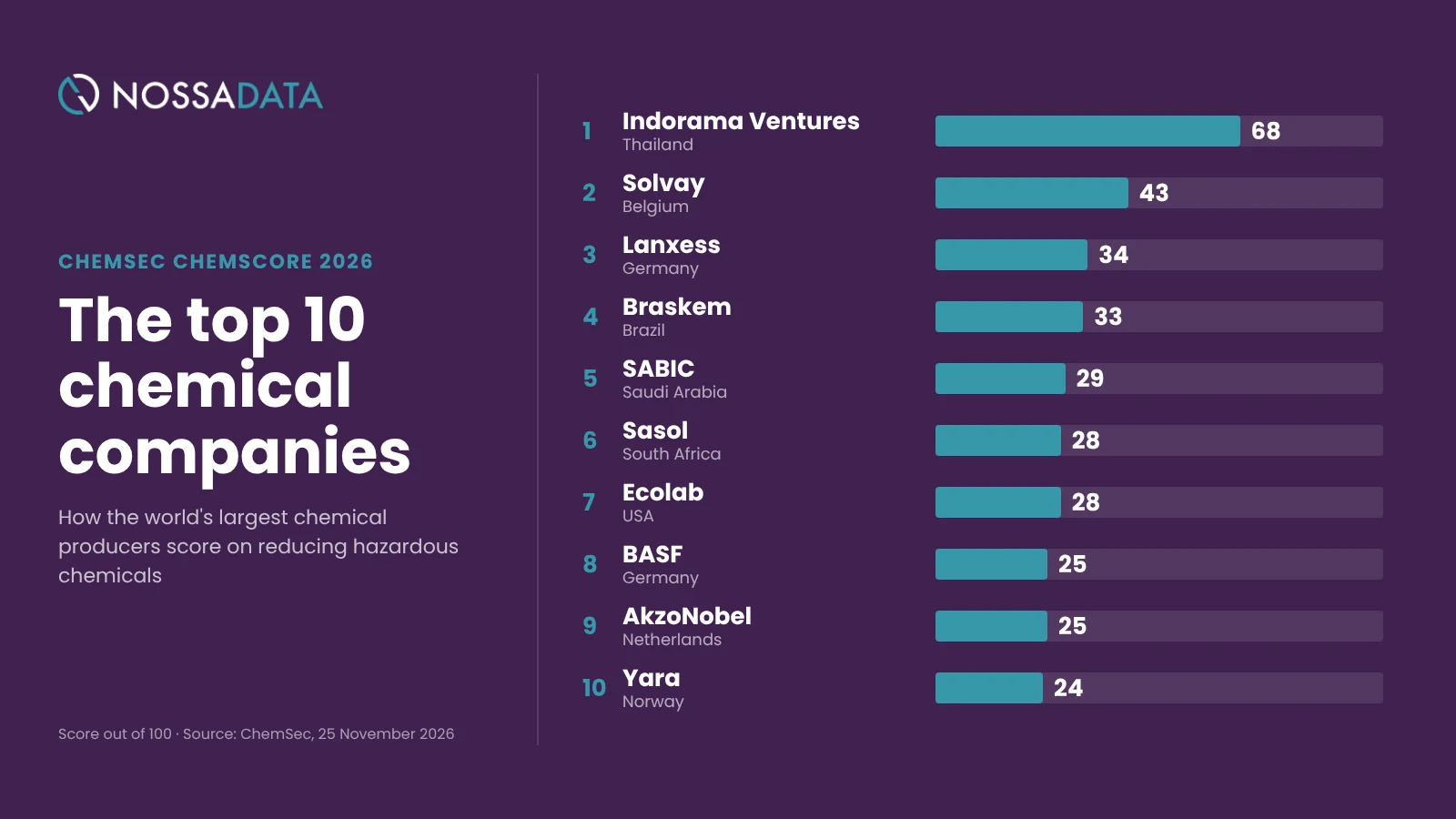
Rounding out the top ten are Braskem with 33 points, SABIC with 29, Sasol and Ecolab with 28 each, BASF and AkzoNobel with 25 each, and Yara with 24.
Biggest climbers in ChemScore 2026
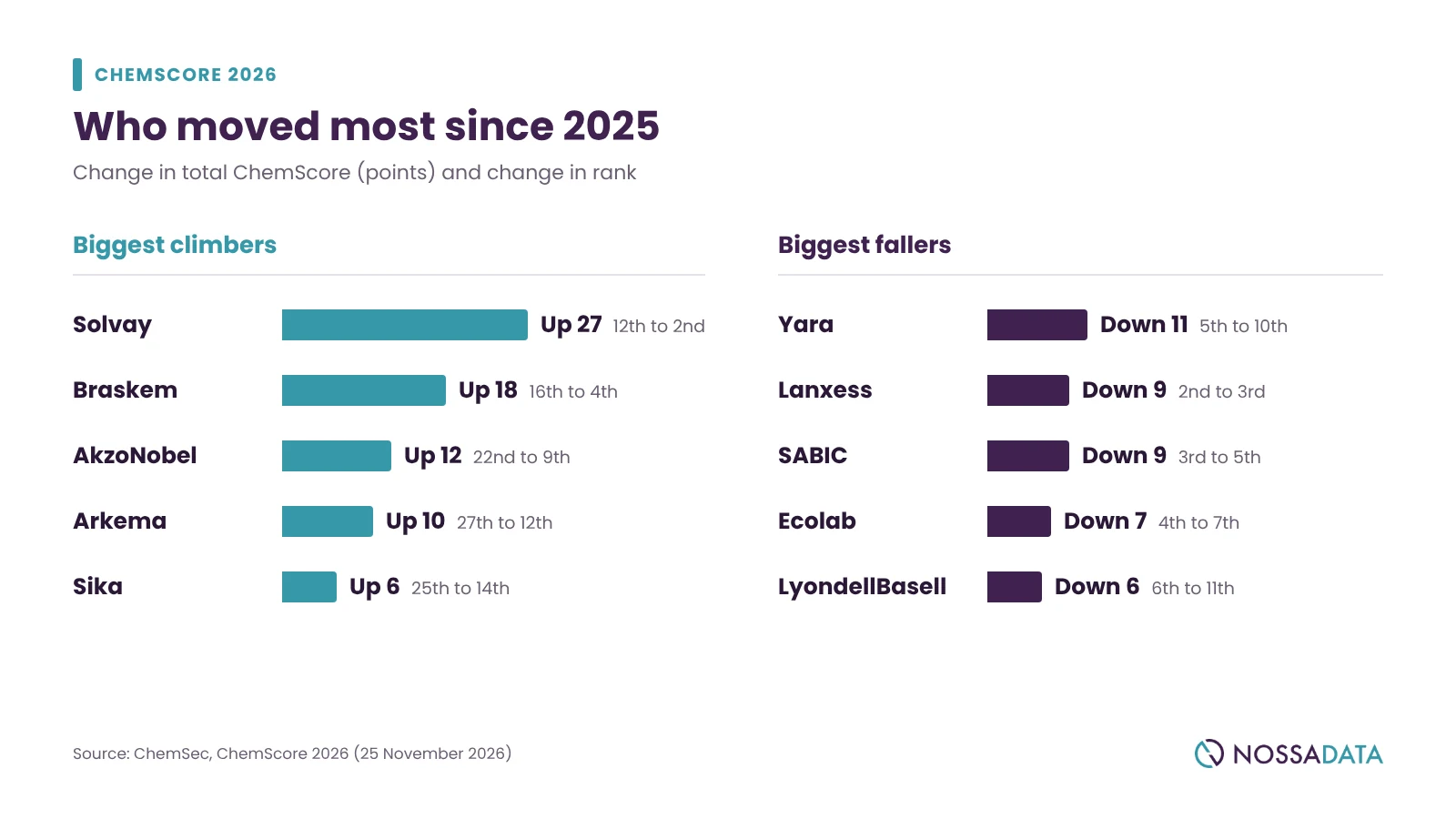
Solvay's gain of 27 points was the largest, but several other companies also moved up a long way. Braskem gained 18 points and rose from 16th to 4th, and AkzoNobel added 12 points to go from 22nd to 9th. Arkema gained 10 points and moved from 27th to 12th, while Sika added six points and climbed from 25th to 14th.
Which chemical companies are lagging in 2026?
Solstice Advanced Materials finished last with zero points, and US companies take up seven of the bottom ten places.
Solstice was spun off from Honeywell and takes Honeywell's place in the ranking this year. It is the only one of the 40 companies that did not score a single point. Just above it are Chemours, 3M and Westlake, all based in the US and all on four points. Chemours has at least moved up from zero last year, but none of the three picked up any points for safer solutions. 3M lost four points after losing the credit it previously had for its commitment to phase out PFAS.
The rest of the bottom ten is made up of Dow and Shin-Etsu on seven points, Sherwin-Williams and AGC on eight, and Corteva and Henkel on nine. ChemSec also says that several US companies have become less willing to engage with it, which matters because responding to ChemSec is one of the things companies are scored on under transparency.
Biggest fallers in ChemScore 2026
Yara had the biggest drop, losing 11 points and falling from 5th to 10th. Lanxess and SABIC both lost nine points, with Lanxess slipping from 2nd to 3rd and SABIC from 3rd to 5th. Ecolab fell seven points and went from 4th to 7th, while LyondellBasell lost six points and dropped from 6th to 11th.
ChemScore 2026: full ranking of all 40 chemical companies
The table below shows the complete ChemScore 2026 ranking of all 40 companies from first to last, together with each company's score in the four categories and how its total changed since 2025. The category scores are rounded, so they will not always add up exactly to the total, and where companies are tied on points we have kept ChemSec's order.
| Rank | Company | Country | 2026 score (out of 100) | Change since 2025 | 2025 rank | Transparency (out of 25) | Persistent chemicals (out of 25) | Product portfolio (out of 25) | Safer solutions (out of 25) |
|---|---|---|---|---|---|---|---|---|---|
| 1 | Indorama Ventures | Thailand | 68 | Up 11 | 1 | 16 | 25 | 20 | 7 |
| 2 | Solvay | Belgium | 43 | Up 27 | 12 | 13 | 6 | 15 | 9 |
| 3 | Lanxess | Germany | 34 | Down 9 | 2 | 12 | 8 | 0 | 14 |
| 4 | Braskem | Brazil | 33 | Up 18 | 16 | 10 | 4 | 18 | 1 |
| 5 | SABIC | Saudi Arabia | 29 | Down 9 | 3 | 13 | 4 | 10 | 2 |
| 6 | Sasol | South Africa | 28 | Up 4 | 7 | 2 | 13 | 13 | 0 |
| 7 | Ecolab | USA | 28 | Down 7 | 4 | 5 | 9 | 8 | 6 |
| 8 | BASF | Germany | 25 | Up 2 | 8 | 9 | 8 | 3 | 5 |
| 9 | AkzoNobel | Netherlands | 25 | Up 12 | 22 | 7 | 6 | 10 | 2 |
| 10 | Yara | Norway | 24 | Down 11 | 5 | 8 | 1 | 13 | 2 |
| 11 | LyondellBasell | Netherlands | 21 | Down 6 | 6 | 8 | 9 | 2 | 2 |
| 12 | Arkema | France | 21 | Up 10 | 27 | 12 | 2 | 0 | 7 |
| 13 | Syensqo | Belgium | 20 | Down 3 | 9 | 10 | 2 | 0 | 8 |
| 14 | Sika | Switzerland | 18 | Up 6 | 25 | 4 | 7 | 5 | 2 |
| 15 | Eastman Chemical | USA | 18 | Down 1 | 11 | 5 | 7 | 3 | 3 |
| 16 | TotalEnergies | France | 18 | Down 1 | 10 | 5 | 1 | 12 | 0 |
| 17 | Evonik | Germany | 17 | Up 1 | 14 | 9 | 2 | 1 | 5 |
| 18 | Umicore | Belgium | 16 | Up 3 | 23 | 9 | 1 | 5 | 1 |
| 19 | Nutrien | Canada | 16 | Up 1 | 15 | 1 | 0 | 14 | 1 |
| 20 | Bayer | Germany | 16 | Up 2 | 17 | 7 | 1 | 8 | 0 |
| 21 | Shell | UK | 15 | Up 3 | 24 | 6 | 0 | 9 | 0 |
| 22 | LG Chem | South Korea | 15 | Up 1 | 20 | 5 | 5 | 3 | 2 |
| 23 | The Mosaic Company | USA | 15 | Up 1 | 19 | 5 | 0 | 9 | 1 |
| 24 | DuPont | USA | 14 | Up 1 | 21 | 3 | 8 | 0 | 3 |
| 25 | Merck Group | Germany | 13 | Down 3 | 13 | 6 | 4 | 1 | 2 |
| 26 | Johnson Matthey | UK | 13 | Down 1 | 18 | 1 | 3 | 8 | 1 |
| 27 | PPG Industries | USA | 12 | Up 3 | 30 | 3 | 4 | 4 | 1 |
| 28 | Daikin | Japan | 11 | No change | 26 | 4 | 1 | 6 | 0 |
| 29 | ExxonMobil | USA | 11 | Up 1 | 29 | 1 | 0 | 10 | 0 |
| 30 | Chevron | USA | 10 | Up 2 | 31 | 1 | 0 | 9 | 0 |
| 31 | Henkel | Germany | 9 | Up 4 | 38 | 4 | 1 | 2 | 2 |
| 32 | Corteva | USA | 9 | Up 2 | 34 | 3 | 0 | 6 | 0 |
| 33 | AGC | Japan | 8 | Up 3 | 39 | 4 | 2 | 1 | 1 |
| 34 | Sherwin-Williams | USA | 8 | Down 3 | 28 | 3 | 1 | 4 | 0 |
| 35 | Shin-Etsu | Japan | 7 | No change | 35 | 4 | 0 | 3 | 0 |
| 36 | Dow | USA | 7 | Down 1 | 33 | 1 | 1 | 3 | 2 |
| 37 | Westlake | USA | 4 | Down 1 | 37 | 0 | 0 | 4 | 0 |
| 38 | 3M | USA | 4 | Down 4 | 32 | 0 | 4 | 0 | 0 |
| 39 | Chemours | USA | 4 | Up 4 | 40 | 4 | 0 | 0 | 0 |
| 40 | Solstice Advanced Materials | USA | 0 | New entry | Not ranked (Honeywell was 36th) | 0 | 0 | 0 | 0 |
What ChemScore 2026 means for investors, buyers and chemical companies
ChemSec's main message this year is that identifying hazardous chemicals is only the start. What it wants to see now are public plans to phase them out, with clear milestones and regular reporting on how those plans are going.
For investors, the ChemScore offers a ready benchmark for chemical risk across the sector. Caroline Sundin of Swedbank Robur, which is a member of the IIHC, has warned that companies relying heavily on persistent chemicals face legal, reputational, insurance and financial risks.
For brands and other buyers of chemicals, the ranking makes it easier to see which suppliers are open about their hazardous portfolios and which are investing in safer alternatives. That is useful to know as rules on PFAS tighten and customers ask more questions.
For the chemical companies themselves, the distance between this year's average of 17.7 and the achievable score of 83 shows how much room there is to improve. Fuller disclosure, a published roadmap for phasing out PFAS and other persistent chemicals, and reporting on how much of their sales and R&D budget goes to safer solutions would all make a noticeable difference to their scores.
ChemScore FAQ
What is a ChemScore?
A ChemScore is a score out of 100 that ChemSec gives to 40 of the largest publicly listed chemical companies in the world, based on how well they manage and reduce hazardous chemicals.
Who publishes the ChemScore ranking?
The ranking is published by ChemSec, the International Chemical Secretariat. ChemSec is an independent non-profit based in Sweden that works to replace toxic chemicals with safer alternatives.
Which company has the highest ChemScore in 2026?
Indorama Ventures came first with 68 points, followed by Solvay on 43 and Lanxess on 34.
Which company has the lowest ChemScore in 2026?
Solstice Advanced Materials, which was spun off from Honeywell, came last with zero points. Chemours, 3M and Westlake are just above it with four points each.
How is the ChemScore calculated?
Companies can earn up to 25 points in each of four categories, which are transparency, phasing out persistent chemicals, the hazardous product portfolio and safer solutions.
What is the average ChemScore in 2026?
The average score in 2026 is 17.7 out of 100, up from 16.3 in 2025.
Does a high ChemScore mean a company is sustainable?
Not necessarily. ChemSec says the score only reflects how a company manages hazardous chemicals and should not be seen as an endorsement of its overall sustainability.
What does ChemScore 2026 say about PFAS?
Almost a quarter of the companies now acknowledge that PFAS may harm health or the environment, and together they produce 47 fewer PFAS substances than last year. However, only nine companies have a public strategy for phasing them out, down from 12 in 2025.
Sources
- ChemSec, ChemScore 2026 key findings, 25 November 2026
- ChemSec, Chemical companies shift stance on PFAS, admitting health and environment risks, 25 November 2026
- ChemSec, ChemScore ranking and reports (2025 scores, countries and score bands)
- ChemSec, ChemScore 2026 overview data (2026 ranks, total scores and category scores)