For sustainability and investor relations teams at listed companies, few metrics carry as much weight as the MSCI ESG Rating. With more than $35 trillion in assets managed by ESG-oriented investors — many of whom use MSCI data as their primary source for company screening — your MSCI ESG rating directly influences your cost of capital, your inclusion in major sustainability indices, and your attractiveness to an increasingly large class of institutional investor.
Unfortunately for issuers, the methodology behind the MSCI ESG rating remains confusing. This guide explains how MSCI ESG ratings work: what data they use, how scores are calculated, and what sustainability teams can do to improve a rating.
Nossa Data is a licensed MSCI advisor supporting companies globally improve their MSCI Ratings. Get in touch with solutions@nossadata.com to learn how Nossa Data can help you improve your MSCI score.
Key Points about MSCI
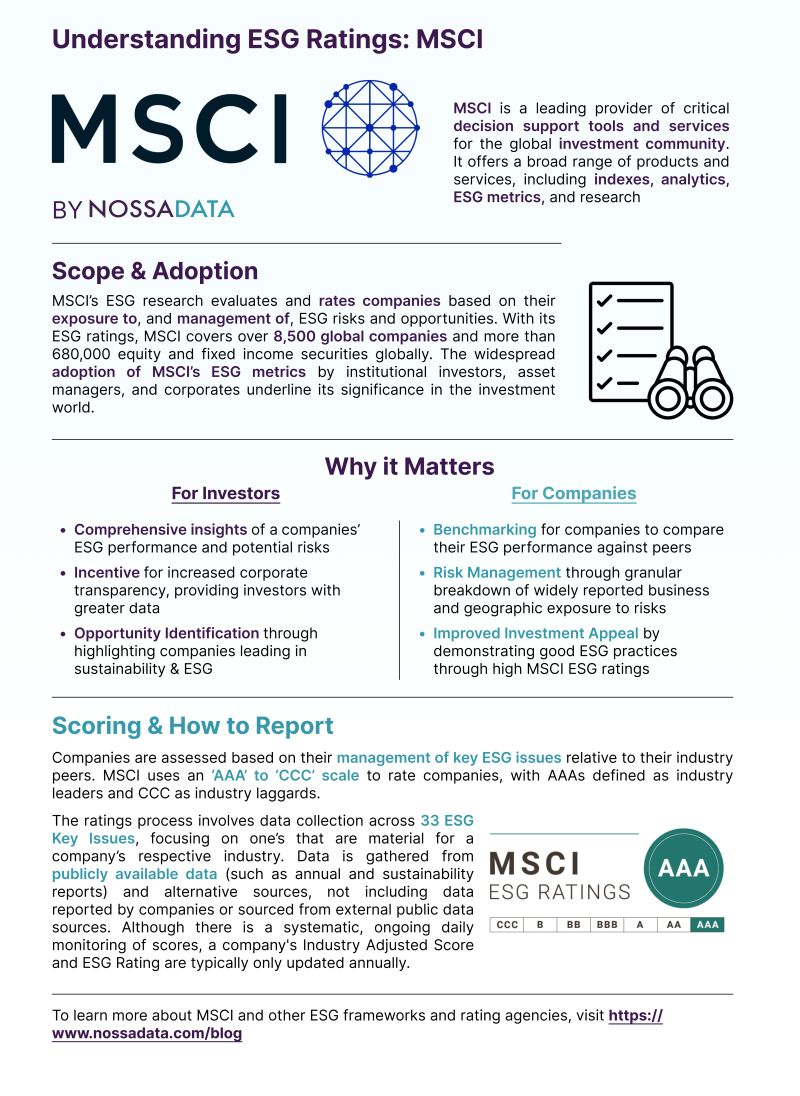
- MSCI ESG Ratings assess around 8,500 companies on a seven-point scale from CCC (Laggard) to AAA (Leader)
- Ratings are industry-relative — your score is benchmarked against global peers in the same GICS sub-industry
- MSCI evaluates companies on up to 35 ESG key issues; the specific issues assessed depend on your industry sector
- Undisclosed data is treated as worst-case performance — transparency almost always helps your rating
- The governance pillar carries a minimum weight of 33% in every rating, regardless of industry
- You can engage directly with MSCI through the Issuer Communications Portal. If you don’t have access to that portal for your company you can access their guide here.
What Is an MSCI ESG Rating?
An MSCI ESG Rating is a measure of how well a company manages the financially material environmental, social and governance (ESG) risks and opportunities most relevant to its industry. The ratings are used by institutional investors globally to evaluate and compare companies' ESG risk profiles.
MSCI ESG ratings are not an assessment of a company's absolute impact on the world. They are a measure of how well a company manages ESG risks relative to its industry peers. A mining company rated AAA is not being declared more sustainable than a software company rated BBB; it is being recognised as managing the material risks of mining exceptionally well compared to other mining companies.
MSCI currently rates approximately 8,500 companies worldwide, covering large and mid-cap equities across global markets. For many of these companies, the MSCI rating is one of the most important ESG assessments they receive — and one of the least understood.
The MSCI ESG Rating Scale: From AAA to CCC
MSCI assigns each company one of seven letter ratings, grouped into three bands: Leaders, Average, and Laggards. The table below shows the overall ratings and their hypothetical WAKI ranges.
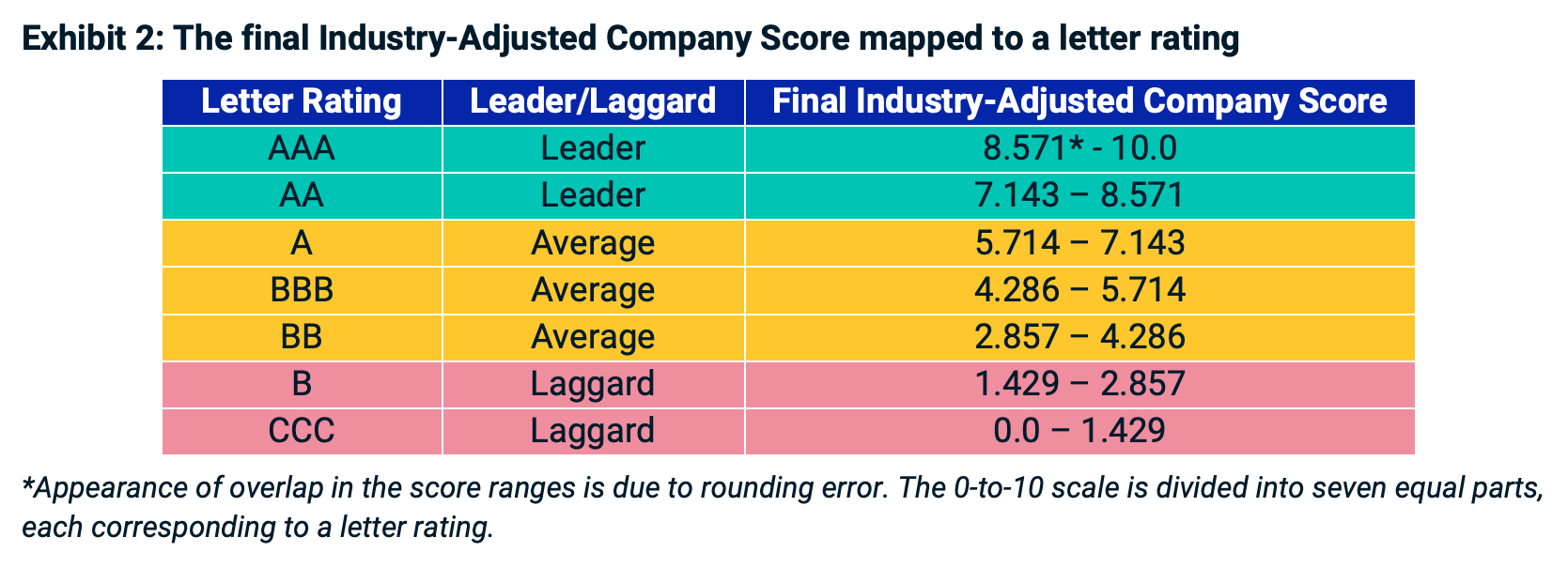
Ratings are assigned relative to each company's GICS (Global Industry Classification Standard) sub-industry. The benchmark shifts depending on what industry you are in. A company in the pharmaceutical sector will be assessed against other pharmaceutical companies — not against technology firms or retailers.
How MSCI Collects Your Data
TL:DR: MSCI uses public data only.
MSCI's ESG Research team collects data from a wide range of publicly available sources. MSCI does not primarily rely on companies submitting data directly to them. Analysts actively harvest information from multiple channels and build a picture of each company's ESG profile independently.
Primary Data Sources
- Company disclosures: Annual reports, sustainability reports, proxy statements, CDP questionnaire responses, corporate websites, and regulatory filings (10-K, 20-F, etc.)
- Government and regulatory databases: Environmental regulators, health and safety authorities, labour ministries, and financial regulators in relevant jurisdictions
- Alternative data: Academic research, NGO publications, media monitoring, and proprietary MSCI datasets built over 18 years of ratings history
- Court and legal records: Litigation history, regulatory sanctions, and legal settlements that may indicate governance or conduct issues
The Issuer Communication’s Portal
MSCI operates a corporate issuer portal through which companies can review the data MSCI holds on them and submit additional information for consideration. Engaging with the Issuer Communications portal is one of the most direct actions a company can take to ensure MSCI has complete and accurate data. Access to the portal is available to companies rated by MSCI. On the portal a company can see:
- Their current overall rating as well as scores on indicators / key issues
- Indicate to MSCI the correct public documents to look at when forming a re-assessment
- Submit public evidence for specific indicators that an issuer has improved on or wants to challenge in their next re-rating
Rating Update Cadence
Up until March 2026 MSCI would issue one re-rating per year for Issuers. This was generally based on the month from the previous year the company was re-rated. E.g. If a company was re-rated in May 2024 they would likely be re-rated again in May 2025. However, in March 2026 all issuers in MSCI’s universe received a re-rating due to a major methodology change. Since March 2026, MSCI performs continuous monitoring of companies throughout the year, with controversy flags and updates applied in near real-time when significant events occur. While the full rating model — including key issue identification and weights for each industry — is still only recalibrated annually, companies can receive a change to their letter grade at multiple points a year after this methodology change.
Public Data is key: Because MSCI collects data proactively from public sources, a company that discloses more earns a better score — even without submitting data directly to MSCI. The quality and accessibility of your public disclosure is one of the most controllable levers available to your team.
Key Issues In MSCI
The concept of ESG 'Key Issues' is at the heart of MSCI’s methodology. Specific environmental, social and governance topics that are most financially material are applied for each industry. MSCI has identified 35 ESG Key Issues in total. For any given company, between two and seven environmental and social key issues will be selected as relevant, based on the company's GICS sub-industry classification. Governance key issues apply to all companies.
Key Issue Scores range from 0 to 10, with higher scores indicating stronger management of that issue. Weights for each key issue — which determine how much it contributes to your overall rating — range from 5% to 30%, based on MSCI's assessment of how material that issue is to the sub-industry's financial performance and the typical time horizon over which the risk may materialise.
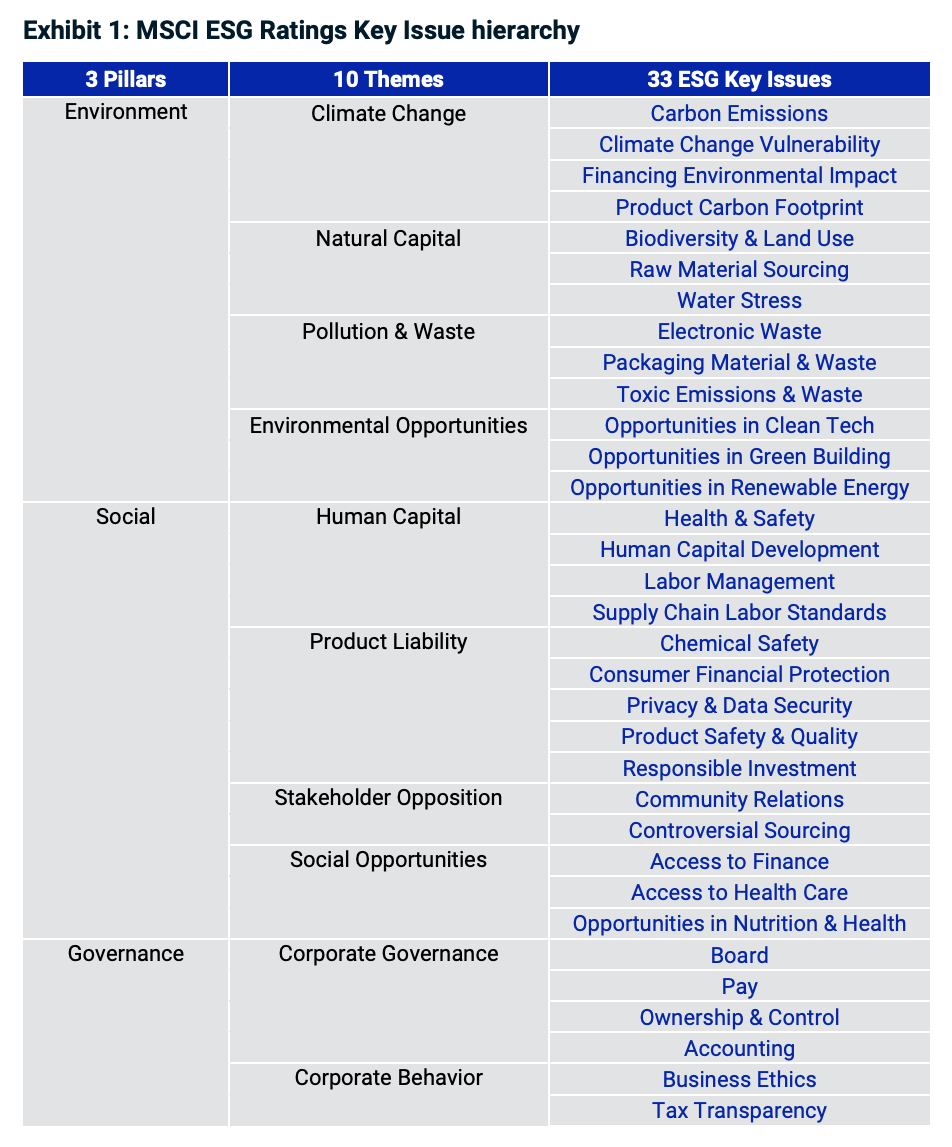
The specific combination of environmental and social key issues assessed for your company depends entirely on your GICS sub-industry. A pharmaceutical company will be evaluated on issues like Chemical Safety, Product Quality and Safety, and Access to Healthcare — which are highly material for that sector. A technology hardware company will be weighted more heavily on Electronic Waste, Privacy and Data Security, and Supply Chain Labour Standards.
MSCI publishes an ESG Industry Materiality Map that shows which key issues apply to each industry. This is publicly available and is an essential starting point for understanding your own MSCI profile. You can access it at:
msci.com/esg-industry-materiality-map.
How Your MSCI ESG Score Is Calculated
The scoring process works in three stages. Understanding each stage helps you identify where your rating can be improved.
Stage 1: Key Issue Scores
For each key issue relevant to your sub-industry, MSCI analysts assign a Key Issue Score from 0 to 10. Each score has two components:
- Exposure Score: How exposed is your company to this ESG risk, given your business model, operating locations, and revenue mix? A chemical company operating in water-stressed regions has higher exposure to water risk than a software company in the same region.
- Management Score: How effectively is your company managing that exposure? This is where your policies, programmes, targets, and disclosed performance data directly determine your score.
Stage 2: Weighted Aggregation
Each Key Issue Score is multiplied by its assigned weight for your sub-industry. The weights reflect how financially material MSCI believes that issue to be for companies in your sector. Weights range from 5% to 30% for individual E&S key issues. The governance pillar carries a minimum weight of 33% in all industries — a reflection of MSCI's view that governance quality affects a company's ability to manage all other ESG risks.
Stage 3: Industry Normalisation and Final Rating
The weighted scores are combined into an overall ESG score on a 0 to 10 scale, which is then normalised against global industry peers. This normalisation step is why the same absolute management quality can result in different ratings for companies in different industries — it is always a relative assessment. The final normalised score maps to one of the seven letter ratings (CCC through AAA).
WAKI Scores: Weighted Average Key Issue (WAKI) scores - While letter grade is the primary piece of information you see looking at your WAKI score can help a company understand how close they are to the next letter grade. For example, your industry could have an AAA WAKI score of 7.5, if you are an AA score at 7.4 you would know you are close to receiving an upgrade.
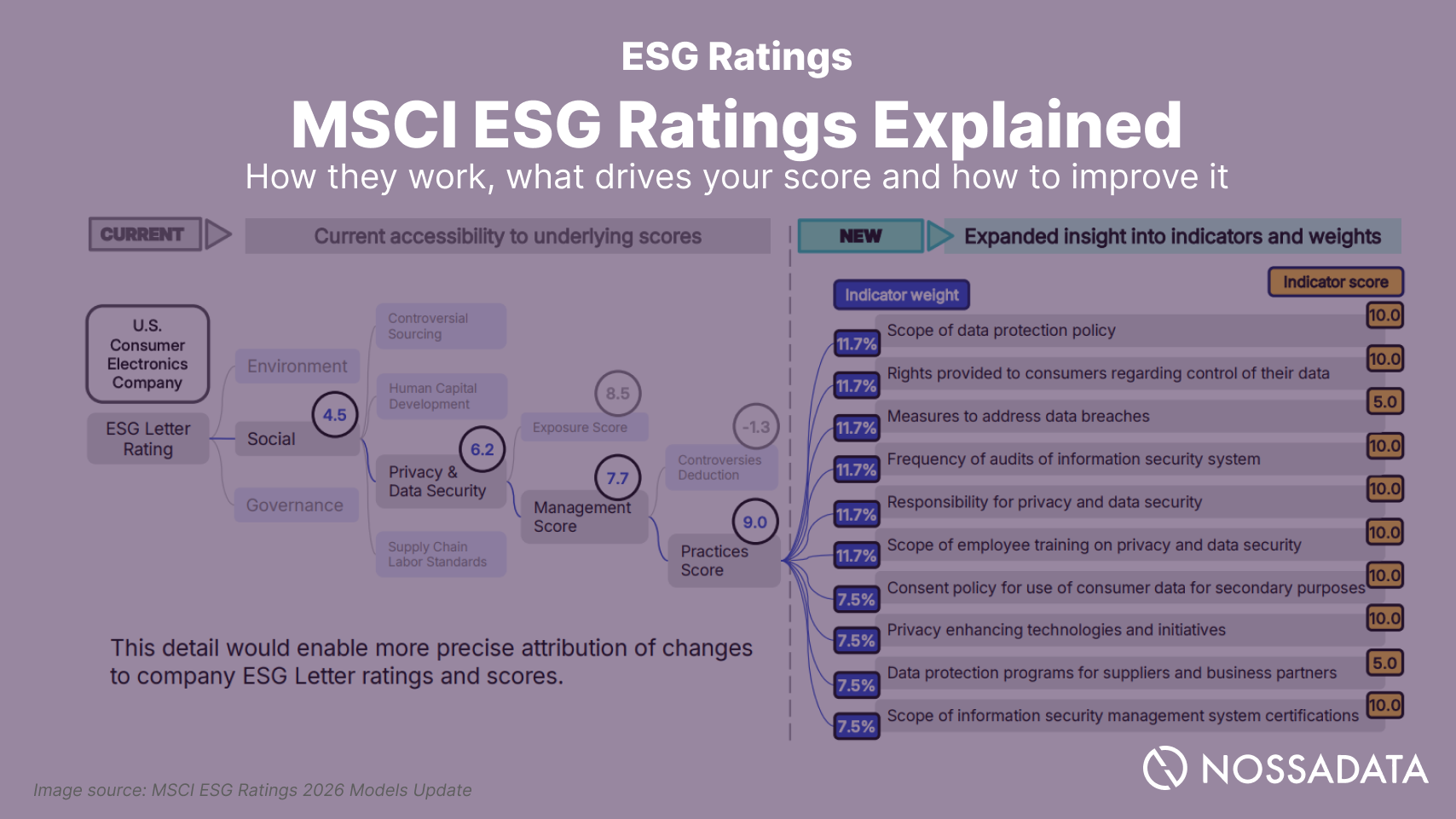
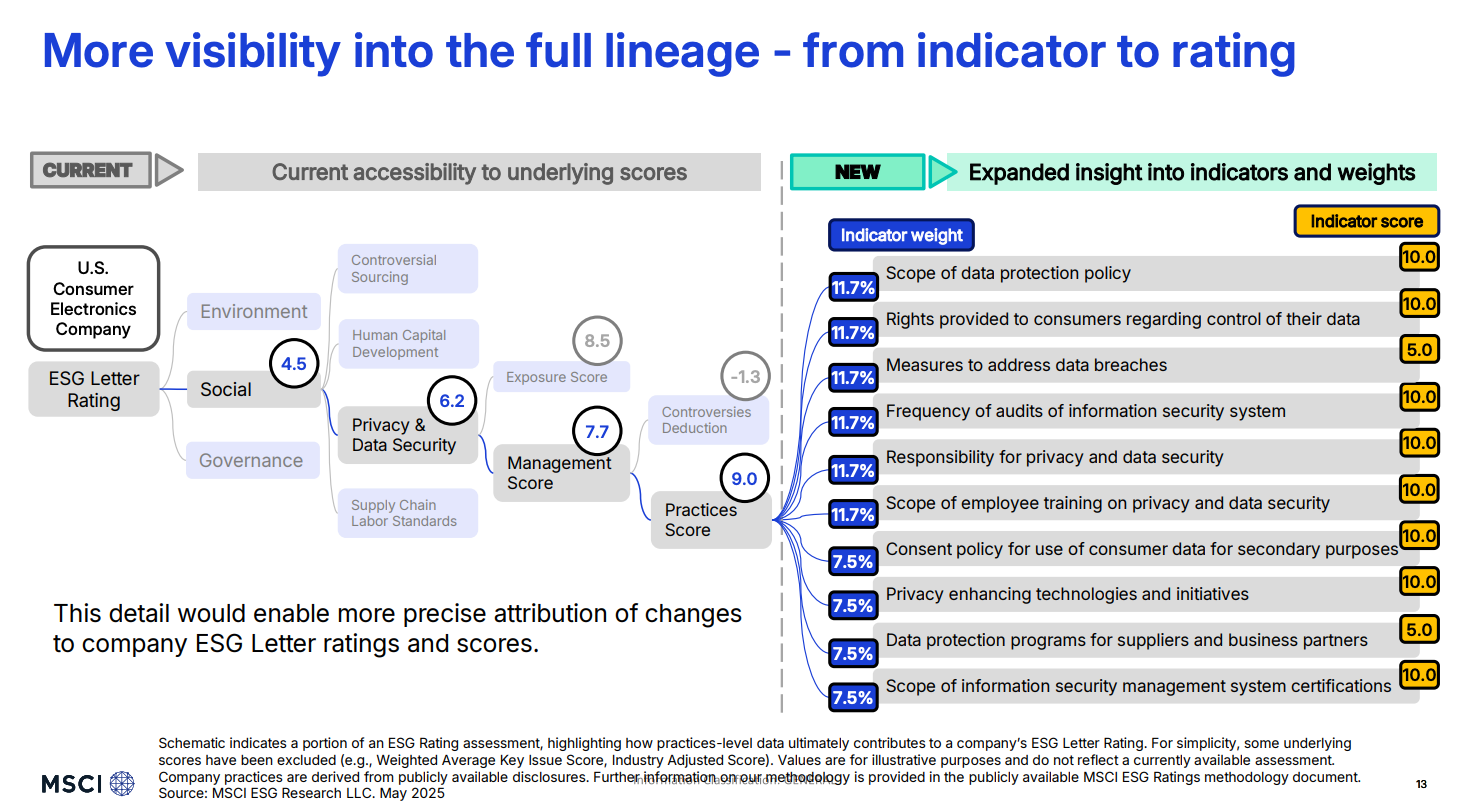
Starting in March 2026, MSCI also began helping issuers understand their indicator level performance within key issues. Below is a visual from MSCI around how this works for companies.
How do controversies impact an MSCI score
In addition to assessing your company’s disclosure, MSCI also monitors controversies that your company is involved in based on public sources. If your company is involved with a controversy, a deduction can be applied at the key issue level for your company GICS industry. Take the below hypothetical example:
Based on your company GICS industry you have the key issue that is Biodiversity and Land use applied to your score.
Prior to controversies you have a Key Issue score in that category of 7. This is based on your exposure score and management practice.
You have a controversy applied to that key issue that is receive a minus 1.3 deduction.
The controversy would be deducted from your key issue score of 7 resulting in a new Key Issue score of 5.7.
How do I remove or respond to a controversy on MSCI? To provide a response to your investors you must do so via a public link on your company website. If you believe that a controversy is incorrectly attributed to your company you can challenge the controversy via the Issuer Communications Portal and MSCI will assess if they agree with your assignment.
The Disclosure Gap: Why Not Disclosing Almost Always Hurts You
One of the most important aspects of the MSCI methodology is how it handles missing data. When MSCI cannot find information on a particular metric for a company, it does not assume average performance. It applies a worst-case assumption for that metric.
This has a direct and significant implication: if your company has strong performance on a key ESG issue but has not disclosed that performance publicly, MSCI will likely score you as if you have poor performance. The gap between 'we are doing this' and 'we have disclosed that we are doing this' can equate to a difference of one or even two full rating bands.
This principle is sometimes called the 'disclosure gap', and it is the single most actionable lever available to most companies. Common examples of disclosure gaps include:
- Having a supply chain audit programme but not publishing your audit methodology or findings
- Conducting an employee engagement survey annually but not disclosing about this
- Running health and safety programmes at sites but not reporting LTIFR (Lost Time Injury Frequency Rate) or equivalent metrics
- Having an anti-corruption training programme but not stating the percentage of employees trained and the frequency of which they are trained
Closing these disclosure gaps — by publishing data you already hold, in formats MSCI can find and verify — is typically the fastest route to a higher MSCI ESG rating.
Get a Free MSCI Baseline assessment from Nossa Data
Still confused about MSCI’s methodology and what you can do to improve your score? Get a free MSCI baseline assessment from Nossa Data. We are happy to speak to you through your current performance on MSCI and point out the top areas you should focus on. Contact solutions@nossadata.com to learn more.
MSCI ESG Ratings vs Other ESG Rating Agencies
MSCI is one of several major providers of ESG ratings including the likes of Sustianalytics, CDP, Ecovadis, ISS, S&P Global CSA, WBA and more.
For most listed companies with institutional investors, improving an MSCI ESG rating is a priority. MSCI data is used in the construction of the MSCI ESG Leaders Indexes and the MSCI ACWI ESG Index family — indices that many asset managers use as benchmarks. Exclusion from or low weighting in these indices has a direct impact on your shareholder base.
Frequently Asked Questions
How often is my MSCI ESG rating reviewed?
MSCI conducts continuous monitoring throughout the year, with controversy assessments updated in near real-time. Full rating reviews typically occur at least annually, aligned with the publication of new sustainability and annual reports. The frequency of which a company is being reviewed is being updated after the March 2026 methodology change.
Can I submit data directly to MSCI?
Yes, through the MSCI issuer communication portal. However, MSCI does not rely solely on company submissions — analysts cross-reference submitted data against publicly available sources. Submitting data through MSCI while also publishing it in your sustainability report provides maximum confidence in your score.
Why has my MSCI rating changed even though I haven't changed my practices?
Several factors can cause a rating change without changes in actual performance: (1) MSCI may have updated its methodology or industry weights in the annual model recalibration; (2) your peer group may have improved their scores, moving the industry average; (3) new or updated disclosure by your company (or its absence) may have been picked up; or (4) a controversy may have been flagged.
What is the difference between an MSCI ESG Rating and an MSCI WAKI score?
The WAKI score is the numerical value on a 0–10 scale that results from MSCI's analysis. The ESG rating is the letter designation (AAA through CCC) that is derived by normalising that WAKI score against industry peers. Both are reported together.
Does MSCI provide feedback on how to improve a rating?
MSCI does not provide prescriptive advice to companies on specific actions to take. However, you can work with MSCI affiliated consultants like Nossa Data to understand how to address gaps. Understanding where data is missing or poor-quality is the most direct signal of where improvement is needed.
Are MSCI ESG ratings publicly available?
MSCI ratings are not publicly available. You can access your own companies ESG rating for free. Working with a third party like Nossa Data is a way to access and understand peer performance.
How Nossa Data Helps You Close Your MSCI Disclosure Gaps
Understanding the MSCI methodology is the first step. Closing the gap between what your company does and what it discloses — in formats that MSCI can find and verify — is the step that actually moves your rating. Nossa Data has helped dozens of companies improve their MSCI rating and counts many MSCI AAA companies as clients.
Nossa Data's ESG reporting platform helps listed companies centralise their sustainability data, map it against the specific frameworks and data points used by major rating agencies including MSCI, and produce disclosures that are comprehensive, clearly structured, and audit-ready. Nossa Data supports more than 30 ESG frameworks, including GRI, SASB, CDP, TCFD, and ISSB — the exact standards from which MSCI draws much of its data.
Nossa Data's peer analytics capability also allows you to benchmark your disclosure against companies in your peer group, so you can see where your coverage is strong and where gaps remain — before MSCI identifies them for you.
To learn more, visit nossadata.com or request a demo to see how Nossa Data maps your current disclosure to MSCI key issues.
Sources and Further Reading
1. MSCI ESG Ratings | MSCI Inc. — Overview of the ratings product, coverage, and use cases.
2. MSCI ESG Ratings Methodology (PDF) — Full methodology document detailing key issues, scoring, and weighting framework.
3. MSCI ESG Ratings Process (PDF) — Process document describing data collection, analyst review, and rating assignment.
4. MSCI ESG Ratings Guide for Corporate Issuers (PDF) — MSCI's own guidance document for companies that are rated.
5. MSCI ESG Industry Materiality Map — Interactive tool showing which key issues apply to each GICS sub-industry.